All species › Caryophyllales › Tropical pitcher plant family › Nepenthes holdenii
Nepenthes holdenii
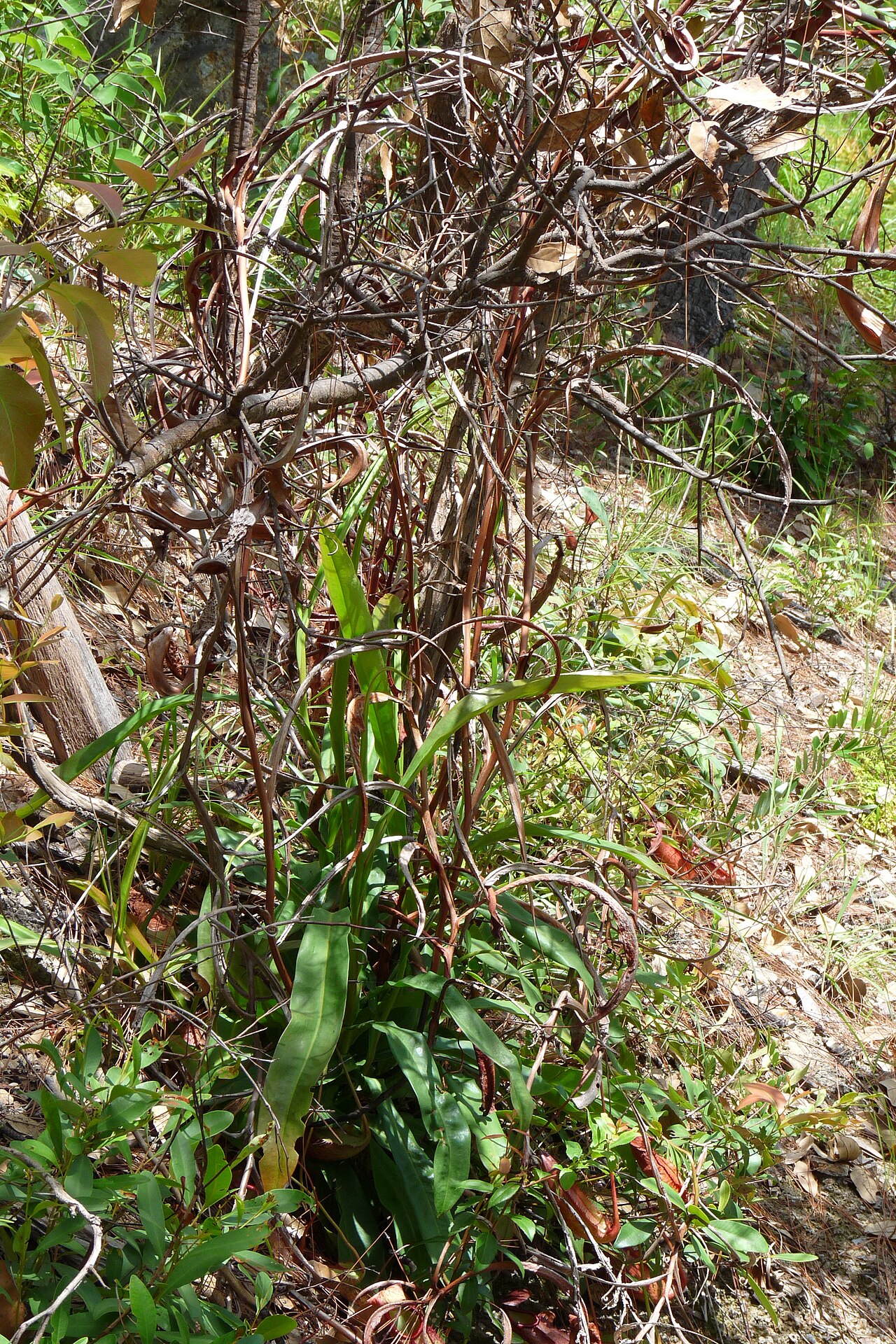
A pitcher plant that lives with fire. In 2006 the British biologist and wildlife photographer Jeremy Holden, who worked for years in Cambodia's Cardamom Mountains, photographed an unknown pitcher plant on a steep mountain ridge. Four years later an international team led by François Mey named the species after him: Nepenthes holdenii. It is a pyrophyte in the true sense: in the dry season most leaves and stems die back through heat and fire, and the plant survives as a thick tuber underground, to resprout with the rains and climb up to five metres in a single season.
Identification
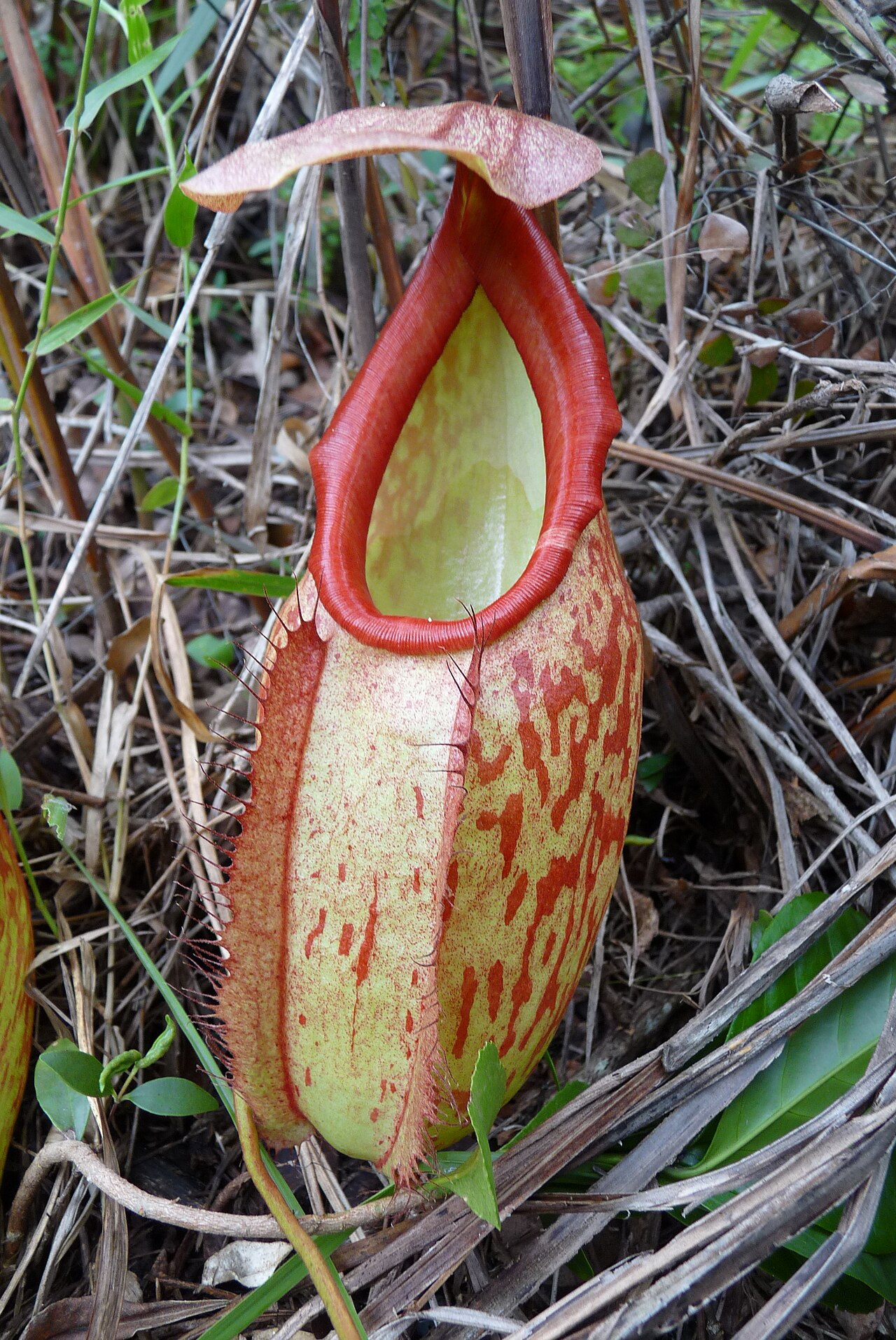
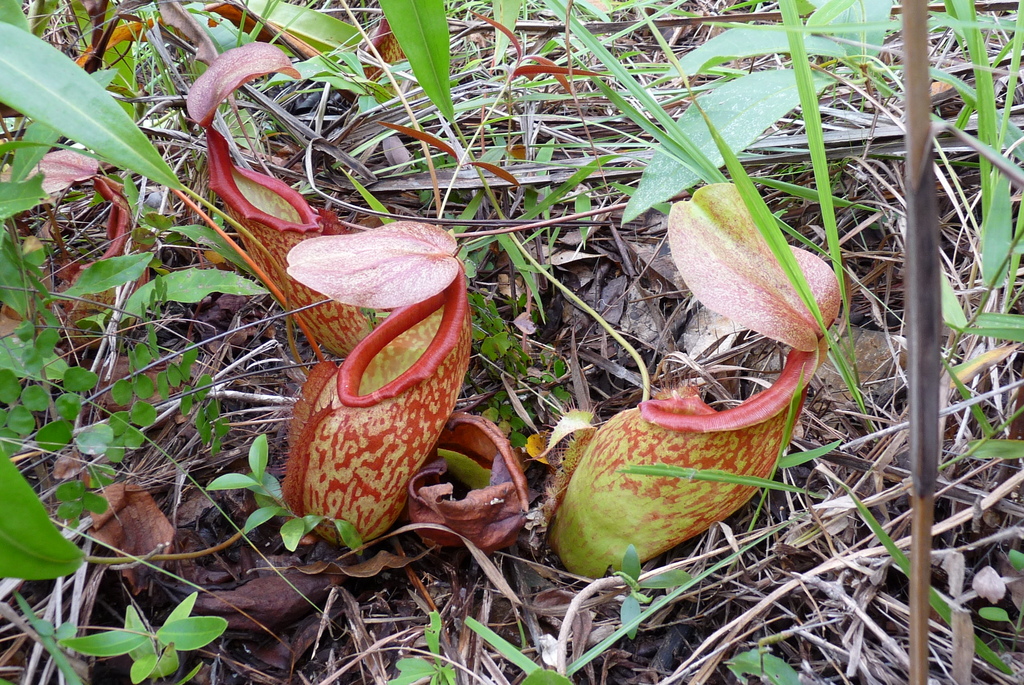
A plant with two lives a year. Underground lies a thick tuber, with knobbly roots up to 2.5 cm thick. In the rainy season round, glossy stems six to eight millimetres thick grow from it and can climb to five metres; on the ground the internodes are two or three centimetres apart, on climbing stems five or six. The leaves are leathery, shortly stalked, linear to linear-lanceolate, 25 to 40 cm long and 3.5 to 6 cm wide, with long tendrils. Lower pitchers are globose, upper pitchers funnel-shaped; the pitchers can reach 30 cm in length. The peristome is slightly sinuate and the lid elliptic with a heart-shaped base, not vaulted. The plant is hairless except in the leaf axils and on tendrils and pitchers. Male and female inflorescences carry two-flowered partial peduncles, usually with bracts.
Similar species
The species belongs to the thorelii group, which also includes Nepenthes andamana, Nepenthes bokorensis, Nepenthes chang, Nepenthes kampotiana, Nepenthes kerrii, Nepenthes smilesii and Nepenthes thorelii. Within that group it stands out for the combination of long tendrils, funnel-shaped upper pitchers with a slightly sinuate peristome, an unvaulted lid and two-flowered partial peduncles with bracts. Nepenthes bokorensis, from the Elephant Mountains a little further south, has a vaulted lid and a rounded striped peristome and is hairy all over. Nepenthes chang, just across the Thai border, is hairy and has tubular upper pitchers.
The trap and how it works
A pitfall trap that has to rebuild itself every year. In the rainy season the plant first forms globose lower pitchers on or just above the ground, which catch crawling animals, and then, as the stems start to climb, funnel-shaped upper pitchers on long tendrils, which catch mainly flying insects. With the onset of the dry season they dry up and often burn. The nutrients drawn from prey in the rainy season must therefore also stock the tuber for the following year. No specific study of this species' prey has been published.
Habitat and ecology
Steep mountain ridges in the transition zone between lowland evergreen forest and low montane evergreen forest, on peaty soil, in bright to fully sunny places, from 600 to 800 m (B5, D4). The climate is tropical monsoonal, with distinct rainy and dry seasons. In habitat and rhythm it is a true savanna pitcher plant, but on mountain slopes where regular fire keeps the vegetation open.
Distribution and elevation
Endemic to Cambodia, in the western Cardamom Mountains in Pursat Province. The species was originally known from only two peaks; a third population was discovered in October 2011. The exact sites are not disclosed for protection, and this guide follows suit. Our own list names the Cardamom Mountains, which is correct.
- Recorded (one-degree cells)
Forms and variation
No varieties have been described and no natural hybrids reported. Little is recorded about variation in pitcher colour in the sources consulted. In 2014 seed was collected and the species brought into cultivation; plant material in the trade should therefore come from cultivation, not from the wild.
Where and when to see it
The Cardamom Mountains are one of the last great wildernesses of mainland Southeast Asia, and access runs through conservation organisations and rangers. Anyone who reaches the open ridges in the rainy season sees the species best: then fresh pitchers hang from the climbing stems. In the dry season there is often nothing to see but scorched ground, with the tuber invisible below. Collect nothing: over-collection is named as the greatest threat.
Conservation status
The species has not (yet) been assessed for the Red List. In 2010 Mey called the populations highly localised and made up of only a few dozen plants, and proposed Near Threatened; the main threat is collection, and in the longer term habitat loss through logging and land speculation. As a member of Nepenthes it is listed in CITES Appendix II, so international trade in wild plants requires a permit. The fact that the species is now in cultivation may reduce pressure on the wild plants.
Scientific name
Nepenthes holdenii | Mey, 2010
Nepenthes holdenii was described in 2010 by François Sockhom Mey, Marcello Catalano, Charles Clarke, Alastair Robinson, Andreas Fleischmann and Stewart McPherson, in "Nepenthes holdenii (Nepenthaceae), a new species of pyrophytic pitcher plant from the Cardamom Mountains of Cambodia", published in Carnivorous Plants and their Habitats, volume 2. The Cardamom Mountains (Phnom Kravanh), Pursat Province, western Cambodia, at 600-800 m elevation; the precise location has deliberately not been shared, to protect the species. The accessible sources do not explicitly state the etymology, but everything points to the species being named after the biologist Jeremy Holden, whose 2006 photographs were instrumental in distinguishing it from related species.
World Checklist of Vascular Plants (WCVP), via Plants of the World Online (POWO), Royal Botanic Gardens, Kew.