All species › Caryophyllales › Tropical pitcher plant family › Nepenthes hirsuta
Nepenthes hirsuta
The 'hairy' pitcher plant of Borneo, described by Hooker in 1873 and recognised by a layer of thick brown hairs covering the stem, leaves and even the inflorescence. Nepenthes hirsuta is a modest species of the hill country, with mostly green pitchers, that receives little attention in the shadow of its better-known relatives. It grows on poor, acid soils on sandstone, from lowland heath forest to the mossy slopes of lower montane forest.

Identification
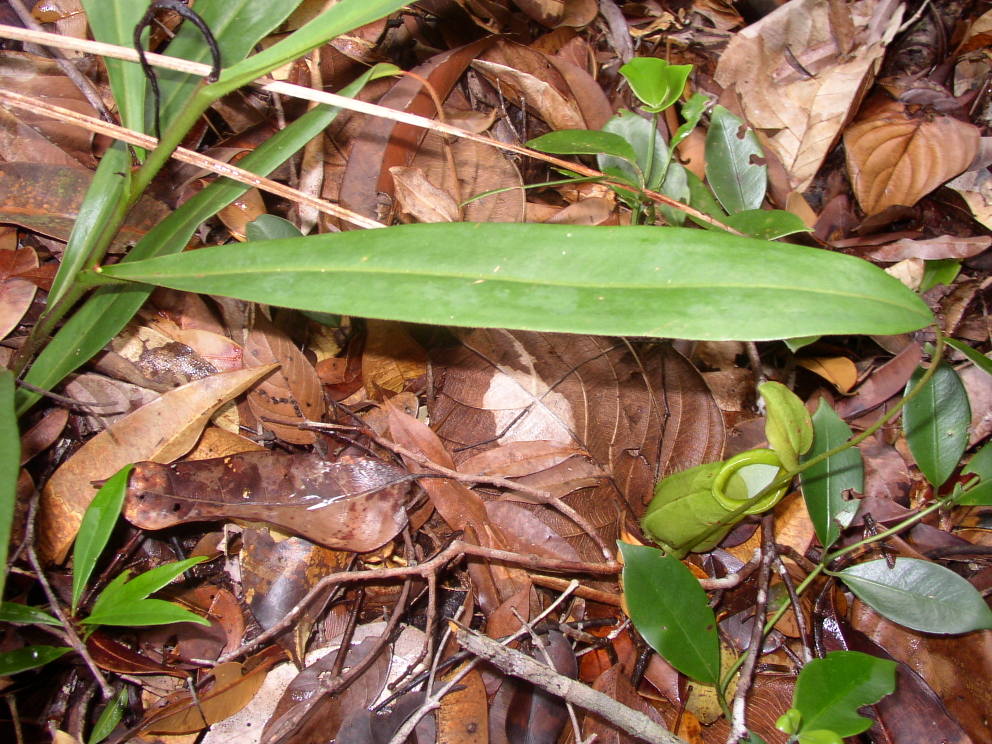
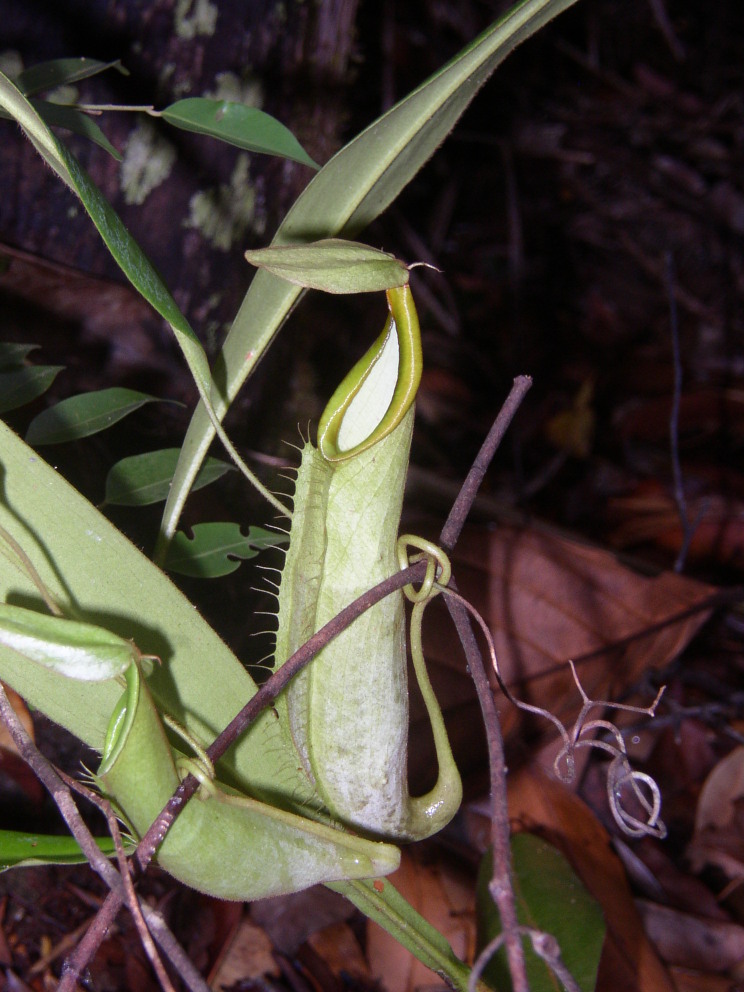
A climber with a stem densely set with long brown hairs. The leaves are leathery, channelled-spathulate to obovate, to 20 cm long, with an acute to rounded tip and a narrowed base passing into a laterally flattened, half-clasping sheath; the longitudinal veins are inconspicuous. The hairs are 1 to 2 mm long and brown. The pitchers are mostly green, some with red blotches inside. Verifiable measurements of the pitchers and of stem length were not available to this guide; the trap size field is therefore left empty.
Similar species
Its closest relatives are Nepenthes hispida and N. macrovulgaris; a relationship with N. philippinensis of Palawan has also been suggested. The distinction from N. hispida matters most: that species has a very dense indumentum of bristly, purplish-grey hairs 1.5 to 4 mm long and a clasping, decurrent leaf base, whereas N. hirsuta has brown hairs of 1 to 2 mm and no decurrent leaf base. In the flower, N. hirsuta has a longer staminal column, 3.5 to 6 mm against 1.5 to 2 mm. N. macrovulgaris is a species of ultramafic soils.
The trap and how it works
A pitfall of the ordinary kind, with lower and upper pitchers that are inconspicuous in this species: mostly green, sometimes with red blotches on the inner wall, and hairy outside like the rest of the plant. Whether the hairs play a part in capture, for example as a walkway for ants, has not been studied. Capture works, as throughout the genus, through the slippery peristome and a digestive fluid at the bottom of the pitcher. No specific prey data have been published.
Habitat and ecology
Poor, acid soils, mainly on sandstone, from 200 to 1100 m. The species grows in kerangas, the heath forest on poor sandy soil (B3), on mossy banks and slopes in lower montane forest (B1), and in open places and disturbed vegetation on lower ridges (B5). That it persists in disturbed, open vegetation too makes it less vulnerable at island scale than many montane species.
Distribution and elevation
Endemic to Borneo. The world checklist gives Borneo only; a finer breakdown over states and provinces was not found in a verifiable source for this guide and is therefore not given. Altitude: 200 to 1100 m. The area in our species list (Borneo) is correct.
- Recorded (one-degree cells)
Forms and variation
Three varieties were described in the nineteenth and early twentieth centuries: var. glabrescens (1882), and var. glabrata and var. typica (1908); they are not recognised as separate taxa today, but show that the density of the indumentum varies. N. leptochila, described by Danser in 1928, is regarded as a synonym. Natural hybrids are known with N. albomarginata and N. ampullaria, and a cross with N. lowii is suspected.
Where and when to see it
Search heath forest and open, poor slopes on sandstone in the hill country, between 200 and 1100 m. The species stands out not for its pitchers but for its hairs: a climber with brown-haired stems and leaf margins on poor ground in Borneo is already a strong clue. Check hair colour and length to rule out N. hispida. Because it also grows along trails and in disturbed vegetation, it can often be found without long treks.
Conservation status
The Red List assesses the species as Least Concern. It tolerates disturbance, spans a broad altitudinal range and occurs in several vegetation types. Loss of kerangas and hill forest to clearing, plantations and fire does affect part of its habitat. As a member of the genus it is listed in CITES Appendix II.
Scientific name
Nepenthes hirsuta | J.D. Hooker, 1873
Nepenthes hirsuta was described in 1873 by Joseph Dalton Hooker, in "Ordo CLXXV bis. Nepenthaceae" (Prodromus Systematis Naturalis Regni Vegetabilis 17: 90-105). The precise type locality could not be established with certainty; the species is endemic to Borneo, growing at 200-1,100 m elevation in kerangas forest, on mossy banks and on sandstone substrates. The name derives from the Latin "hirsūtus" ("hairy, bristly"), referring to the plant's indumentum of thick brown hairs, which is even present on the inflorescence.
World Checklist of Vascular Plants (WCVP), via Plants of the World Online (POWO), Royal Botanic Gardens, Kew.