All species › Caryophyllales › Tropical pitcher plant family › Nepenthes glandulifera
Nepenthes glandulifera
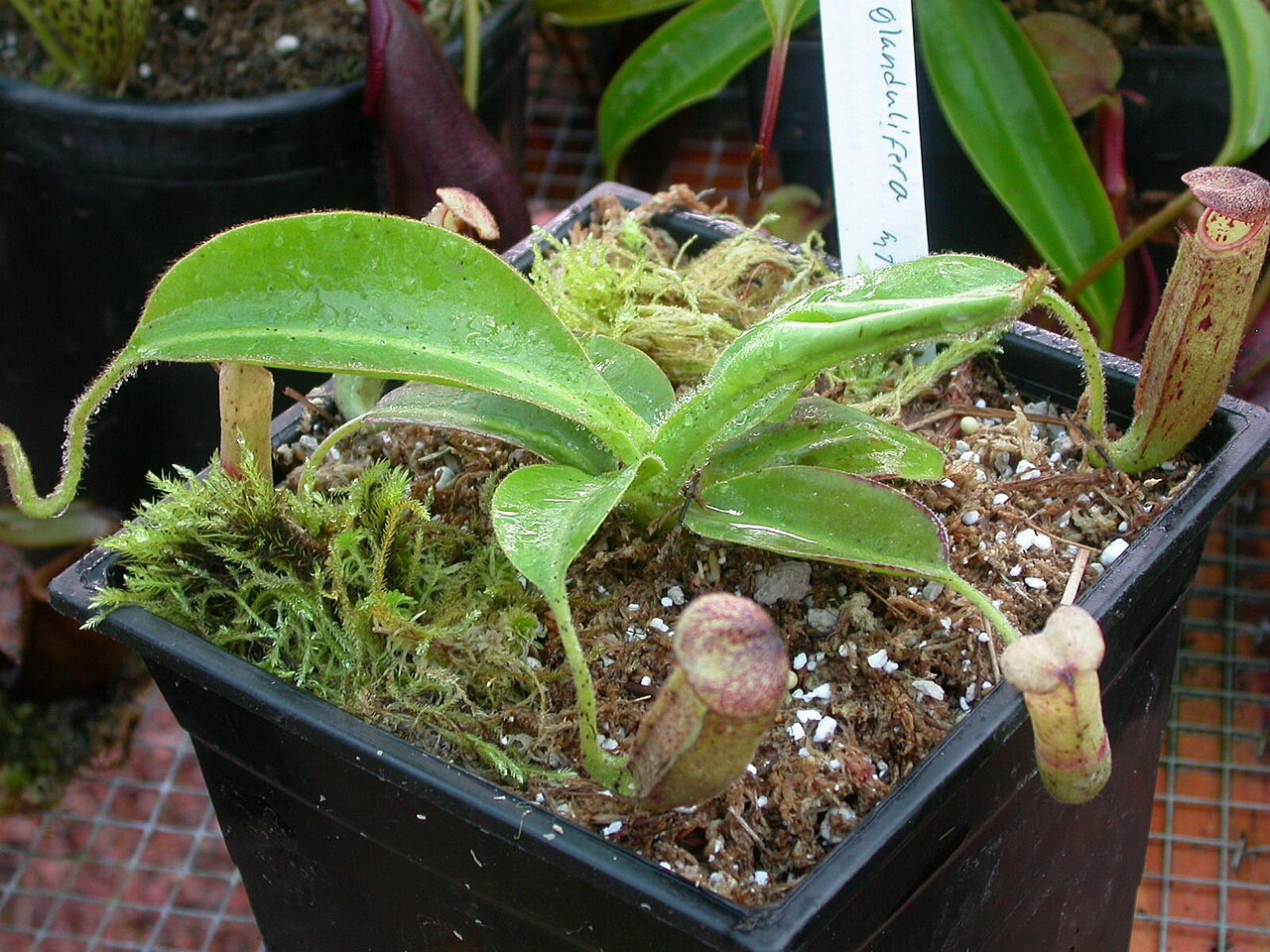
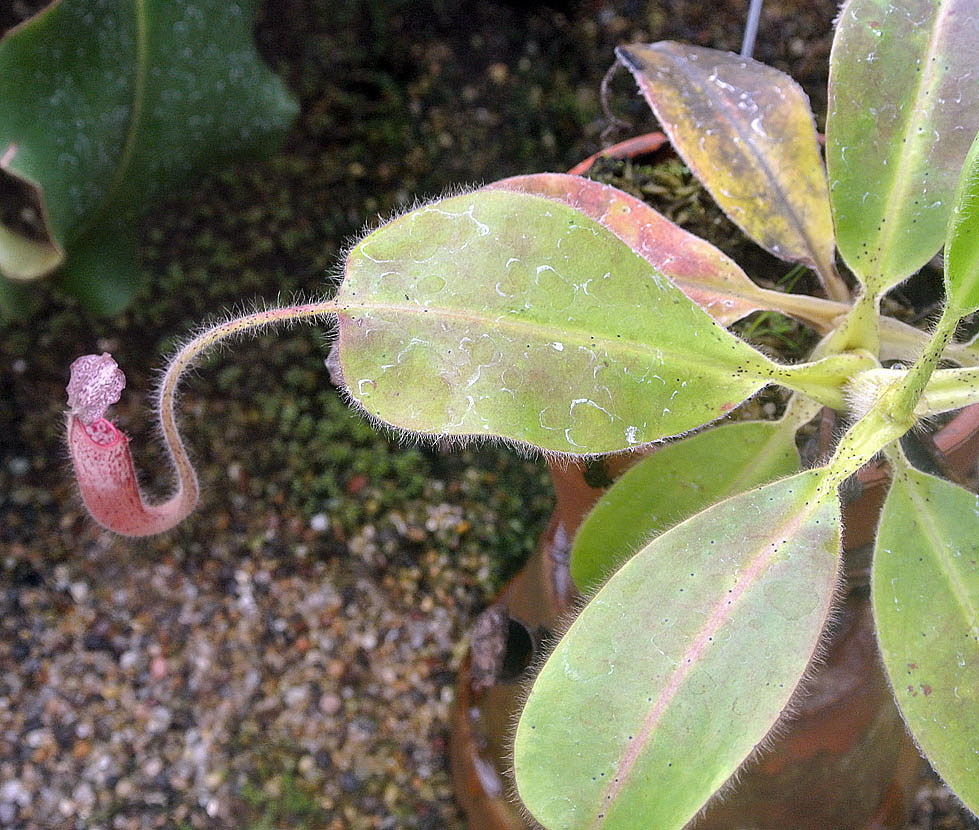
A hairy pitcher plant from the heart of Borneo, named after the glands that cover its petioles. When Ch'ien C. Lee found the species in the Hose Mountains of central Sarawak, he at first took the black specks on the petioles for a disease; they turned out to be large nectar glands. In 2002 the plant was provisionally listed as 'Nepenthes sp. A'; in 2004 Lee formally described it as N. glandulifera, 'gland-bearing', in the journal Sandakania. Besides its glands it is striking for a dense coat of soft, yellowish-brown hairs.
Identification
A climber or scrambler with stems up to 3 m long. The leaves are oblong to elliptic, up to 25 cm long and 9 cm wide, bright green and glossy, with a winged petiole up to 7 cm. All parts except the leaf blades are densely covered in long, soft, yellowish-brown hairs, and everywhere, especially on petioles and stem, there are large, conspicuous black nectar glands up to 2 mm across. Lower pitchers are cylindrical or narrowly funnel-shaped, up to 13 cm tall and 3 cm wide, with wings to 5 mm and thread-like fringes to 8 mm, a rounded peristome to 6 mm, a lid up to 3 by 2.8 cm with a cordate base, and a spur reduced to a hairy bump of at most 2 mm. They are yellowish green or flushed orange with dark purple to black blotches, pale yellow or cream inside. Upper pitchers are funnel-shaped throughout, up to 19 cm tall and 5.5 cm wide, with a peristome up to 15 mm wide; they are bright yellow, often flushed orange and pink, with dark red blotches. The inflorescence is a long raceme, up to 70 cm.
Similar species
The closest relative is Nepenthes pilosa, also a very hairy species of interior Borneo. The large black nectar glands on petioles and stem, and the bright yellow, orange-pink-flushed upper pitchers, distinguish N. glandulifera. In the Hose Mountains, which are still little explored, no other species with this combination of glands and hair is known.
The trap and how it works
A pitfall with lower and upper pitchers. In this species the nectar glands are not confined to the peristome and lid, but are spread over the whole plant: on petioles, stems and tendrils. They may draw insects to the plant, which then find the pitchers; exactly how this works has not been studied. The broad peristome of the upper pitchers, with ribs up to 0.4 mm high, turns slippery when wet. Lower pitchers stand in moss and catch walking animals; the yellow upper pitchers are conspicuous from afar in the scrub and catch flying insects.
Habitat and ecology
Stunted, mossy mountain forest and scrub on ridge tops (B1, R4), between 1100 and 1700 m. The plant grows on the ground and climbs or scrambles through the surrounding vegetation. The Hose Mountains are a remote upland in the interior of Sarawak, with poor soils and an almost permanently humid climate.
Distribution and elevation
Endemic to Borneo, and known only from the Hose Mountains in central Sarawak (Malaysia), in Kapit Division. The world checklist gives Borneo as its area. The species does not occur on Sumatra.
- Recorded (one-degree cells)
Forms and variation
No varieties or forms have been described. As far as is known Nepenthes glandulifera forms no natural hybrids with other species. Colour differences between upper pitchers, from pure yellow to strongly flushed orange and pink, are probably related to light exposure.
Where and when to see it
The Hose Mountains are very remote and can only be reached by river and long treks on foot, with local guides and permits; a visit is in practice an expedition. Anyone who gets there will recognise the species at once by the black dots on the petioles and the dense hair. Take time to look at the glands closely, and photograph them with a scale.
Conservation status
The species has not been evaluated by the IUCN (NE). What is known: it occurs in a single remote mountain range, where there is little direct human pressure, but its total range is small and poorly explored. Forest fires and logging in the surrounding lowlands of Sarawak are indirect risks. As a member of the genus it is listed in CITES Appendix II.
Scientific name
Nepenthes glandulifera | Lee, 2004
Nepenthes glandulifera was described in 2004 by Ch'ien C. Lee, in "New records and a new species of Nepenthes (Nepenthaceae) from Sarawak" (Sandakania 15: 93-101). The Hose Mountains of central Sarawak, Borneo — the species' only known locality. The name derives from the Latin "glandula" ("gland") and "ferre" ("to bear"), referring to the distinctive black speckles around the petioles, which were initially mistaken for signs of disease but later identified as nectar glands.
World Checklist of Vascular Plants (WCVP), via Plants of the World Online (POWO), Royal Botanic Gardens, Kew.