All species › Caryophyllales › Tropical pitcher plant family › Nepenthes fusca
Nepenthes fusca
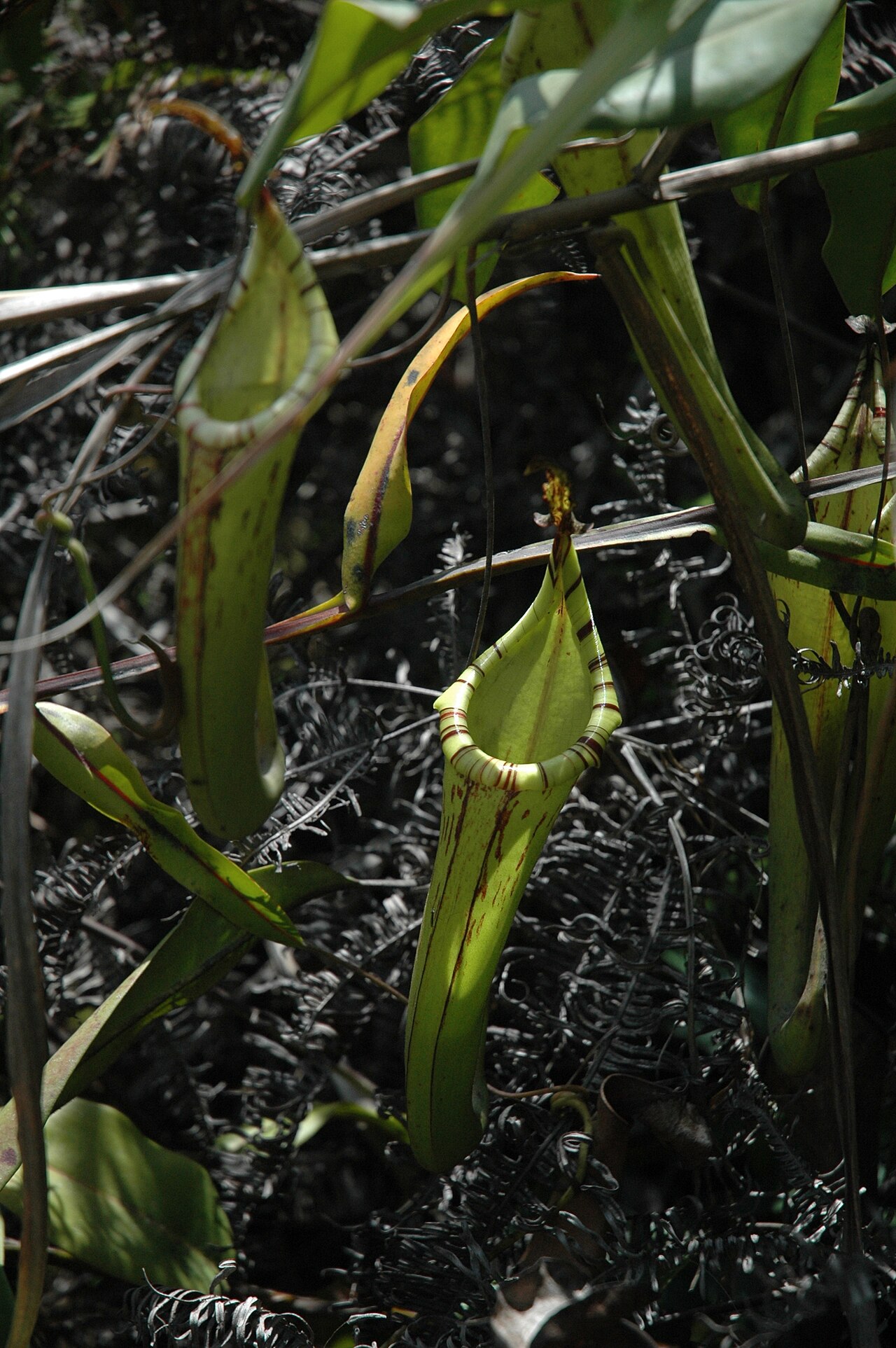
A cloud-forest epiphyte that often hangs its pitchers ten to fifteen metres above the ground, making it for most visitors a plant for binoculars. Nepenthes fusca, Latin for 'dark', was described by Danser in 1928 from a single specimen that the forester Endert had collected in East Kalimantan three years earlier and at first taken for N. veitchii. It is one of the most widespread montane species of Borneo, with long, slender pitchers and a strikingly narrow, triangular lid.
Identification
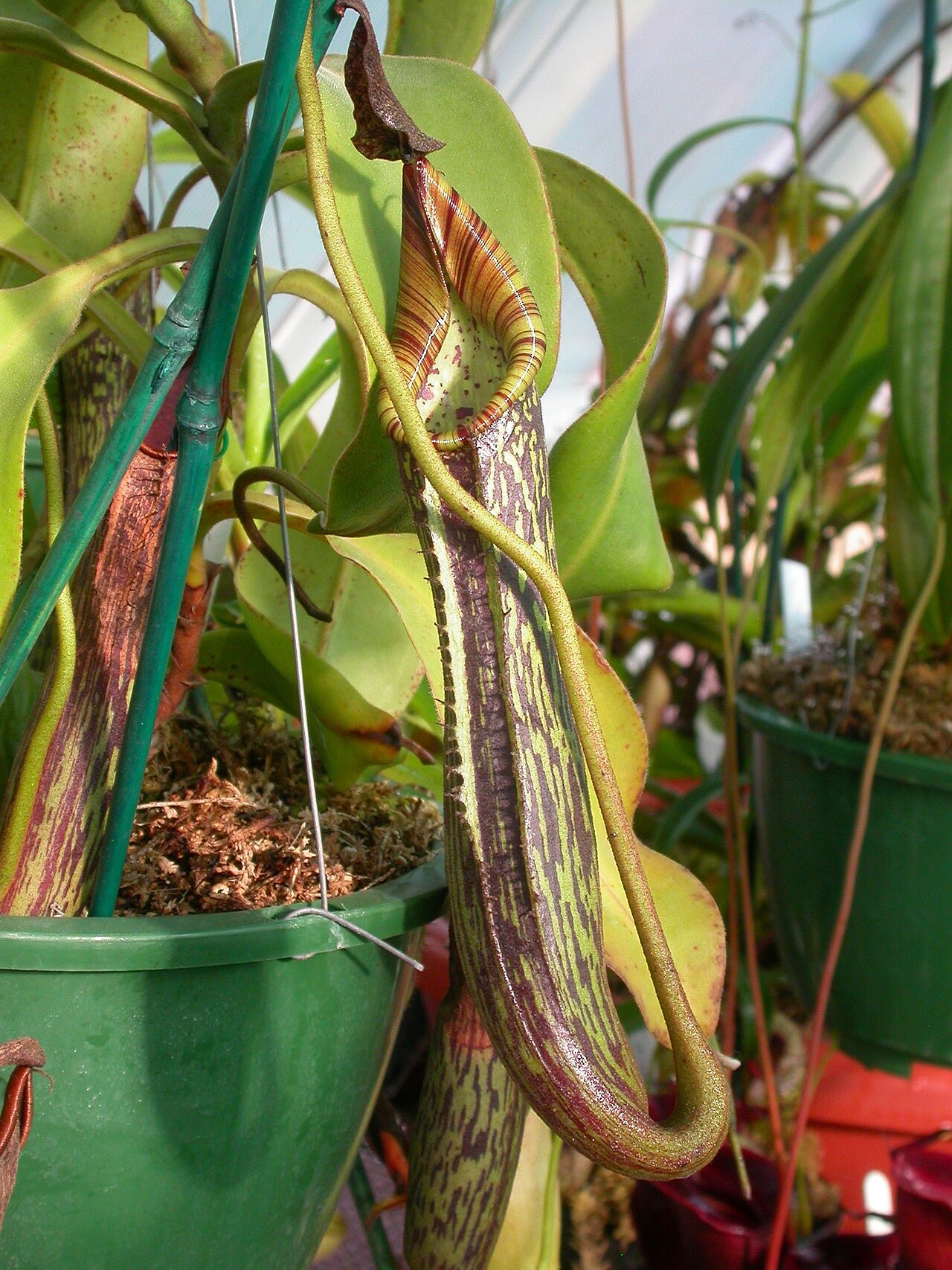
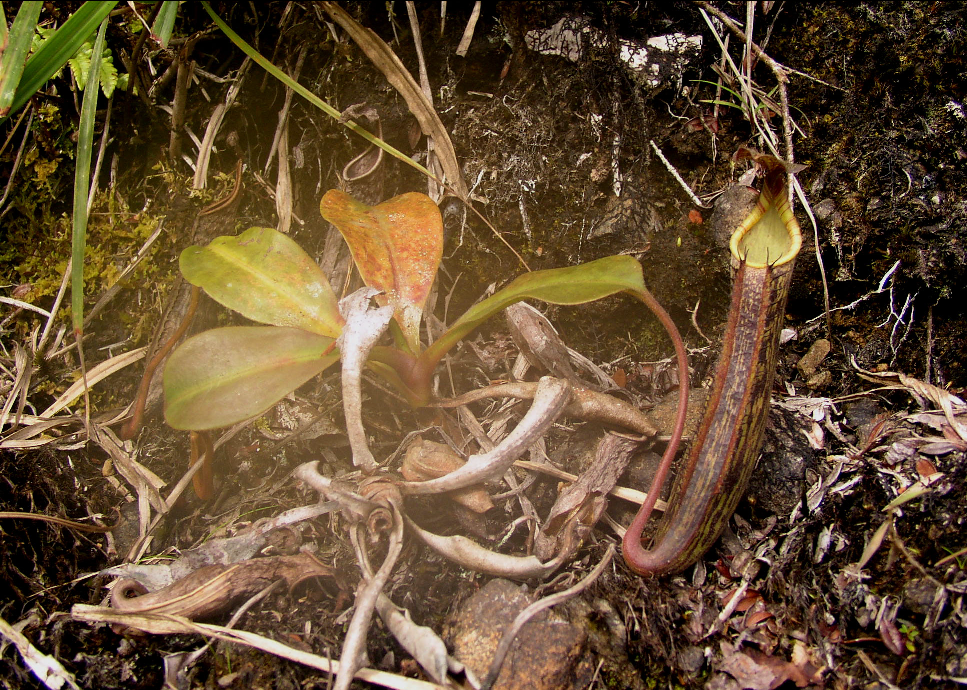
A climber with stems to 10 m long and 8 mm thick, with round internodes to 7 cm. The leaves are leathery and stalked, oblong to obovate, to 15 cm long and 6 cm wide; the channelled petiole to 4 cm has clasping wings, and the tendril is short. Lower pitchers are cylindrical, usually 20 cm tall and 4 cm wide (exceptionally 28 cm), with narrow fringed wings, a horizontal mouth rising at the back into a neck, and a flattened peristome to 12 mm with indistinct teeth. The lid is narrowly ovate with a crest at its base. Upper pitchers are narrowly funnel-shaped in the lower two-thirds and widely funnel-shaped above, to 18 cm and in large forms 26 cm tall, with a narrowly triangular lid whose margins and tip curl downwards. Young parts bear long brown hairs that mostly disappear.
Similar species
The species belongs to a group of related Bornean montane species and the wider N. maxima group. Nepenthes hurrelliana has a hairy crest under the lid and a horizontal mouth rising abruptly into a long neck. N. vogelii has much smaller pitchers, no lid appendages, a broadly rather than narrowly triangular lid and pale cream pitchers with dark speckles. N. faizaliana has a round lid and differs in inflorescence, glandular zone and indumentum. N. platychila has a much broader peristome and lid, without appendages. The narrow, triangular lid of the upper pitcher is the best field character.
The trap and how it works
Two pitcher types, each with its own fine structure. Lower pitchers have a small digestive zone with about 600 to 650 glands per square centimetre and a reduced waxy zone. In the upper pitchers the glands are much denser, 1500 to 2000 per square centimetre, but tiny and overarched. The narrow, triangular lid with down-curled margins stands at an angle over the mouth and leaves the opening clear. The funnel-shaped upper pitchers hang high in the mossy forest and are aimed at flying insects. No specific prey data have been published.
Habitat and ecology
Mossy cloud forest on mountain ridges (B1), mostly between 1200 and 2500 m, in Sarawak sometimes from 300 m. The species is chiefly an epiphyte in shady mossy forest, where it may hang ten to fifteen metres above the ground; it rarely grows on the ground in open montane forest or along logging roads. It often grows with N. reinwardtiana, N. stenophylla and N. tentaculata.
Distribution and elevation
Endemic to Borneo, from Central Kalimantan to north-western Sabah, and also in Sarawak. The species was described from material from a mountain in East Kalimantan. Altitude: mostly 1200 to 2500 m, locally from 300 m. The area in our species list (Borneo) is correct.
- Recorded (one-degree cells)
Forms and variation
No varieties are recognised. Two invalidly published subspecies names now belong to other species: one to N. stenophylla, the other to N. epiphytica, described separately in 2011. Pitcher size varies; there are larger forms with upper pitchers to 26 cm. Natural hybrids are known with N. burbidgeae (since the 1980s), N. lowii, N. reinwardtiana, N. stenophylla and N. tentaculata, and crosses with N. platychila, N. rajah and N. veitchii have been reported.
Where and when to see it
Search mossy montane forest above 1200 m, in parks such as Kinabalu and the mountain areas of Sarawak, up in the trunks and branches. The slender funnel-shaped upper pitchers with their narrow triangular lid often hang far out of reach; good binoculars are indispensable. Where logging roads cross montane forest the species sometimes grows on the ground along the verges, and there the pitchers can be studied close up. Leave them hanging: epiphytic plants recover poorly from damage.
Conservation status
The Red List assesses the species as Least Concern. The range is large, and because the species grows high in the trees and is in little demand among enthusiasts, collecting hardly matters. The main threat is loss of montane forest to logging; substantial populations, however, lie in national parks, so the species does not appear threatened in the near future. It is listed in CITES Appendix II.
Scientific name
Nepenthes fusca | Danser, 1928
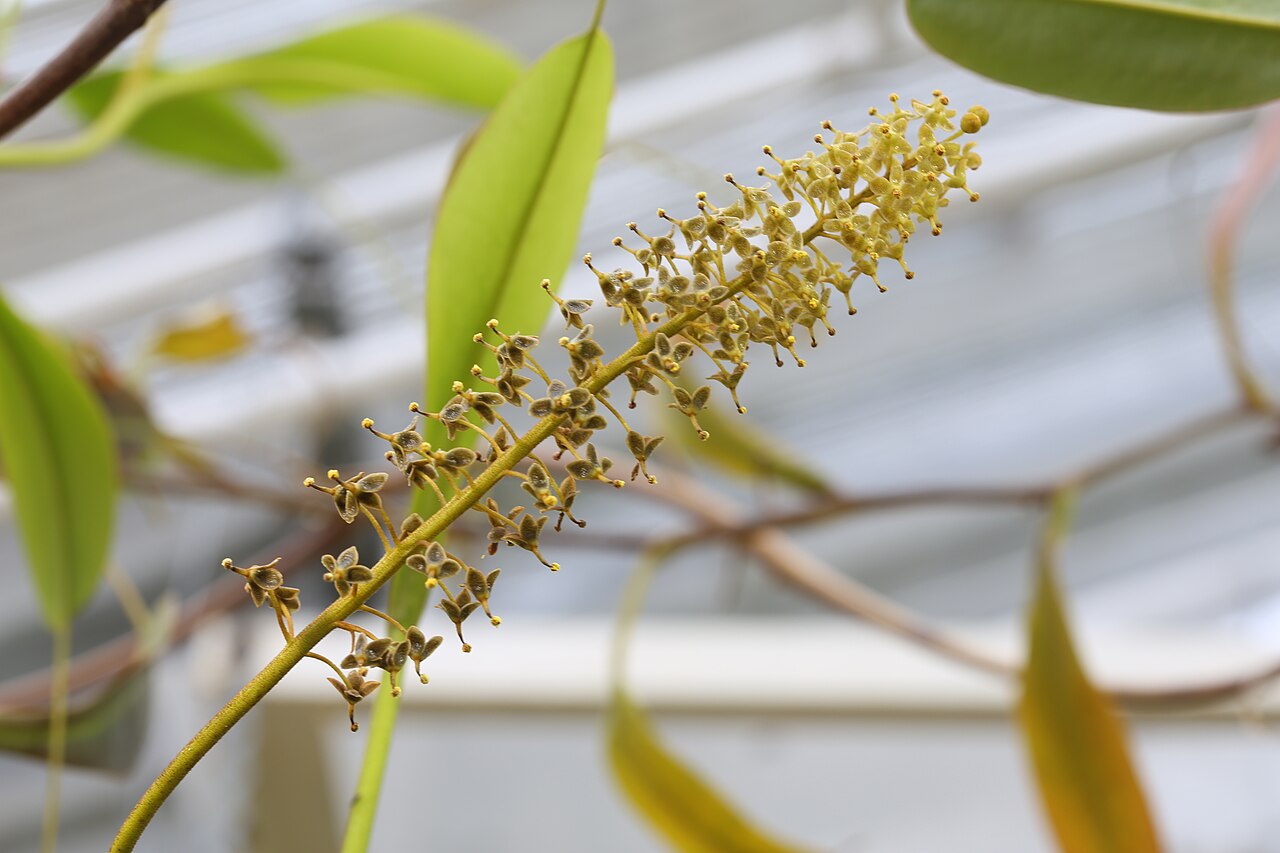
Nepenthes fusca was described in 1928 by Benedictus Hubertus Danser in his monograph "The Nepenthaceae of the Netherlands Indies", based solely on the specimen Endert 3955. This type material (with male floral parts) was collected on 12 October 1925 by Frederik Endert during an expedition of the Forest Research Institute of Bogor, and is held at Herbarium Bogoriense (BO). Mount Kemul, East Kalimantan, Borneo, at 1,500 m elevation. The specific epithet derives from the Latin "fuscus" ("dark brown, dusky"), referring to the colouring of the pitchers.
World Checklist of Vascular Plants (WCVP), via Plants of the World Online (POWO), Royal Botanic Gardens, Kew.