All species › Caryophyllales › Tropical pitcher plant family › Nepenthes edwardsiana
Nepenthes edwardsiana
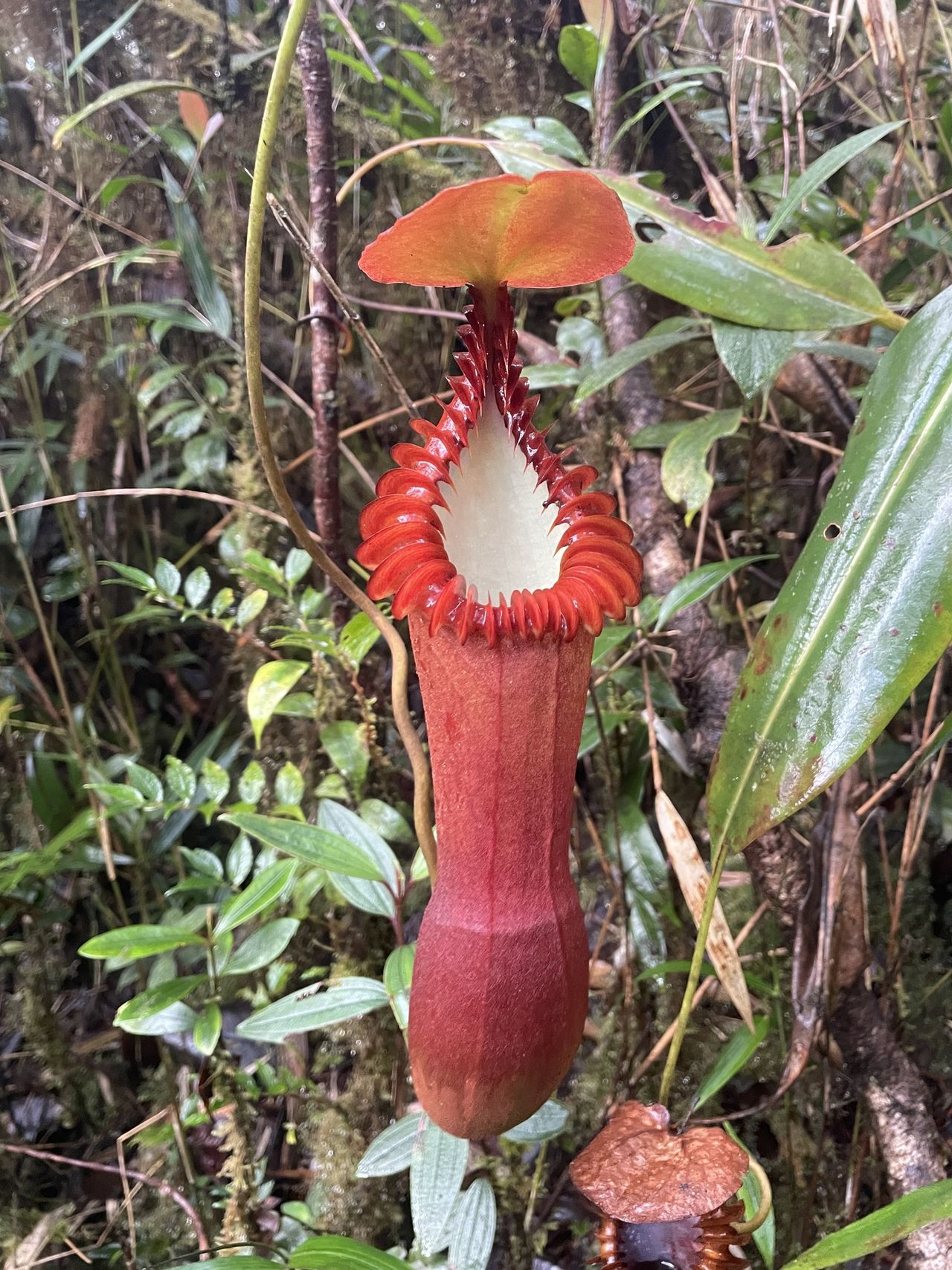
One of the three classic pitcher plants of Kinabalu, collected in 1858 by Hugh Low and Spenser St. John and described a year later by Hooker, named after George Edwardes, then governor of Labuan. Nepenthes edwardsiana has perhaps the most elegant peristome in the whole genus: a cylindrical collar of ribs ending in long, curved teeth, like the lamellae of a ruff. The pitchers are long, bulbous below and cylindrical above, and can exceptionally exceed half a metre in height.
Identification
A climber with stems to 15 m long and 10 mm thick, with round internodes to 35 cm. The leaves are leathery and stalked; the blade is truly lanceolate, to 30 cm long and 7 cm wide, and the channelled, winged petiole to 15 cm clasps two-thirds to three-quarters of the stem. The tendril is one to two times the blade length, to 35 cm. Lower pitchers are bulbous to ovoid below and cylindrical above, usually about 30 cm tall and exceptionally over 50 cm. The peristome is cylindrical, to 30 mm wide, with highly developed ribs and teeth. The lid is cordate, to 8 cm wide, without appendages, with an undivided spur to 20 mm. Upper pitchers are wholly cylindrical and similarly coloured: light yellow to dark red outside, usually white inside. The plant bears very short, inconspicuous hairs.
Similar species
Its nearest relatives are Nepenthes villosa, also of Kinabalu, and N. macrophylla of Mount Trusmadi. N. villosa has an even more intricate peristome, pitchers not elongated above the hip, an emarginate leaf tip, a dense indumentum and bracts on the pedicels, and grows higher, from 2300 to over 3200 m. N. macrophylla has much shorter ribs and teeth, a gradually rising mouth without a neck, a broader ovate lid, more ovoid upper pitchers and leaves twice as large; it does not occur in the Kinabalu area. On Kinabalu itself the long cylindrical pitcher with its elegant collar is unmistakable.
The trap and how it works
The peristome is this species' story. The ribs are up to 2 cm high and end at the inner edge in long teeth overhanging the mouth: an insect sliding inwards over the wet ribs has no hold on the inside and falls straight down the long cylinder. The pitchers are so long that a fallen insect can hardly escape; the digestive glands lie at the bottom, in the bulbous part. The lid has no appendages. Because lower and upper pitchers differ little in shape, their function is similar, but the upper pitchers hang free in the mossy forest and catch mainly flying insects.
Habitat and ecology
Ridge-top vegetation in dense, mossy cloud forest, between 1500 and 2700 m (B1). The plant lives mainly as an epiphyte, but also on the ground on mossy rocks. It grows mostly on ultramafic soil (R3) but is also known from sandstone. The forest is constantly moist and often in cloud. Unlike N. burbidgeae, which seeks open scrub, N. edwardsiana stands in closed mossy forest, its pitchers hanging among mossy branches.
Distribution and elevation
Endemic to Borneo, and there confined to Kinabalu and neighbouring Mount Tambuyukon in Sabah, Malaysia. Altitude: 1500 to 2700 m. The area in our species list (Kinabalu) is correct but slightly too narrow: Tambuyukon belongs too. The world checklist gives Borneo.
- Recorded (one-degree cells)
Forms and variation
No varieties have been described; the species varies little over its small range. Pitcher colour runs from light yellow to dark red. Three natural hybrids are known: with N. burbidgeae, with N. rajah, and with N. villosa. The last was described as a species in 1882, as N. ×harryana, and recognised as a hybrid only in 1908. Taxonomically the species has had a changeable history: it was twice placed in N. villosa and has been separate again since 1936.
Where and when to see it
The species can be seen in Kinabalu National Park, on mossy ridges above about 1500 m, always with a park guide and on official trails. As an epiphyte, its pitchers often hang above eye level; look for long red to yellow cylinders among the moss. Binoculars help to study the peristome without touching the plant. The park strictly forbids collecting plants.
Conservation status
The Red List assesses the species as Vulnerable. Clarke proposed treating it as conservation dependent: all populations lie in Kinabalu National Park and are hard for collectors to reach. Its small range, limited to two mountains, makes it sensitive to changes in the cloud-forest climate and to fire in dry years. It is listed in CITES Appendix II.
Scientific name
Nepenthes edwardsiana | Low ex J.D. Hooker, 1851
Nepenthes edwardsiana was described in 1859 by Joseph Dalton Hooker, in The Transactions of the Linnean Society of London 22(4): 415-424, with an accompanying illustration. The type material (Low s.n.) was collected in 1858 by Hugh Low and Spenser St. John on the north side of Mount Kinabalu, at 1,800-2,400 m elevation, and is held at the Royal Botanic Gardens, Kew. The north side of Mount Kinabalu, Borneo, at approximately 1,800-2,400 m elevation (given as "6,000-8,000 feet" in the original publication). Hooker named the species after George Edwardes, Governor of the Crown Colony of Labuan, at the request of his friend Hugh Low.
World Checklist of Vascular Plants (WCVP), via Plants of the World Online (POWO), Royal Botanic Gardens, Kew.