All species › Caryophyllales › Tropical pitcher plant family › Nepenthes distillatoria
Nepenthes distillatoria
This is the species on which the genus rests. When Linnaeus fixed the name Nepenthes in 1753, Nepenthes distillatoria was the only species he named, which makes it the type species of the entire genus. Linnaeus knew the plant not from the field but from books: as early as the seventeenth century European scholars had described and illustrated the Sri Lankan pitcher plant under names such as ‘marvellous distilling plant’. The fluid in the pitchers was thought to be distilled by the plant — hence the epithet. In Sri Lanka the plant is called bandura, a name that already appears in those early European sources.
Identification
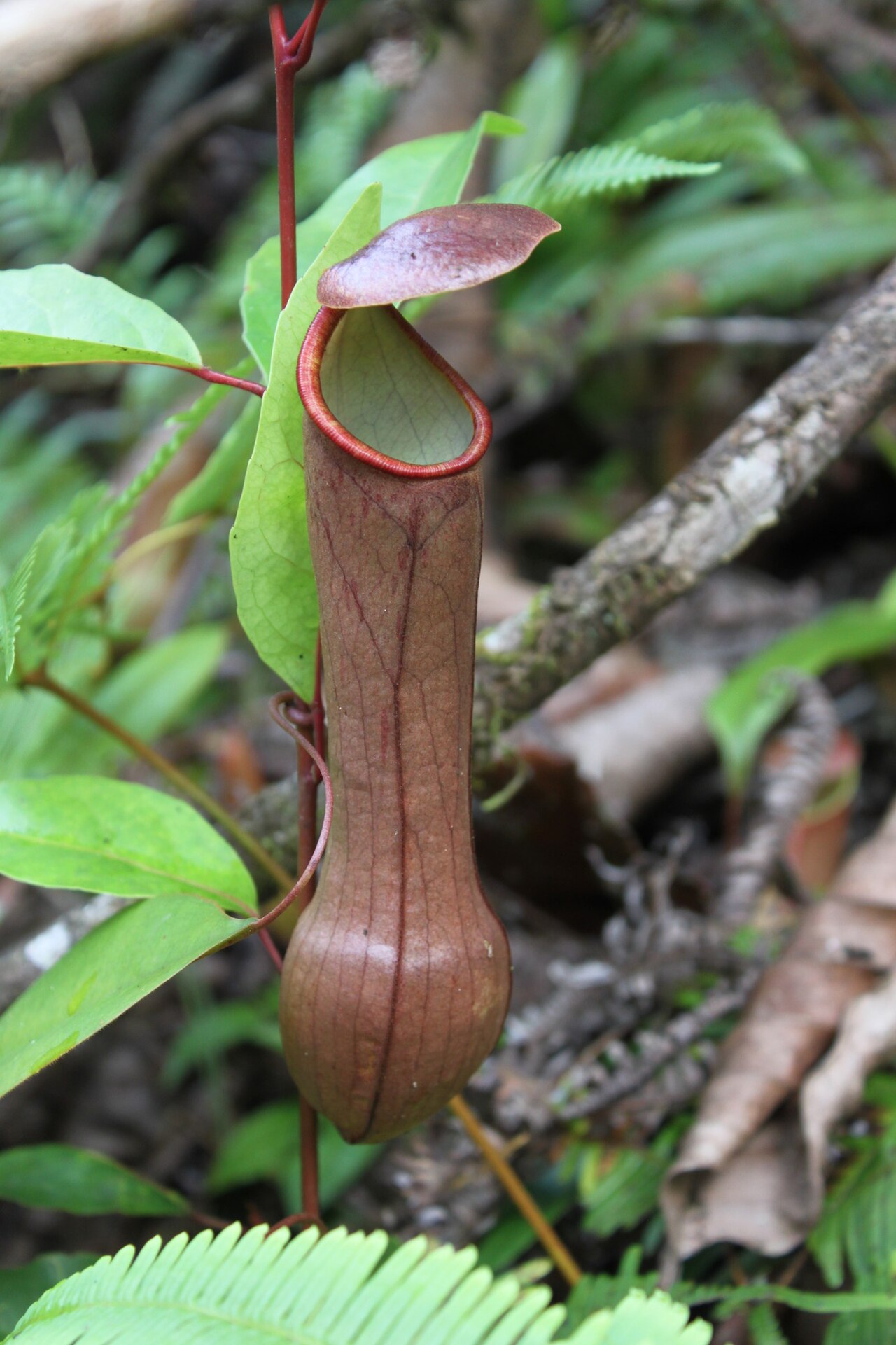
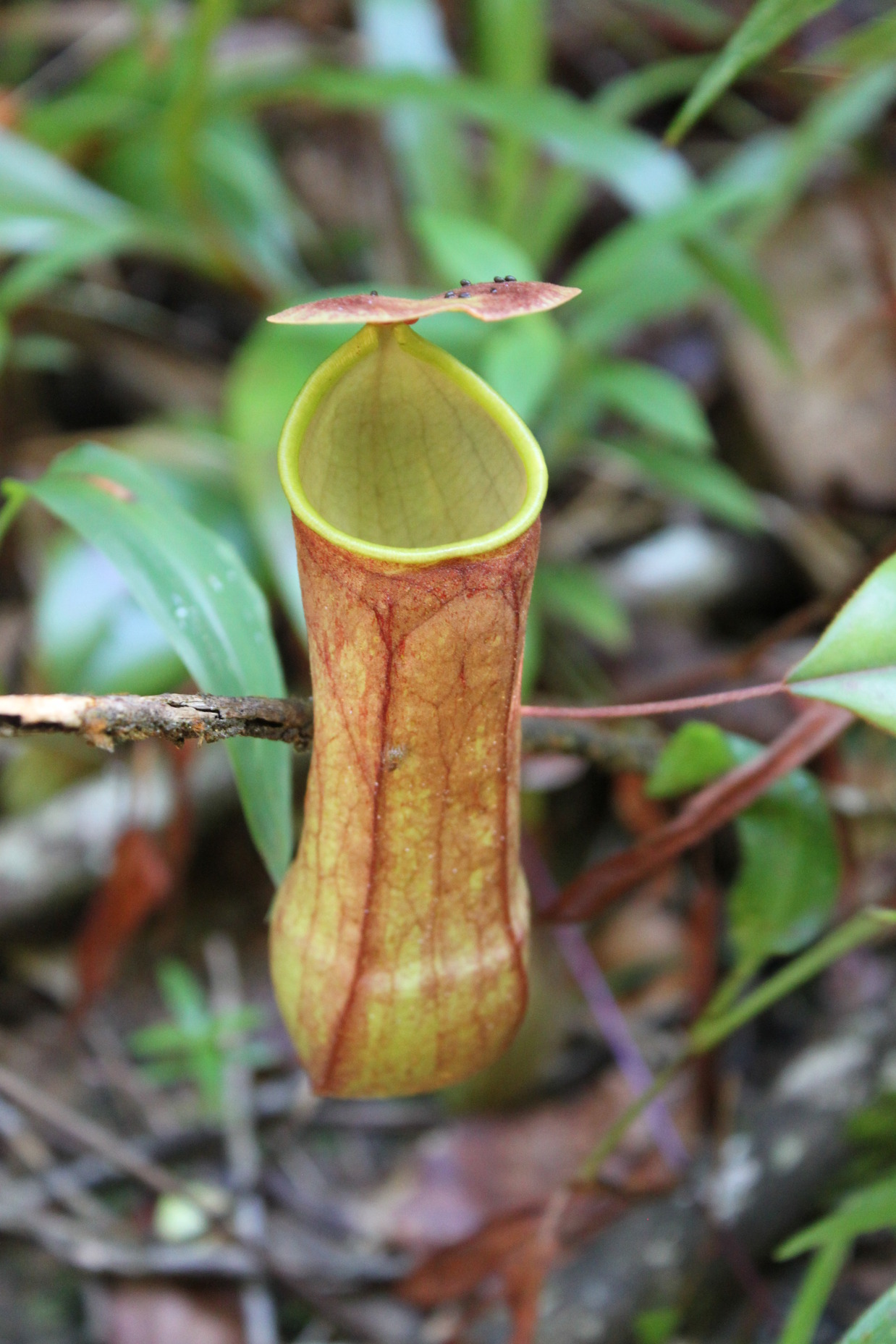
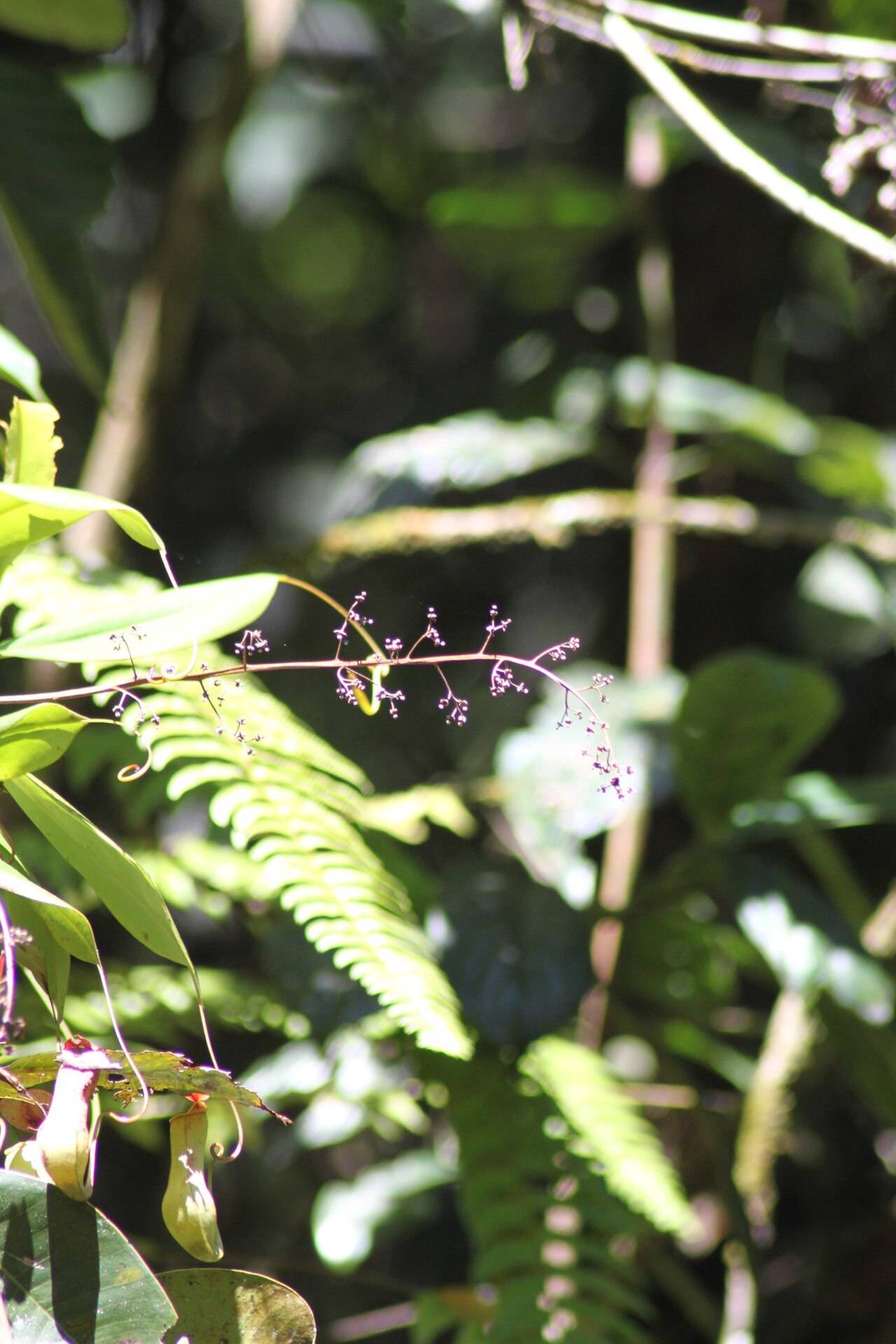
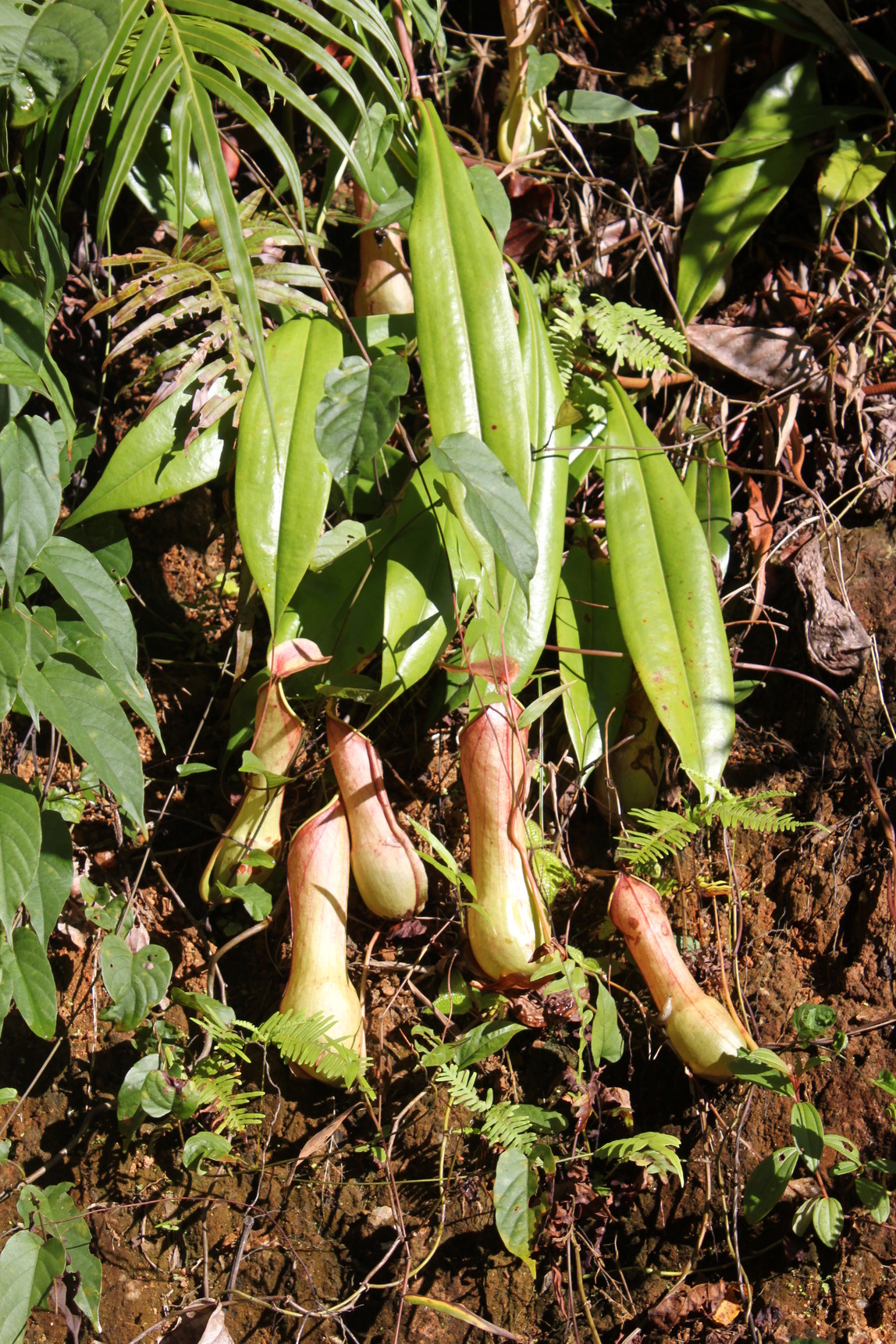
A vigorous climber with branched stems up to nine metres long, scrambling over surrounding shrubs. The lamina is up to 30 cm long and 6 cm wide and runs into a winged petiole up to 8 cm long and 2 cm wide. Lower pitchers are up to 14 cm tall and 5 cm wide, with two strikingly broad wings down the front, up to 22 mm, fringed or not with long filaments up to 18 mm. Upper pitchers are slimmer and taller, to 18 cm tall and 4 cm wide, with the wings reduced to narrow ridges. Colour ranges from green to yellowish green, often with red or reddish-brown blotches and a red peristome; in full sun the pitchers are redder. A flowering plant carries a paniculate inflorescence with widely spaced partial peduncles each bearing three to five flowers.
Similar species
In Sri Lanka confusion is ruled out: it is the island's only Nepenthes, and the nearest other species, Nepenthes khasiana in north-east India, grows more than two thousand kilometres away. Outside Sri Lanka, in herbarium material, it resembles several lowland species from Southeast Asia with winged petioles and green, red-blotched pitchers. The best character then is the combination of the broad, sometimes long-fringed wings of the lower pitchers with the inflorescence of many-flowered partial peduncles. In cultivation hybrids sometimes circulate under this name; they are of no concern in the field.
The trap and how it works
A pitcher trap like that of most of the genus, with a cylindrical peristome up to 5 mm wide whose ribs are up to half a millimetre high. The lid is up to 4.5 cm long and 5 cm wide, with an unbranched spur up to 6 mm. Nectar on the peristome and lid attracts insects; when the peristome is wet they slide over the ribs and in. Several digestive enzymes have been found in the pitcher fluid: protein-splitting aspartic proteases of the kind named nepenthesin after the genus, but also phosphatase, lipase and glycosidases. The fluid is also a habitat: the mite Anoetus guentheri is known from the pitchers of this species. As in related species, the wings of the lower pitchers serve as a walkway for ants and other crawling creatures.
Habitat and ecology
A species of wet, open and often disturbed ground: waterlogged open scrub, road embankments and other cleared land, but also forest (W6, B5, H1). It grows from sea level to about 700 m in the wet south-west of Sri Lanka, where rain falls all year. That it thrives on road verges and in cleared land says something about its needs: plenty of light, soil that stays wet and poor, and little competition from taller vegetation. In closed forest it keeps to the edges and clearings, where it climbs up through the shrubs.
Distribution and elevation
Endemic to Sri Lanka, and there confined to the wet zone in the south-west of the island, from sea level to about 700 m. It is one of the geographical outliers of the genus: like the species of Madagascar and the Seychelles it stands far from the centre of gravity in the Malay Archipelago. That isolation also means there are no natural hybrids. Because the species became known in Europe as early as the seventeenth century through Dutch contacts with Ceylon, it is one of the best-documented pitcher plants in the old botanical literature.
- Recorded (one-degree cells)
Forms and variation
A few varieties and forms of this species were described in the past, but none of them is now considered valid; the species is treated as a single, variable unit. The variation seen in the field lies mostly in colour — from almost plain green to heavily red-blotched, depending on light and plant — and in the width and fringing of the wings of the lower pitchers. No natural hybrids are known, because no other species occurs in Sri Lanka.
Where and when to see it
Search in the wet south-west of Sri Lanka, in the lowlands and low hills below 700 m. Precisely because the species likes disturbed ground, road cuttings and clearings along forest edges are often the best places; watch for green to red-blotched pitchers hanging among ferns and low shrubs. The rainy seasons of the south-west monsoon (roughly May to September) and of October–November make the ground wet and the pitchers full; travel is easier in the months between. Protected areas in the rainforest of the south-west offer the most natural sites.
Conservation status
The Red List assesses the species as Vulnerable. Its range is limited to part of one island, and pressure on land is heavy precisely in the wet south-west: conversion to tea, rubber and other plantations, building and road construction. Its ability to persist on road verges and in cleared land makes it less vulnerable than species strictly tied to forest, but such sites are also unstable. Collection for trade plays a part; as a member of the genus it is listed in CITES Appendix II, so international trade in wild plants requires a permit.
Scientific name
Nepenthes distillatoria | Linnaeus, 1753
Nepenthes distillatoria was already described in 1753 by Carl Linnaeus — the very first formally described species of the genus, which Linnaeus himself had named in 1737. Earlier naturalists had already documented the plant under other names, such as "Miranda herba" (1677) and "Planta mirabilis destillatoria" (1683). Sri Lanka, where this is the only native Nepenthes species on the island; it occurs from sea level to 700 m, in diverse habitats from waterlogged open scrub to forest. The name is Neo-Latin, combining the Latin verb "destillo" ("to distil") with the adjectival ending "-oria", literally meaning "something from which a liquid is distilled" — referring to the plant's pitcher-like structure.
World Checklist of Vascular Plants (WCVP), via Plants of the World Online (POWO), Royal Botanic Gardens, Kew.