All species › Caryophyllales › Tropical pitcher plant family › Nepenthes danseri
Nepenthes danseri
A small, yellowish pitcher plant from a single island at the far western end of New Guinea. Nepenthes danseri is named after the Dutch botanist B. H. Danser, whose 1928 monograph laid the foundation for knowledge of the genus in what was then the Netherlands Indies. The name had been in use since at least 1994, but the species was only formally described in 1997 by Matthew Jebb and Martin Cheek in their revision of the genus in the journal Blumea. It is a plant of open, sunny ground on ultramafic rock in the lowlands: a specialist of a soil on which little else thrives.
Identification
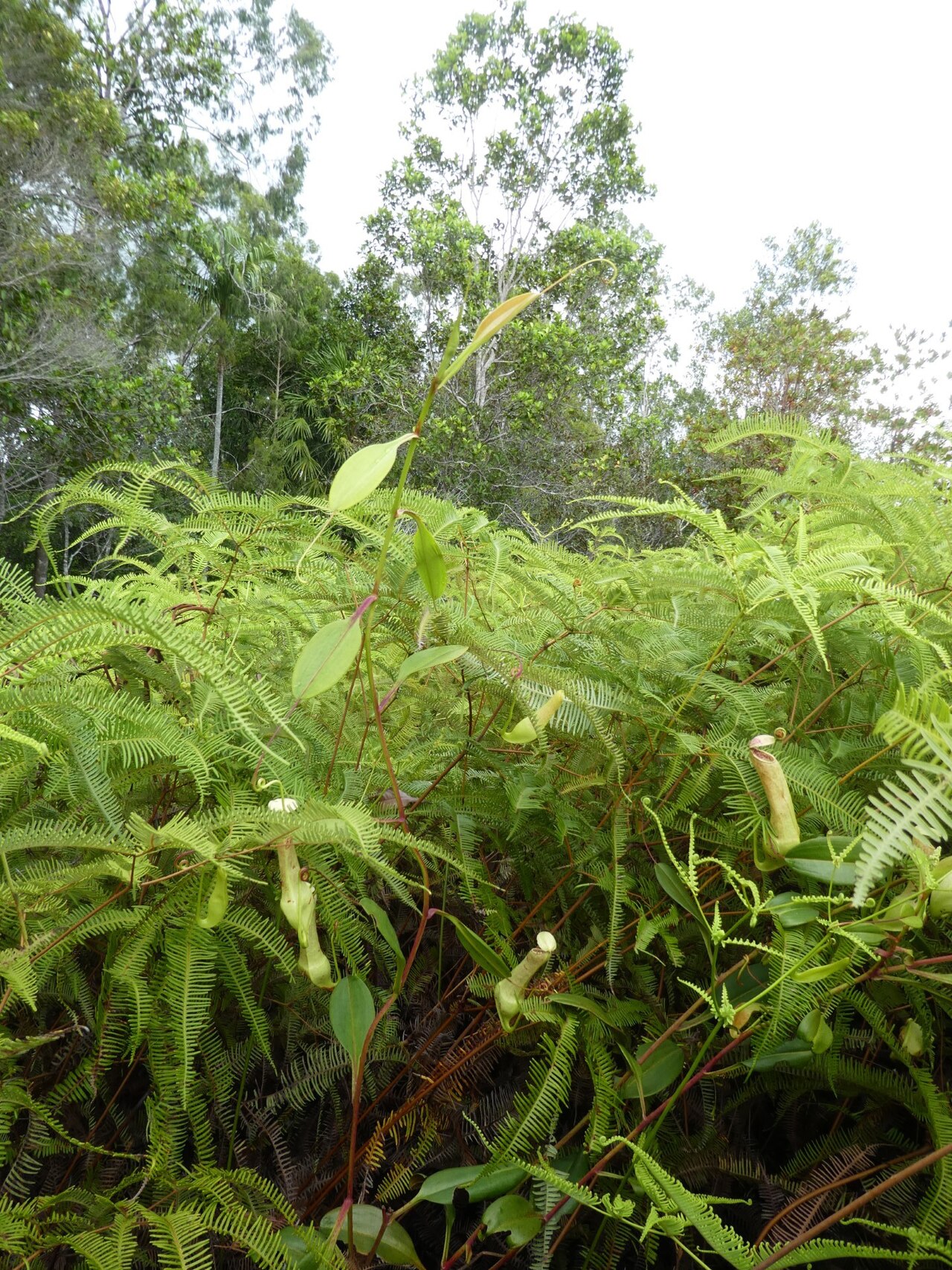
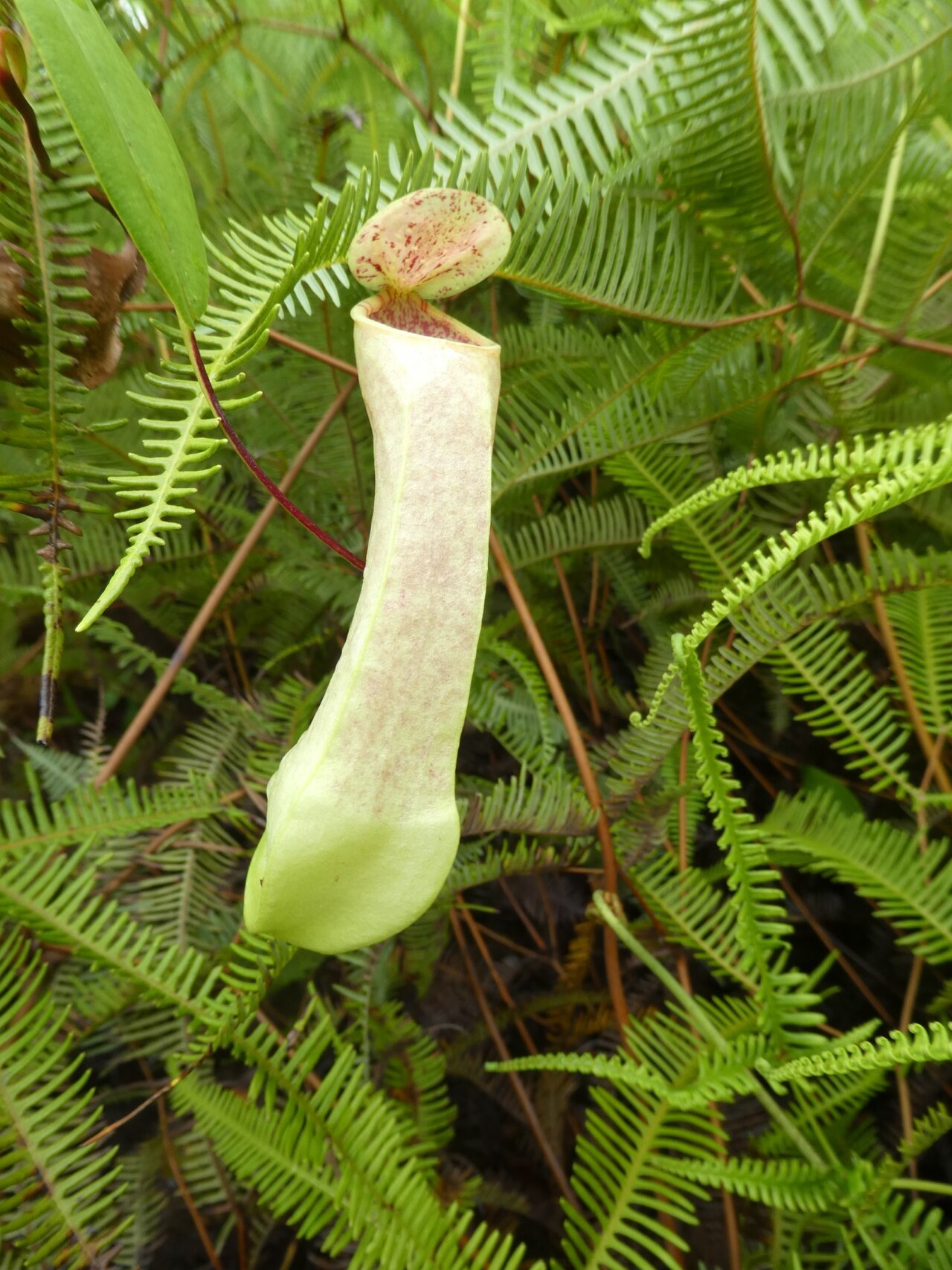
A low shrub or modest climber, from thirty centimetres to at most four metres tall, with terete stems no more than a centimetre thick. What strikes first is the colour: the whole plant is yellowish, leaves, tendrils and pitchers alike. Leaves of the climbing stem are broadly to narrowly elliptic, 6 to 11.5 cm long and 2 to 4.3 cm wide, with four to eight longitudinal nerves on each side of the midrib. The blades of the rosette leaves are remarkably small. Lower pitchers are ovoid below and become cylindrical towards the mouth, 4.5 to 10 cm tall, with two fringed wings about half a centimetre broad. The peristome is narrow and rounded, 0.5 to 2 mm, with barely visible ribs. Upper pitchers are slimmer, 9 to 13.5 cm tall, without fringes but with two distinct ridges down the front, and a slightly wider peristome of 1 to 3 mm.
Similar species
The main source of confusion lies on another island. Plants from Halmahera were long included in this species, or treated as an aberrant form of it; in 2015 Cheek described them as a separate species, Nepenthes halmahera. Anyone reading older literature in which Nepenthes danseri also occurs on Halmahera is therefore reading about that species. On Waigeo itself, the combination of an entirely yellowish plant, small pitchers with a very narrow, almost smooth peristome, and growth on bare ultramafic ground is characteristic. Other species in the wider region, such as Nepenthes mirabilis, have a broader, clearly ribbed peristome and larger, coloured pitchers.
The trap and how it works
A pitfall trap of the usual kind, but small and with an unusually narrow peristome. Lower pitchers sit on or just above the ground and carry two fringed wings that can serve as a ramp for crawling animals; upper pitchers hang from the tendrils of the climbing stem and have only two ridges. The peristome, the ribbed collar around the mouth, is in this species only half a millimetre to three millimetres wide and barely ribbed; how much this affects capture has not been studied. Nectar glands beneath the lid draw insects to the rim, and at the bottom stands fluid in which the prey is digested. Nothing was found in the literature on the prey composition of this species. It is known, however, that plants in forest often form no pitchers at all: the plant makes its traps only in full light.
Habitat and ecology
Open scrub and bare soils on ultramafic rock, from sea level to about 300 m (R3, B5). Ultramafic soils, weathered from serpentinite and related rocks, are poor in the main nutrients and rich in heavy metals such as nickel and chromium; trees grow slowly there, and the landscape consequently stays open. That is exactly where this species grows. In closed forest the plant can survive, but it usually forms no pitchers, which suggests a high demand for light. The combination of a nutrient-poor soil and full sun makes animal prey an important source of nitrogen and phosphorus for the plant.
Distribution and elevation
On current understanding endemic to the island of Waigeo, one of the Raja Ampat islands off the western tip of New Guinea, and known there from the north coast. Our own species list also names Halmahera, as did the 2001 Flora Malesiana treatment, but since the description of Nepenthes halmahera in 2015 the plants of that island are referred to that species. Waigeo lies biogeographically on the edge of New Guinea, and the island's ultramafic rocks harbour other plants of restricted range as well. The species is known from sea level to about 300 m.
- Recorded (one-degree cells)
Forms and variation
No varieties or forms have been described, and no natural hybrids are known. The latter is not surprising: few other species of the genus occur on Waigeo with which it could cross, and the open ultramafic ground where this species grows is not the habitat of the widespread lowland species. The variation seen in the field is mainly that between lower and upper pitchers and between plants in sun and in shade: shaded plants are laxer, greener and often without pitchers.
Where and when to see it
Waigeo is reached from Sorong, and the island is best known for its coral reefs and birds of paradise; its interior is far less visited. Look for open, low scrub on red or brown, bare-looking soil: that is where the chance of finding this species is highest. Look low to the ground for the small yellowish lower pitchers, easily overlooked among grass and shrubs, and for the somewhat larger upper pitchers in the scrub. In the forest itself the plant is hard to recognise, as it often bears no pitchers there. The area is remote; travel with a local guide and respect local arrangements on access to land.
Conservation status
Listed on the Red List as Vulnerable, based on an older assessment (version 2.3 of the criteria). The reason is the small range: one island, with known sites along the north coast. Ultramafic areas across the region attract nickel mining, and on Waigeo too there has been prospecting for minerals; deforestation and road building are further possible threats. As a member of Nepenthes the species is listed in CITES Appendix II, so international trade in wild plants requires a permit. A new assessment, taking into account the separation of the Halmahera plants, would probably sharpen the picture.
Scientific name
Nepenthes danseri | Jebb & Cheek, 1997
Nepenthes danseri was described in 1997 by Matthew Jebb and Martin Cheek in their revision "A skeletal revision of Nepenthes (Nepenthaceae)" (Blumea), although according to the Carnivorous Plant Mailing List the name had already been in informal use since at least 1994. Known only from the northern coast of Waigeo Island (Indonesia); plants historically attributed to this species on Halmahera (Maluku Islands) are now classified as a distinct species, N. halmahera. The specific epithet honours the botanist Benedictus Hubertus Danser, who published the major monograph on the Nepenthaceae of the Netherlands Indies in 1928 (see also N. clipeata, also described by him).
World Checklist of Vascular Plants (WCVP), via Plants of the World Online (POWO), Royal Botanic Gardens, Kew.