All species › Caryophyllales › Tropical pitcher plant family › Nepenthes chaniana
Nepenthes chaniana
A mountain species of northern Borneo that passed through the literature under the wrong name for nearly eighty years. What field guides and nurseries called Nepenthes pilosa proved, on closer study, to be largely a different and still undescribed plant. In 2006 Charles Clarke, Ch'ien Lee and Stewart McPherson gave it a name of its own, Nepenthes chaniana, after the Malaysian publisher Chan Chew Lun, who has published much on the natural history of Borneo. The most striking thing about the plant is its coat: stem, leaves and pitchers are covered in long, soft, white to golden hairs.
Identification
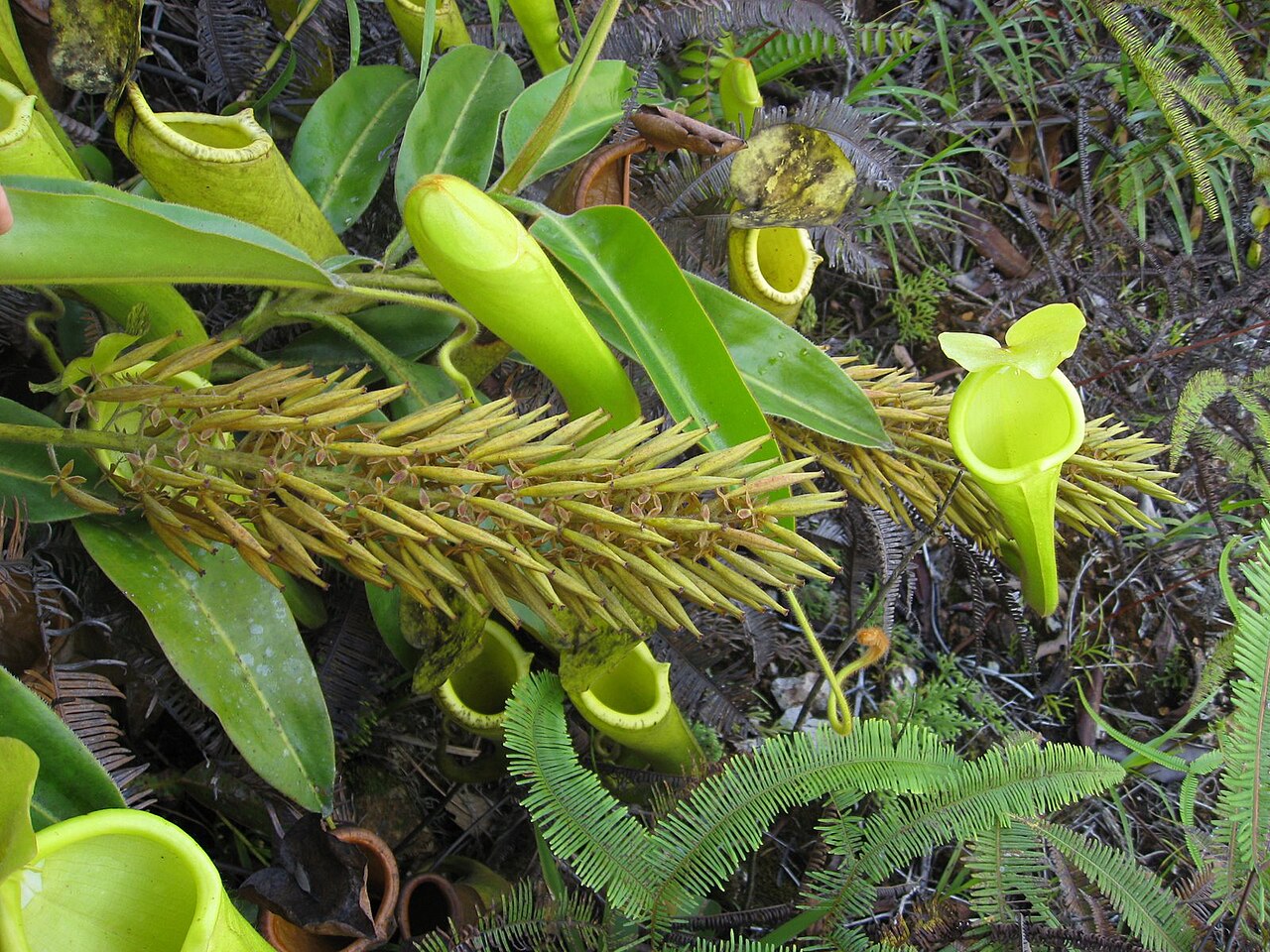
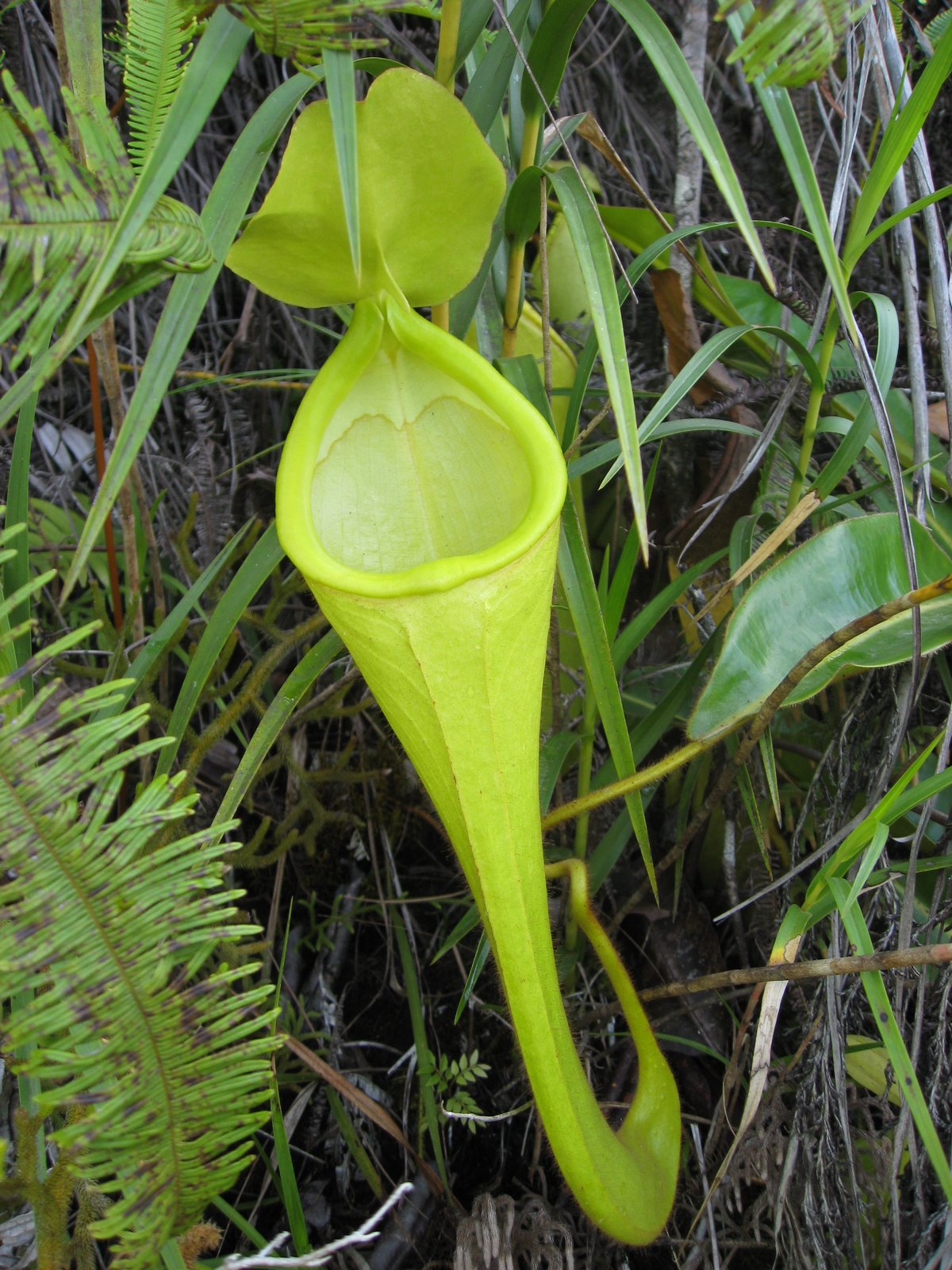
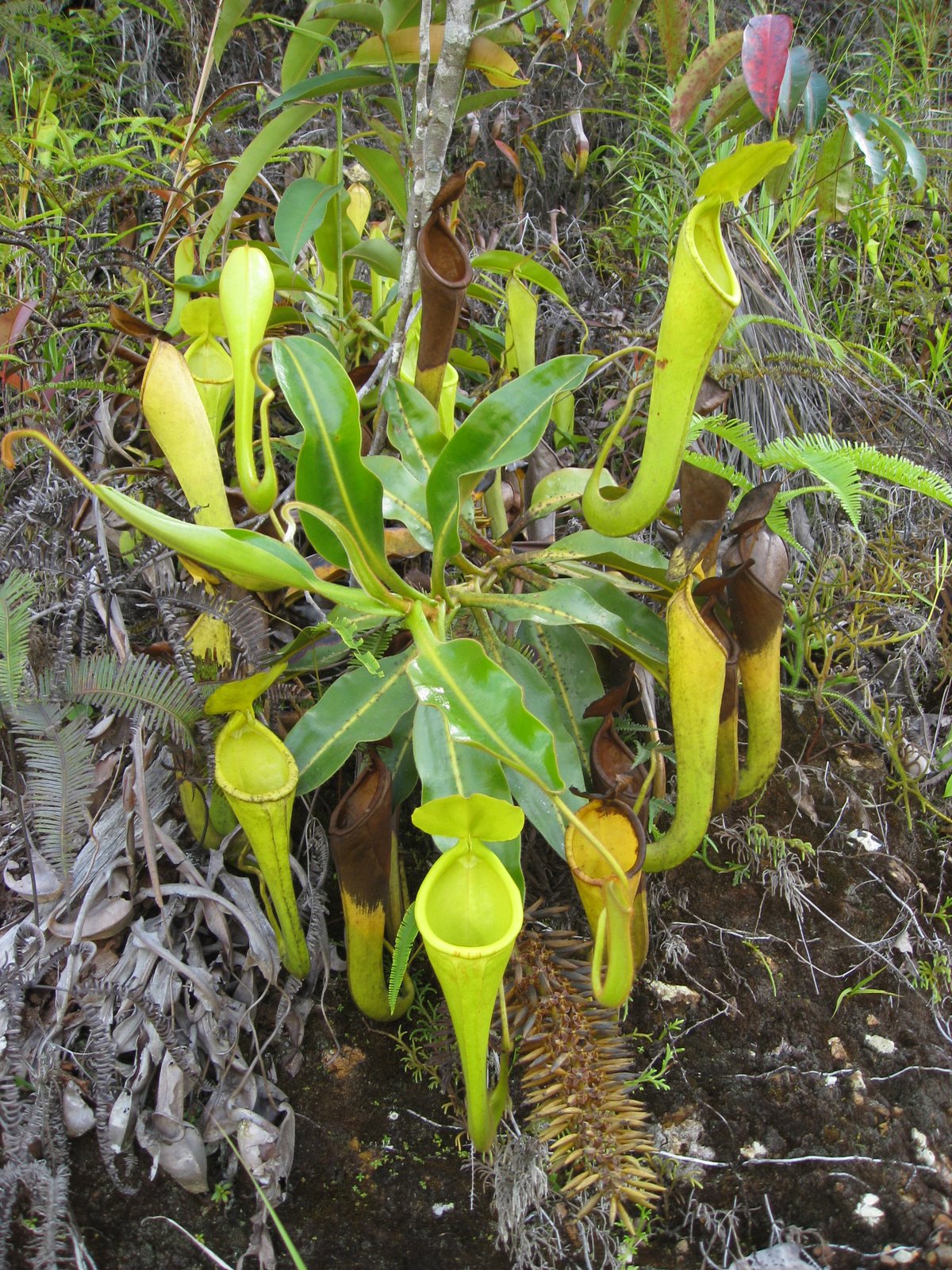
A climber with a stem to eight metres long. The leaves are oblong to elliptic, to 30 cm long and 10 cm wide, with a winged or grooved petiole. The whole above-ground body of the plant, pitchers included, is densely hairy: the hairs reach 7 mm and are white, yellow or golden, so that young shoots look almost woolly. The lower pitchers are small, to 15 cm tall and usually less, funnel-shaped to cylindrical below, with two wings to 8 mm wide down the front and a narrow, cylindrical peristome of at most 4 mm. The upper pitchers are much larger, to 30 cm tall and 7 cm wide, long and narrow, laterally compressed below, with a wider peristome to 1 cm. Both pitcher types carry a hook-shaped appendage on the underside of the lid, up to 1.5 cm long in the upper pitchers. The pitchers are usually white to yellowish.
Similar species
Its closest relative, and the species it was confused with for decades, is Nepenthes pilosa of East Kalimantan. Both are densely hairy and have a hooked appendage under the lid. The difference lies mainly in the pitchers: those of N. pilosa are rounder, broader and squatter, those of N. chaniana longer, narrower and laterally compressed. Nepenthes burbidgeae of Kinabalu also has such a hooked lid appendage, but lacks the dense white indumentum and has short, funnel-shaped upper pitchers. The plant is placed in the so-called N. maxima complex, a group of related species ranging from Borneo to New Guinea.
The trap and how it works
As throughout the genus, the pitcher is a pitfall: a modified part of the leaf holding digestive fluid at the bottom. The peristome, the ribbed rim around the mouth, bears nectar glands and becomes slippery when a film of moisture lies on it; insects looking for nectar there slide into the pitcher. The underside of the lid carries nectar glands as well. The lower pitchers, standing on the ground or in moss, have wings that serve as a walkway for crawling animals; the upper pitchers hang free on their tendrils and take more flying insects. What the dense hairs on the outside mean for capture has not been studied. No dedicated study of this species' prey was found for this guide.
Habitat and ecology
Humid, mossy mountain ridges and summits, where the plant grows on the ground or climbs as an epiphyte up trunks and branches (B1). This is cloud forest: nearly always in the clouds, with abundant moss, low trees and an acid, nutrient-poor litter layer. The species occurs between about 1100 and 1800 m. Light on such ridges varies: in openings and along the forest edge the plants stand in more sun and stay compact, while in denser forest they climb higher into the trees.
Distribution and elevation
Endemic to Borneo, where it is known from the mountains of Sabah and northern Sarawak; whether it also occurs in Kalimantan is uncertain. Here the guide departs from its own species list, which gives 'Borneo (Kalimantan)': the describing authors and later overviews place the known populations in Malaysian Borneo and mention Kalimantan at most with a question mark. The confusion is understandable, since its closest relative, N. pilosa, does come from Kalimantan. Because the species is endangered, this guide gives no more precise localities.
- Recorded (one-degree cells)
Forms and variation
No varieties or wild colour forms have been described. The hairs range from white through yellow to golden, and the pitchers from almost plain white or cream to yellowish; such differences appear to be individual variation. Natural hybrids have been reported with Nepenthes veitchii, and possibly with Nepenthes albomarginata; such crosses are intermediate in shape and often less densely hairy.
Where and when to see it
To see this species in the wild you must reach the cloud-forest ridges of the mountains of northern Borneo and expect steep, muddy trails. Look in the moss on the ground for the small lower pitchers and in the trees for the long, pale upper pitchers, which stand out in the half-light of the cloud forest because of their white hairs. As the species is endangered and sought after in trade, it is wise not to share localities and never to take anything. The drier season, roughly March to September, makes the trails most passable.
Conservation status
The IUCN Red List assesses the species as Endangered. Its range is small and fragmented across a limited number of summits, and it is sought after by collectors; cloud-forest ridges are also sensitive to disturbance and to climate change, which may shift the cloud line. Some of the known populations lie in protected areas. As a member of Nepenthes it is listed in CITES Appendix II, so international trade requires a permit.
Scientific name
Nepenthes chaniana | Clarke, Lee & McPherson, 2006
Nepenthes chaniana was described in 2006 by Charles Clarke, Ch'ien C. Lee and Stewart McPherson, in "Nepenthes chaniana (Nepenthaceae), a new species from north-western Borneo" (Sabah Parks Nature Journal 7: 53-66). Mount Alab, the highest peak in Crocker Range National Park, Sabah, north-western Borneo. The specific epithet honours Datuk Chan Chew Lun, Managing Director of Natural History Publications (Borneo), in recognition of his contributions to natural history publishing in the region.
World Checklist of Vascular Plants (WCVP), via Plants of the World Online (POWO), Royal Botanic Gardens, Kew.