All species › Caryophyllales › Tropical pitcher plant family › Nepenthes chang
Nepenthes chang
Named after Ko Chang, the 'elephant island' in the Gulf of Thailand, where the type plant was collected. Nepenthes chang was described in 2010 by Marcello Catalano, but here too the plant had been known far longer: the Irish physician and botanist Arthur Kerr, founder of the modern Thai flora, collected it as early as 1929. It grows in the far east of Thailand, in Trat Province, in open, steep forest on hills and mountains between 300 and 600 m. It belongs to the thorelii group and is, alongside Nepenthes kampotiana, the pitcher plant of the Cambodian border region.
Identification
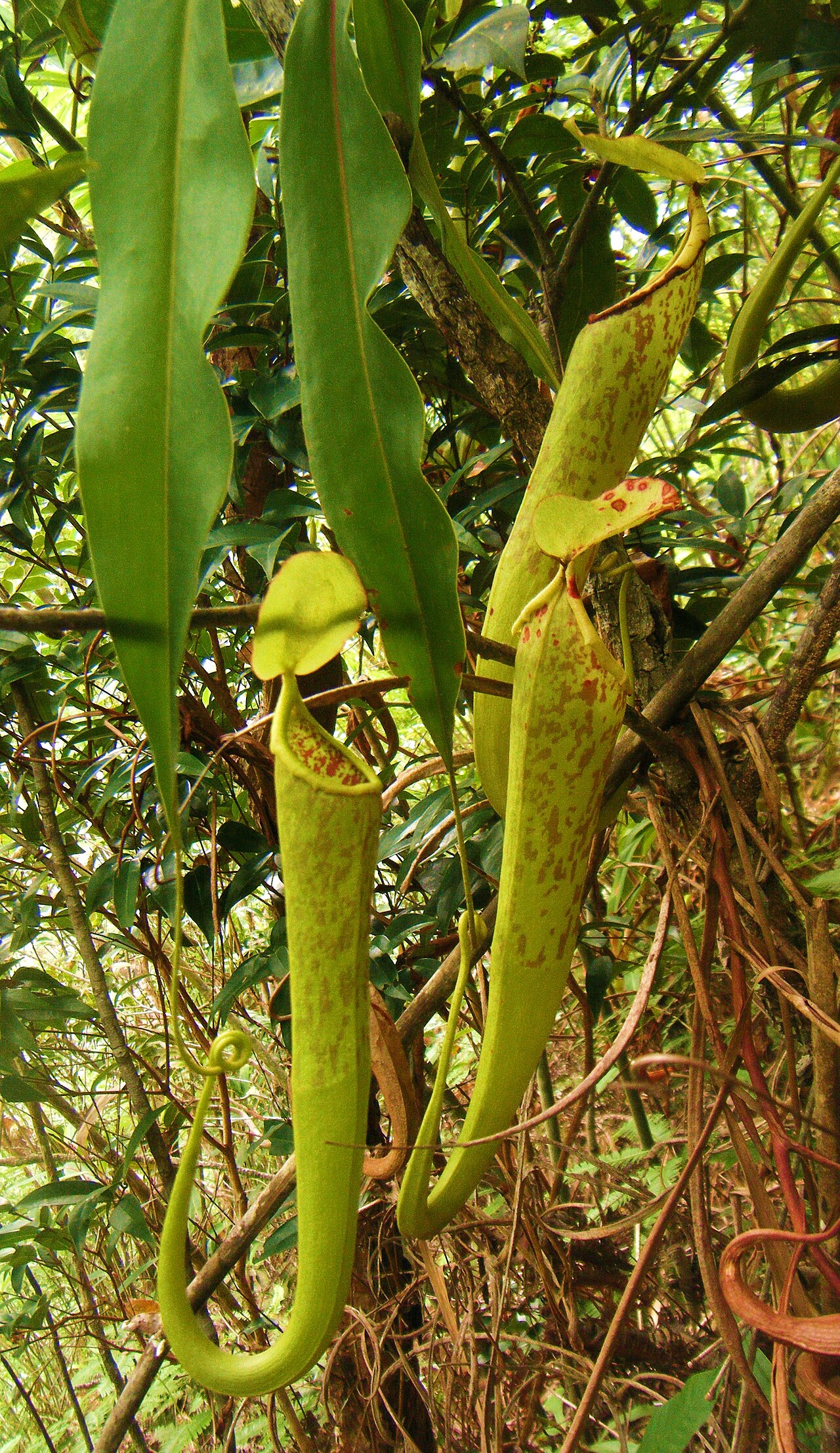
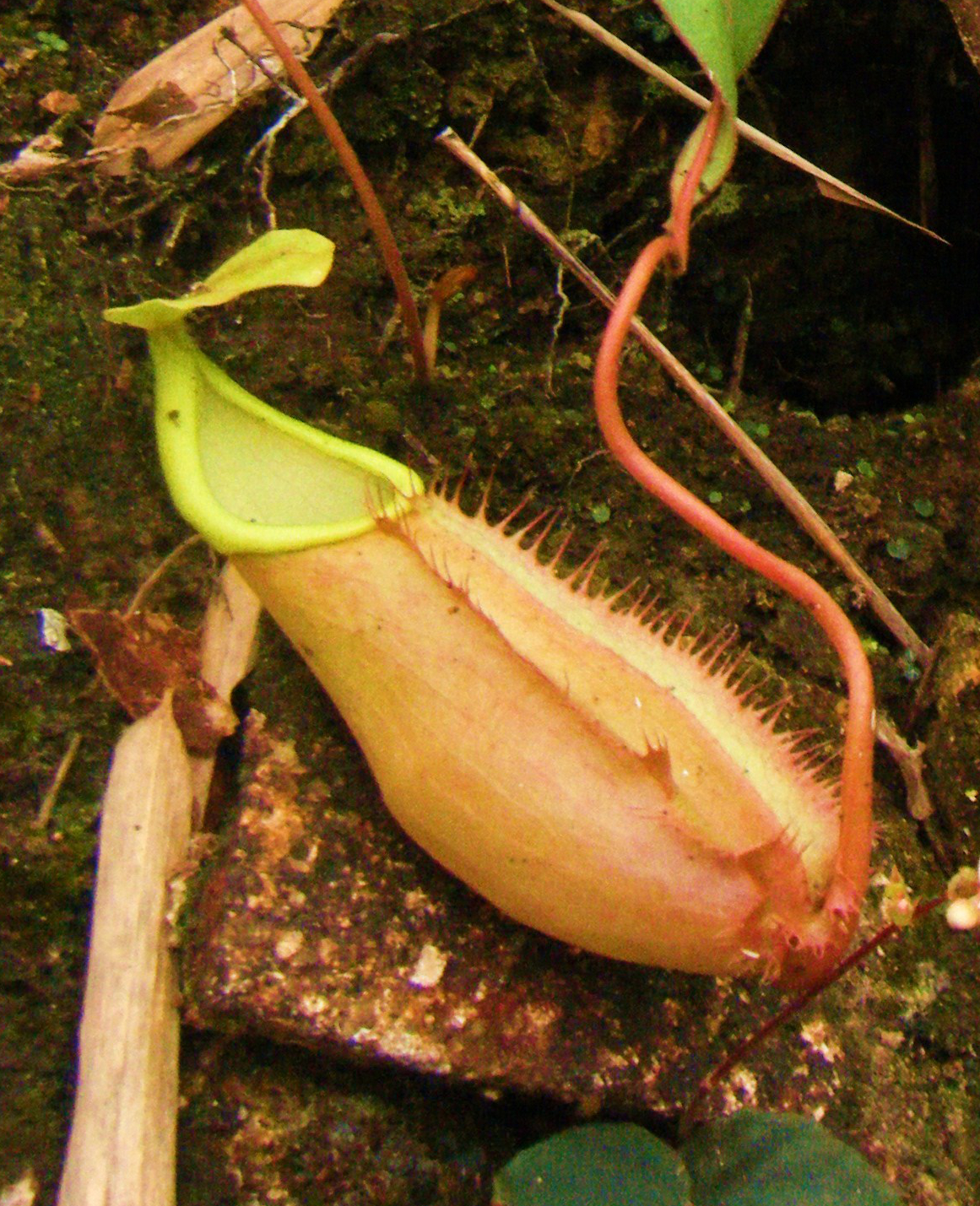
A climber to five metres, with stems four to six millimetres thick. The whole plant, except the upper surface of the leaf, is covered with white or golden hairs a tenth to half a millimetre long. The leaves are lanceolate, 20 to 35 cm long and 3.5 to 5 cm wide, and strikingly thin for a species of this group: about 0.2 mm. Older leaves are dark green, young leaves reddish, orange or yellowish. Lower pitchers are ovate, or ovate only in the lower third, 7 to 12 cm tall, with a cylindrical peristome two to five millimetres wide bearing fine teeth. Upper pitchers are much larger than the lower ones: tubular, up to 25 cm tall but only 3 cm wide, light green, with a green peristome whose outer margin is often slightly lobed. The colour of the lower pitchers ranges from green to orange or pink with red stripes.
Similar species
The closest relative is Nepenthes kampotiana, which grows in the same border region. According to Catalano, chang differs by two-flowered partial peduncles in the male inflorescence (one-flowered in kampotiana), a hairy staminal column, thinner leaves (0.2 against 0.5 mm), different leaf colour, its hairs, the shape of the lower pitchers and the tubular upper pitchers. From Nepenthes holdenii, just across the border in Cambodia, it differs by its hairs and its tubular rather than funnel-shaped upper pitchers. The common Nepenthes mirabilis has stalked, papery leaves.
The trap and how it works
A pitfall trap in which the upper pitchers do most of the work. The ovate lower pitchers stay small, to 12 cm, and stand on the ground; the long, slender upper pitchers hang up to 25 cm long from the tendrils in the open forest and catch mainly flying and climbing insects. The narrow peristome carries fine teeth, and nectar glands under the lid lure prey to the mouth. The dense hairiness of the plant is unusual within the group; whether it has any function in capture has not been studied. No specific prey study was found for this species.
Habitat and ecology
Peaty soil in open, steep forest, from 300 to 600 m (B5). Unlike many relatives it is therefore not a savanna plant in the strict sense, but a species of light, open forest on slopes where enough light reaches the ground. Kerr's early collection was made at about 600 m, the type collection at about 300 m on Ko Chang. The climate of Trat is markedly monsoonal, with a long and very wet rainy season and a shorter dry season. The light, open forests in which the species grows are therefore strongly affected by drought for part of the year, and like other members of the thorelii group the plant has an underground rootstock that carries it through such periods.
Distribution and elevation
Endemic to Thailand, in Trat Province, known from two sites: the island of Ko Chang and the mountain Khao Kuap on the mainland. The range may extend into the Cardamom Mountains on the Cambodian side of the border, but this is unconfirmed. Our own list names Thailand, which is correct; the narrowing to Trat comes from the literature. The Cardamom Mountains and their outliers form a large, largely forested upland straddling the border between Thailand and Cambodia; Nepenthes holdenii grows on the Cambodian side, so it is no surprise that botanists also look for this species there.
- Native
Forms and variation
No varieties are recognised and no natural hybrids are known. Colour varies: young leaves are tinged red, orange or yellow, lower pitchers green to orange or pink with red stripes, upper pitchers light green. The thin leaves are a good character for separating the species from its relatives in the hand.
Where and when to see it
Ko Chang is a popular holiday island with a large national park; its interior is mountainous and forested. With a guide, search open, steep slopes above 300 m for long, slender light-green pitchers hanging in the shrubs, and for hairy stems with thin lanceolate leaves. The rainy season on the eastern shore of the Gulf is long and wet, from May to October; at its end the plants are at their best.
Conservation status
The species has not (yet) been assessed for the Red List. The known range is small, but Ko Chang lies largely within a national park. Tourism development on the island and deforestation on the mainland are possible threats. As a member of Nepenthes it is listed in CITES Appendix II, so international trade in wild plants requires a permit.
Scientific name
Nepenthes chang | Catalano, 2010
Nepenthes chang was described in 2010 by Marcello Catalano, in his book Nepenthes della Thailandia: Diario di viaggio; the description was reviewed by Alastair Robinson, with a Latin translation by Andreas Fleischmann. The holotype (Catalano 013394) was collected by Catalano himself in 2009 on Ko Chang island, at about 300 m elevation, and is held at the Chulalongkorn University Herbarium (BCU). Ko Chang island, Thailand, at approximately 300 m elevation. The specific epithet refers to the Thai island of Ko Chang, where the type specimen was collected.
World Checklist of Vascular Plants (WCVP), via Plants of the World Online (POWO), Royal Botanic Gardens, Kew.