All species › Caryophyllales › Tropical pitcher plant family › Nepenthes argentii
Nepenthes argentii
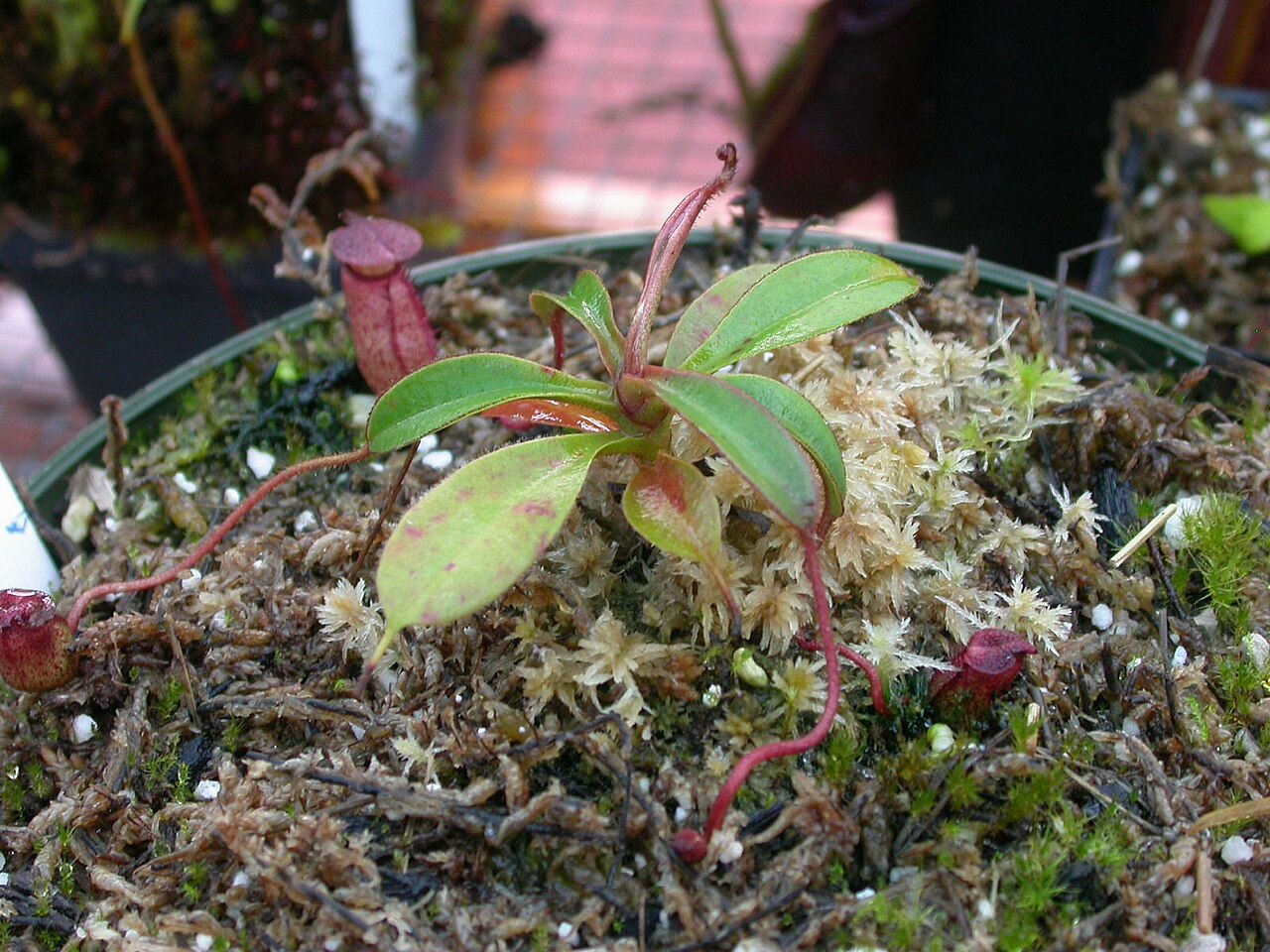
Possibly the smallest pitcher plant in the world. Nepenthes argentii grows no taller than about thirty centimetres, never climbs, and makes only pitchers four to five centimetres tall that lie on the ground among grass and sedge. It was collected in August 1989 on the ridge of Mount Guiting-Guiting on Sibuyan by George Argent of the Royal Botanic Garden Edinburgh and the Filipino botanist Reynoso, and described in 1997 by Matthew Jebb and Martin Cheek in their revision of the genus. Argent is known for his fieldwork in Borneo, the Philippines and New Guinea and his work on bananas and rhododendrons.
Identification
An erect, non-climbing shrublet of around thirty centimetres. Most of the stem, two to four millimetres thick, some 22 cm of it, is buried in the litter, and only a few centimetres rise above, densely set with leaves, about four per centimetre. The leaves are thickly leathery, small and obovate to oblanceolate, 3.5 to 4 cm long, with an obtuse to truncate tip and a short petiole clasping half the stem. The leaf underside and tendril are densely covered in red hairs about two millimetres long. The only pitchers are lower pitchers: funnel-shaped to shortly cylindrical, 4 to 4.7 cm tall, buff mottled red, with two fringed wings whose fringe elements are often webbed together in groups of two to four. The peristome is dark purple, about a millimetre wide, with high, laterally flattened ribs and stout incurved teeth up to a millimetre long near the column. The lid is almost circular, about one and a half centimetres, spotted red. The outside of the pitcher is covered in a felty layer of stellate and twisted hairs.
Similar species
On Sibuyan there is nothing to confuse it with: Nepenthes sibuyanensis, which grows on the same ridges, has pitchers twenty centimetres tall, and Nepenthes graciliflora and Nepenthes armin are slender climbers from lower on the mountain. The species the authors compared it with is Nepenthes bellii of Mindanao and its offshore islands, which also has rotund lower pitchers and rarely makes upper pitchers, but is a climber with different leaves. Unique in the genus is that the peristome of Nepenthes argentii is fused to the underside of the lid.
The trap and how it works
A pitfall that literally sits in the ground. The pitchers lie hidden in the substrate among grasses and sedges, under the closed layer of wind-shorn shrubs, and catch whatever walks over the soil there. The narrow peristome with high ribs and stout inner teeth, and the lid with very dense, pit-like nectar glands, elliptic in the centre and round at the edge, make it a compact but fully equipped trap. Upper pitchers apparently are not formed, so the plant does not catch flying prey the way climbing species do with their aerial pitchers. What exactly is caught has not been published.
Habitat and ecology
Subalpine scrub with a smooth, wind-clipped canopy about thirty centimetres high, on a ridge of ultramafic rock (R3, R5). The plant stays completely hidden beneath that layer of shrubs. A remarkable adaptation is the long, vertical underground stem: the authors suggest that the stem grows slowly upwards, keeping pace with the build-up of organic matter at the surface, which buries the lower part ever deeper, as the round-leaved sundew does in growing sphagnum.
Distribution and elevation
Endemic to Sibuyan, in Romblon province, on the Mount Guiting-Guiting massif. The type collection comes from 1400 m; later field observations report the species up to about 1900 m, and between about 1600 and 1770 m it grows together with Nepenthes sibuyanensis. The label in our species list is correct.
- Recorded (one-degree cells)
Forms and variation
No forms or varieties have been described. The species is small and inconspicuous and, as far as is known, not very variable in the field either. No natural hybrids have been established, but a cross with Nepenthes sibuyanensis, which grows on the same slopes, is mentioned in the literature as a possibility.
Where and when to see it
Search not for pitchers but for inflorescences: observers noted that the plants are completely hidden under the low scrub and can only be found because the flowering stems rise above the canopy of the shrubs. The pitchers then lie below, among grass and sedge. Mount Guiting-Guiting is a protected natural park and a hard, multi-day climb; go with a permit and a guide, and stay on the path, because the ridge-top scrub is fragile.
Conservation status
The Red List assesses the species as Vulnerable, because it is confined to a single mountain massif. The massif lies within Mount Guiting-Guiting Natural Park, but logging and mining proposals on Sibuyan are named as threats to the park. The high-altitude scrub where this species grows is, through its remoteness, the best-protected zone of the mountain. Like all Nepenthes it is listed in CITES Appendix II.
Scientific name
Nepenthes argentii | Jebb & Cheek, 1997
Nepenthes argentii was described in 1997 by Matthew Jebb and Martin Cheek, in their revision "A skeletal revision of Nepenthes (Nepenthaceae)" (Blumea 42(1): 1-106). The species occurs on Mount Guiting-Guiting on Sibuyan Island, Philippines, in subalpine shrubbery on an ultrabasic ridge between 1,400 and 1,900 m. The specific epithet honours the British botanist George Argent.
World Checklist of Vascular Plants (WCVP), via Plants of the World Online (POWO), Royal Botanic Gardens, Kew.