All species › Caryophyllales › Tropical pitcher plant family › Nepenthes angasanensis
Nepenthes angasanensis
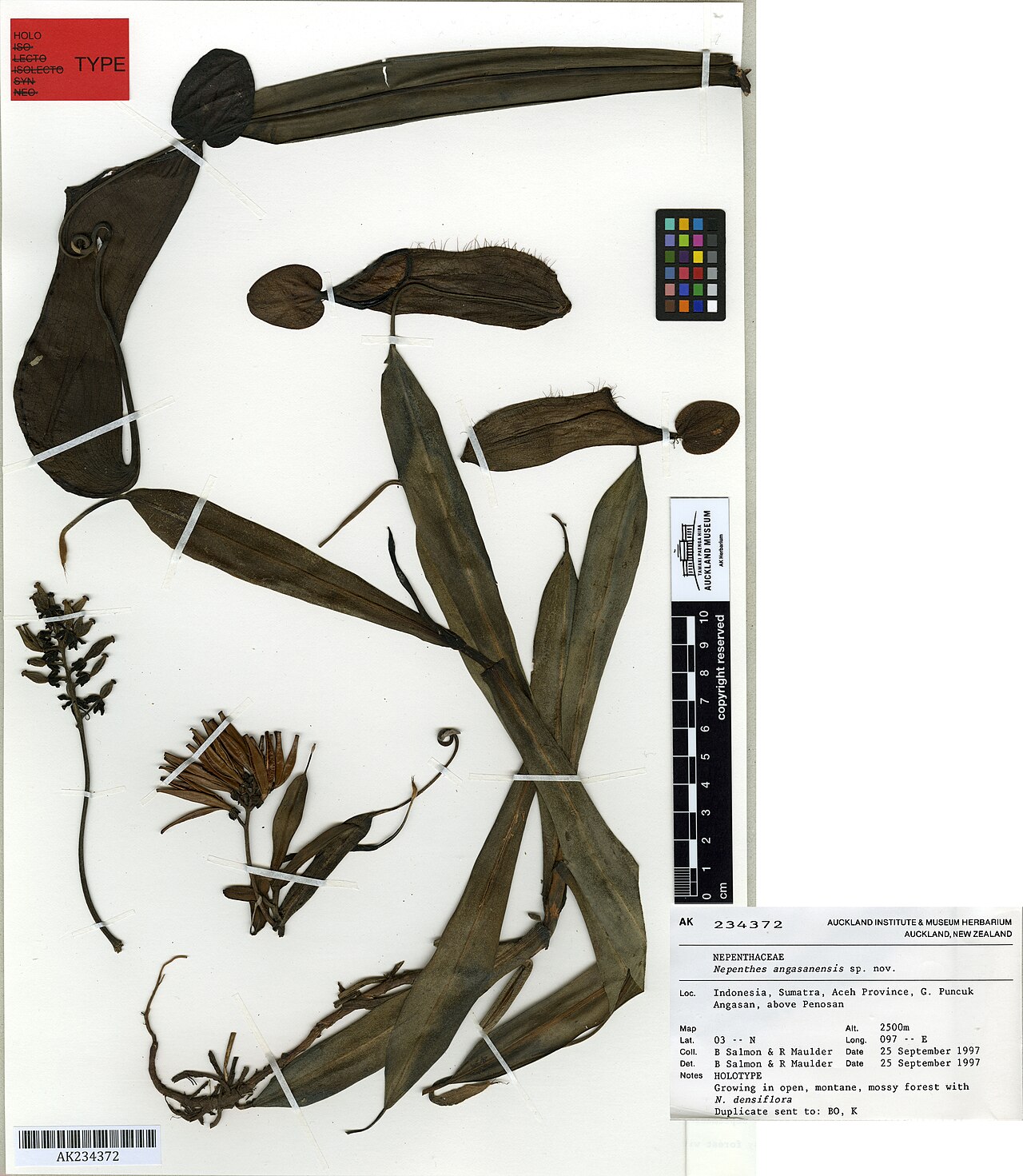
A species on which the specialists disagree. Nepenthes angasanensis was described in 1999 by Maulder, Schubert, Salmon and Quinn, in Carnivorous Plant Newsletter, from plants on Puncak Angasan in Aceh province, after which it is named. It is so close to N. mikei and N. tobaica that Cheek & Jebb did not include it as a separate species in their Flora Malesiana treatment (2001), whereas Clarke (2001) and later Indonesian researchers do recognise it. The world checklist, which this guide follows, accepts the name.
Identification
A small, slender climber in the N. mikei alliance, with narrow leaves and small, narrow pitchers. The clearest difference from its relatives lies not in the pitchers but underground: N. angasanensis forms underground runners, so that a plant can spread over the ground as a loose group of stems, which does not happen in N. mikei or N. tobaica. It further has a forked spur under the lid, fine teeth of 1.5 to 2 mm on the inner edge of the peristome, and a very dense covering of digestive glands in the pitcher, around 300 per square centimetre. The female inflorescence is short, 5.5 to 12.5 cm, with 9 to 17 flowers on one-flowered pedicels without bracteoles. No verifiable source was found for this guide for the dimensions of stem, leaf and pitchers; those fields are left empty.
Similar species
Nepenthes mikei is the closest relative; in Clarke's (2001) cladistic analysis the two form a sister pair with 79 per cent support. N. mikei has shorter peristome teeth, fewer digestive glands (150 to 180 per square centimetre), carries bracteoles on the pedicels and always grows on the ground, on open, exposed ridges. N. tobaica is paler, has broader leaves and a longer inflorescence with two-flowered pedicels, and forms no runners. Because N. angasanensis combines features of N. densiflora and N. tobaica, it has been suggested that it could be a hybrid of those two.
The trap and how it works
A narrow pitcher trap as in N. mikei: nectar glands on the peristome and under the lid attract insects, the rim turns slippery when wet, and prey sinks into the fluid at the bottom. The exceptionally high density of glands in the inner wall points to rapid uptake of nutrients from the catch. Lower pitchers stand in moss, often on the runners, and mainly catch walking animals; pitchers formed higher on the stem also catch flying insects.
Habitat and ecology
Montane cloud forest and open vegetation on the highest parts of the range (B1, R5), over a wide altitudinal zone of about 1400 to 3100 m. Unlike N. mikei, which is tied to open, sunny ridges, N. angasanensis also grows in shady forest, both on the ground and epiphytically on mossy trunks. Thanks to its underground runners it can spread through the moss layer and litter.
Distribution and elevation
Endemic to Sumatra, in the province of Aceh in the north of the island. The type locality is Puncak Angasan; because the species is confused with N. mikei, and many mountains in Aceh are poorly explored, its exact distribution beyond the type locality is uncertain. Altitude: about 1400 to 3100 m. The world checklist gives Sumatra as its only area.
- Recorded (one-degree cells)
Forms and variation
No forms or varieties have been described. One natural hybrid is known, with N. densiflora, which grows in the same area. The greatest uncertainty is the status of the species itself: those who place N. angasanensis in N. mikei regard the differences as geographic variation within one species. The synopsis of Sumatran Nepenthes by Hernawati and colleagues (2022) recognises it as a separate species.
Where and when to see it
The northern Barisan range in Aceh is rugged and little visited, and access requires local guides and permits for the protected areas. Anyone wishing to separate N. angasanensis from N. mikei should look at the growth habit: several stems rising from the ground and connected to each other point to runners. Note the site as well: in shady forest or growing epiphytically, N. angasanensis is more likely than N. mikei. Photograph the spur under the lid and the inner edge of the peristome close up.
Conservation status
Assessed on the Red List as Least Concern: the species grows over a wide altitudinal zone in remote mountains of Aceh, partly within protected areas. As a member of the genus it is listed in CITES Appendix II. Because its status as a species is disputed, the assessment may change with a taxonomic revision.
Scientific name
Nepenthes angasanensis | Maulder, Schubert, Salmon & Quinn, 1999
Nepenthes angasanensis was described in 1999 by Ch'ien Lee, David Schubert, Bruce Salmon and Barry Quinn, following a collecting expedition in Sumatra. The type locality is Mount Puncak Angasan in Sumatra, where the species is endemic, growing at elevations between 1,400 and 3,100 m. The specific epithet refers directly to Mount Puncak Angasan, from which the type specimen was collected.
World Checklist of Vascular Plants (WCVP), via Plants of the World Online (POWO), Royal Botanic Gardens, Kew.