All species › Caryophyllales › Tropical pitcher plant family › Nepenthes albomarginata
Nepenthes albomarginata
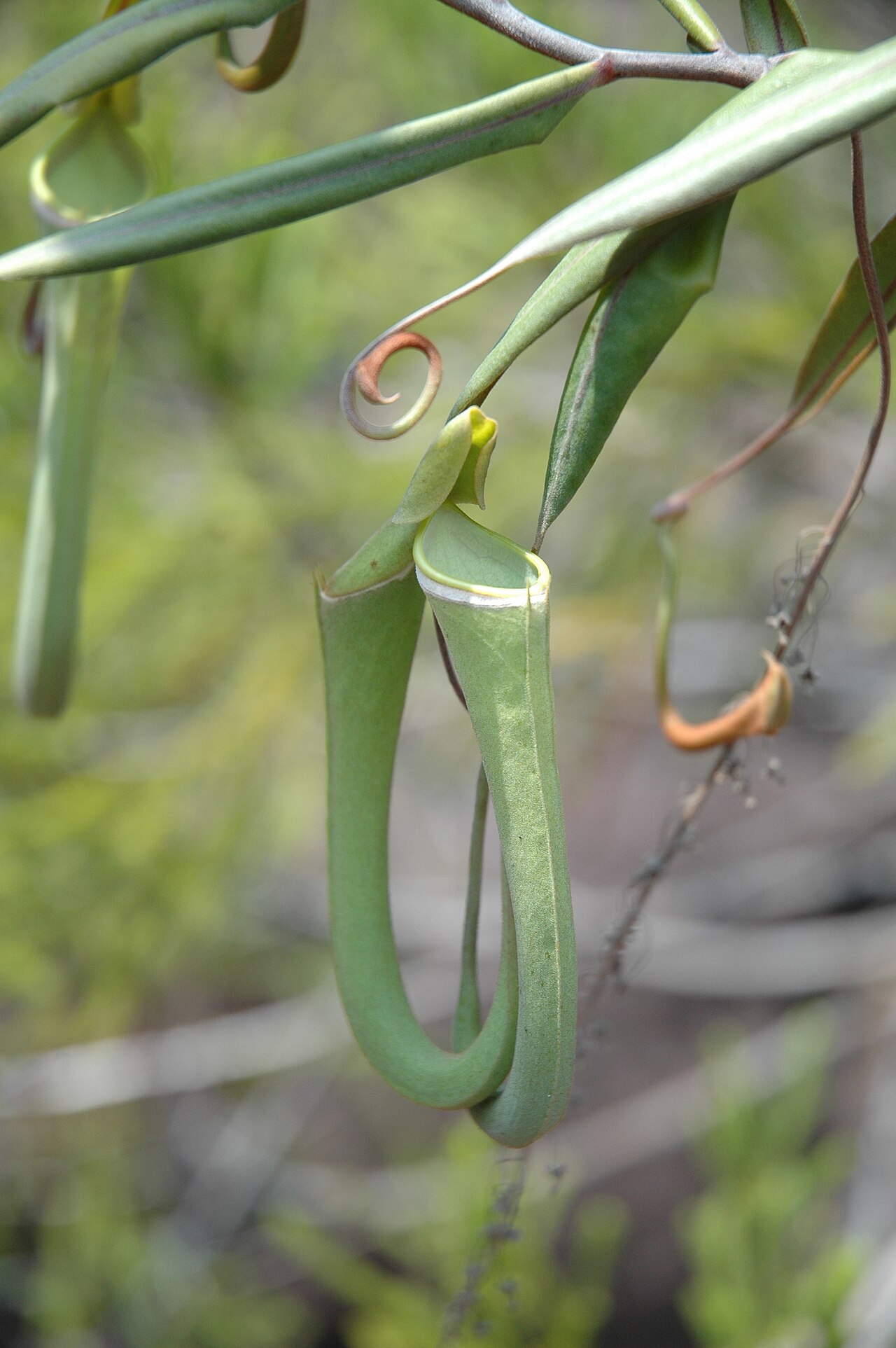
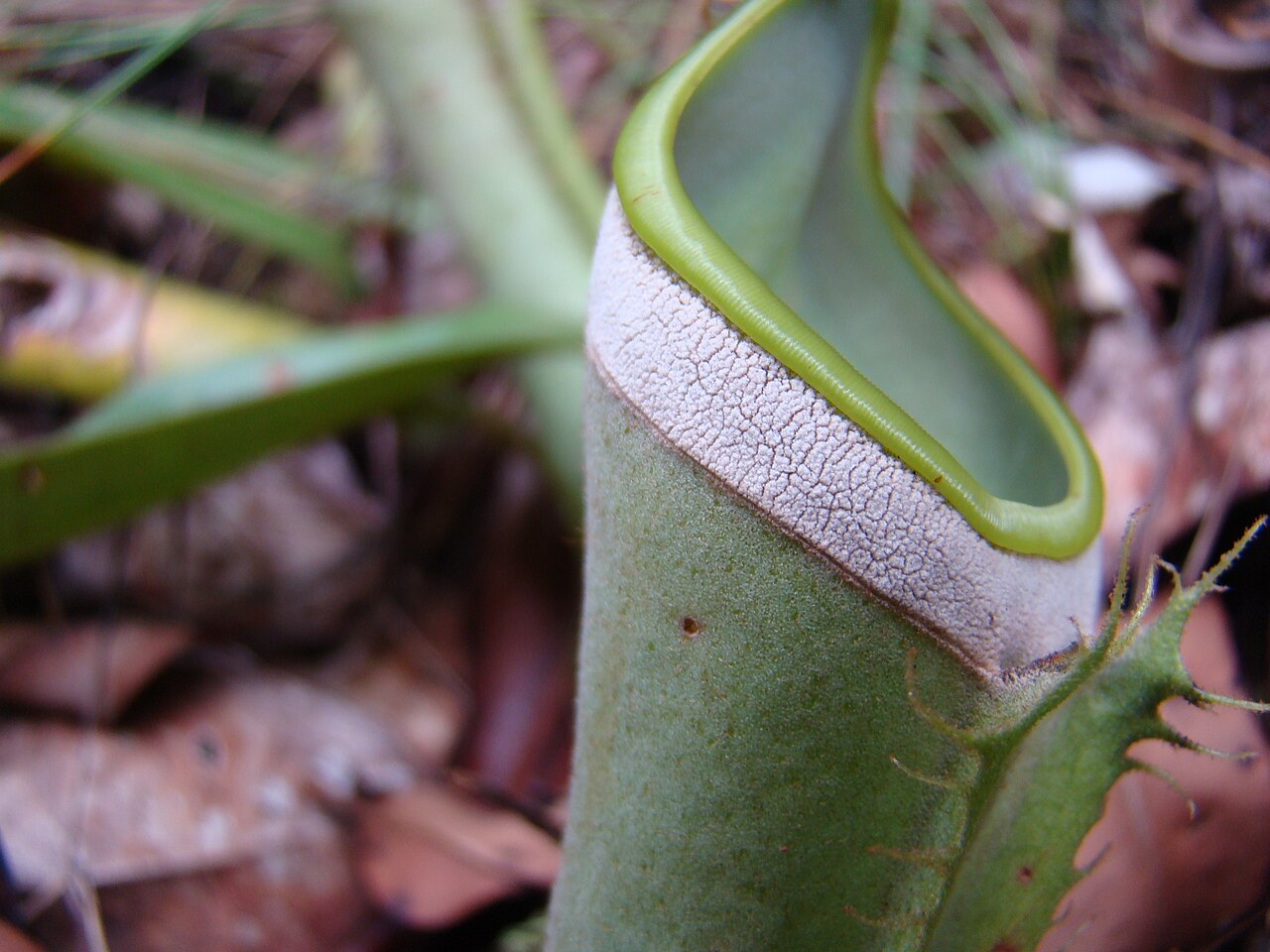
Beneath the mouth of the pitcher runs a narrow, glistening white band, as if someone had drawn a line with chalk. That band is not decoration but bait. It is made of short hairs that termites eat, which makes Nepenthes albomarginata the only plant known to offer part of its own tissue as a lure. The species catches almost nothing but termites, sometimes dozens a minute, when a foraging column passes the pitcher. That makes it one of the most specialised carnivores in the genus.
Identification
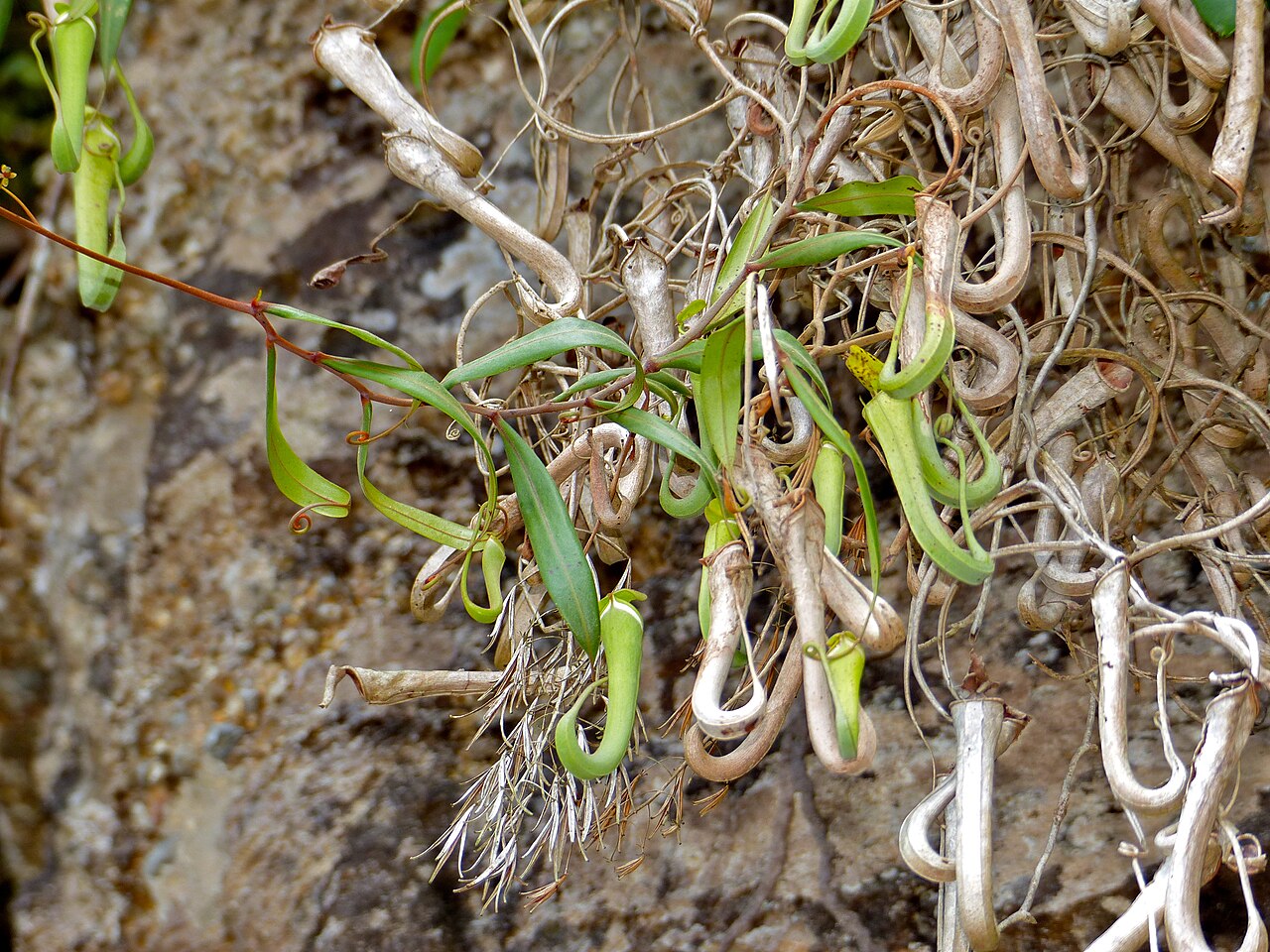
A climber to 2 m and sometimes to 10 m tall, with round stems 3 to 5 mm thick. The leaves are leathery and sessile; those at the base are 20 to 36 cm long and 2 to 3.5 cm wide, those on climbing stems smaller, 7 to 17 cm long. The whole plant is covered in short white star-shaped hairs, longer on the leaf undersides. Lower pitchers are 8.5 to 15 cm tall, bulbous below and up to 6 cm wide, cylindrical above, with two fringed wings up to 6 mm broad. Upper pitchers are cylindrical to funnel-shaped, 7.5 to 12 cm tall, with two narrow ridges instead of wings. The peristome is narrow, about 1 mm, finely and closely ribbed. The pitchers are green, red or green mottled with red, always with the glistening white band just below the mouth.
Similar species
The only character you need is the white band: no other lowland species in the region has such a dense, bright zone of hairs directly below the peristome. Nepenthes gracilis, which often grows in the same kerangas, has similarly narrow pitchers but no white band, a hair-thin peristome and triangular stems. After a big termite catch the band may have gone, because the insects have eaten the hairs; then look at the rest of the plant, which is also recognisable by its white indumentum and leathery, sessile leaves. Natural hybrids may partly inherit the white band.
The trap and how it works
A pitcher trap aimed at one kind of prey. Merbach and colleagues described in Nature in 2002 how the band of white hairs attracts termites of the genus Hospitalitermes. These termites forage in long columns on mosses, lichens and algae; when they come upon the pitcher they start grazing the hairs, and in doing so many workers and soldiers fall in — more than twenty a minute in observations. After such a visit the hairs are gone and the pitcher is full of termites. There was no sign of scent attraction over distance: contact seemed to be by chance, so a pitcher often catches nothing for a long time and then an enormous haul at once. Otherwise the trap works as usual, with a wet, slippery peristome and fluid with digestive glands at the bottom.
Habitat and ecology
Mainly kerangas: heath forest on poor, acid sandy soil in the lowlands, but also low-altitude montane forest and exposed ridge-tops, and locally on peat and limestone (B3, B5, R2). The species grows from sea level to about 1100 m. It likes light and grows along forest edges and in open, shrubby vegetation, often among Nepenthes gracilis and other lowland species. On offshore islets it also grows close to the sea.
Distribution and elevation
Sumatra, the Malay Peninsula and Borneo, with the islands of Nias and Penang; it is absent from Singapore. The range runs from sea level to about 1100 m. Thomas Lobb collected the first specimens in 1848, and John Lindley described the species a year later; the name comes from Latin albus, white, and marginatus, bordered.
- Recorded (one-degree cells)
Forms and variation
No varieties are recognised, but colour varies widely. Plants with green, red and heavily red to almost black mottled pitchers sometimes grow side by side; those colour forms are popular among growers but are not distinguished botanically. Natural hybrids are known with a long list of species, including N. ampullaria, N. gracilis, N. rafflesiana and N. reinwardtiana, the last known as Nepenthes × ferrugineomarginata. With N. northiana it forms the rare Nepenthes × cincta, found on limestone near Bau in Sarawak.
Where and when to see it
Search in kerangas in Borneo or the Malay Peninsula, or on the vegetated summits of low hills. The white band shows from a few metres away, especially on red pitchers. With luck you will find a column of termites on a pitcher; then watch the peristome to see how they graze and fall. National parks with kerangas in Borneo, such as Bako in Sarawak, are good places, and on Penang it grows on the hills. The climate is wet year round; any season will do.
Conservation status
The Red List assesses the species as Least Concern, following an assessment by Clarke in 2018. It has a large range across three islands and a wide altitudinal span, and grows in protected areas too. Kerangas is disappearing in many places through clearance, fire and sand extraction, which affects local populations. As a member of the genus it is listed in CITES Appendix II; international trade in wild plants requires a permit.
Scientific name
Nepenthes albomarginata | Lobb ex Lindley, 1849
Named by Thomas Lobb, validly published by John Lindley in 1849, in The Gardeners' Chronicle and Agricultural Gazette 1849: 580–581, based on material collected by Lobb in 1848. The type material originates from Borneo. The name derives from the Latin albus (white) and marginatus (margined) and refers to the dense band of short white trichomes this species bears directly below the peristome.
World Checklist of Vascular Plants (WCVP), via Plants of the World Online (POWO), Royal Botanic Gardens, Kew.