All species › Caryophyllales › Sundew family › Drosera uniflora
Drosera uniflora
The southernmost sundew in the New World. Drosera uniflora grows at the very tip of the continent, in the windswept, permanently wet cushion bogs of Patagonia, Tierra del Fuego and the Falkland Islands. The plant is small enough to overlook, but the single white flower that rises above the moss in the short summer gives it away. The name says it all: one flower.
Identification
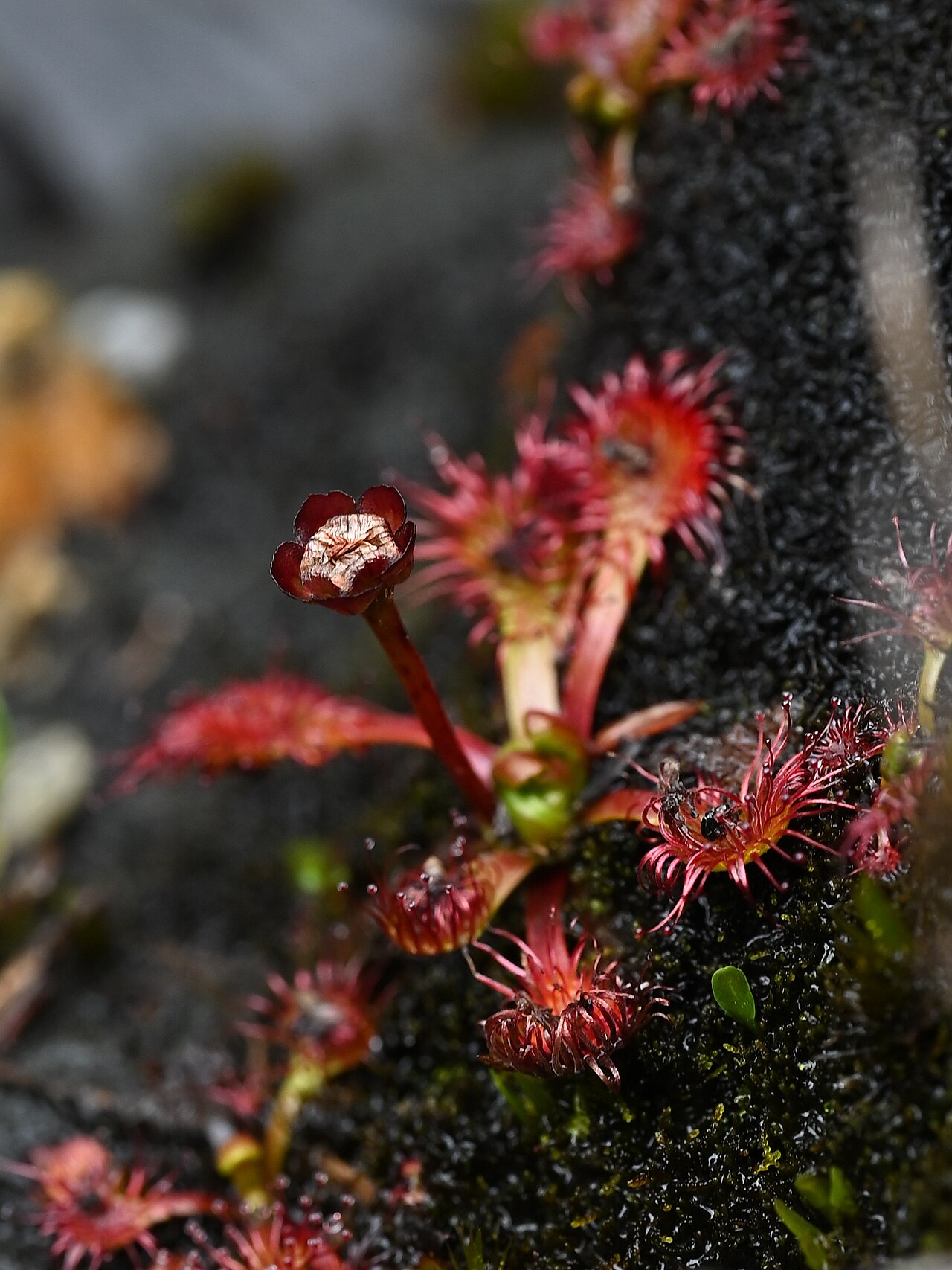
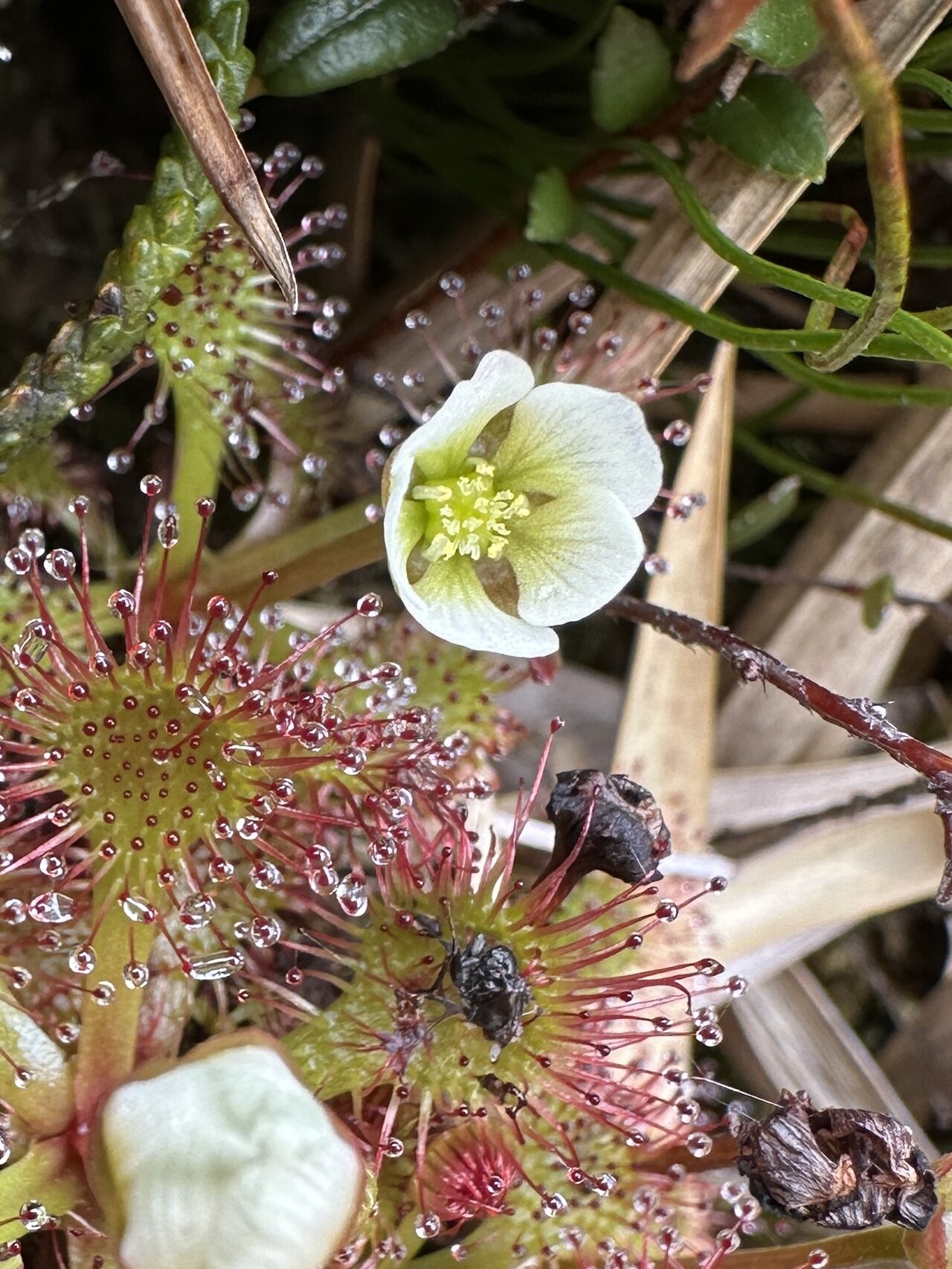
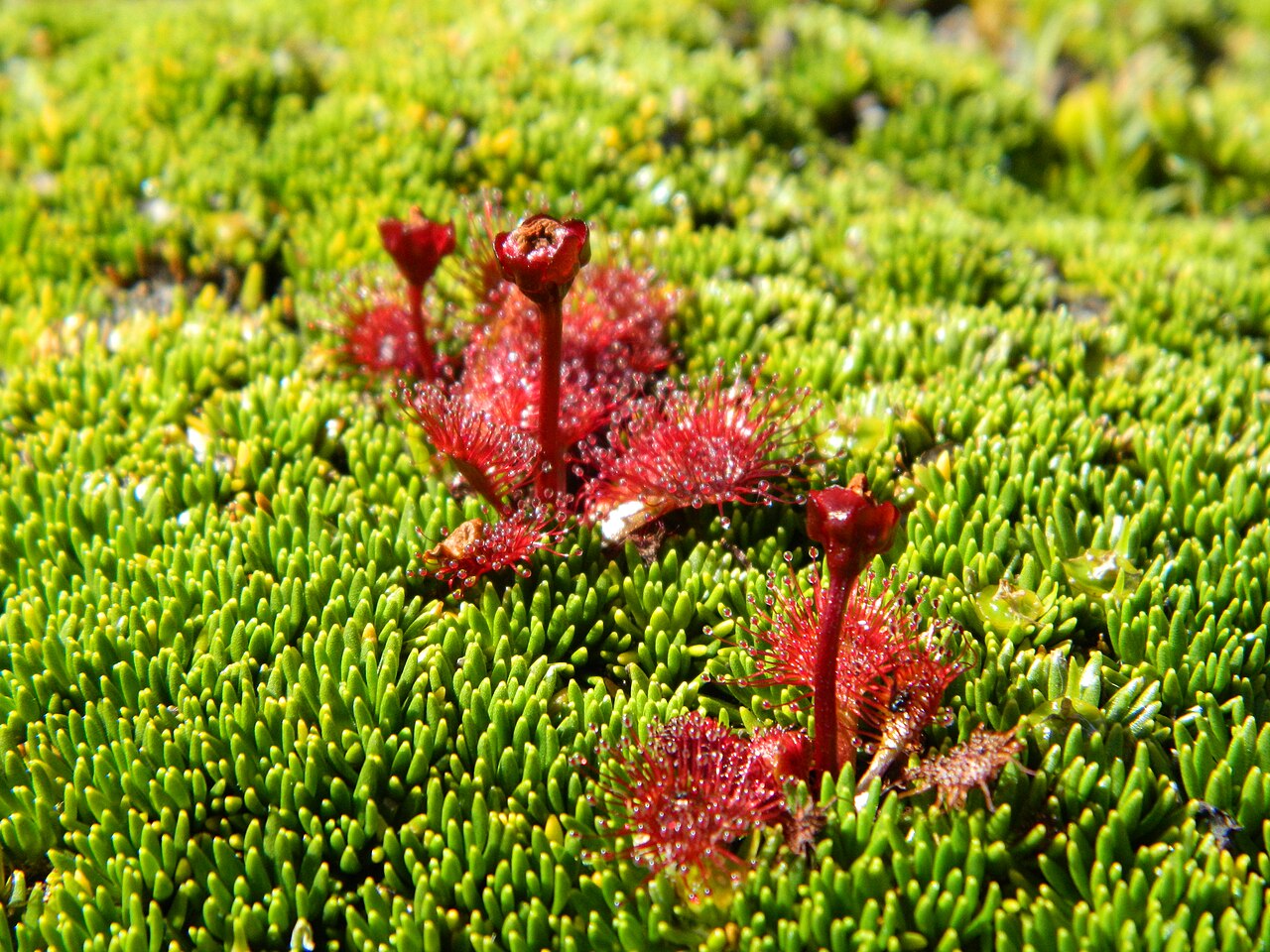
A small, flat rosette of spatulate leaves pressed against moss or cushion plants, red where the plant sits in full sun and greener in shelter. The blade is short and roundish on a narrow petiole, and carries the usual stalked glands with their droplets on its upper surface and margin. The most striking feature is the inflorescence: instead of a coiled raceme of several flowers there is a single white flower on a short scape that often barely clears the rosette. No reliably published measurements for rosette and flower were found, so the size fields are left empty.
Similar species
Within its range there is almost nothing to confuse it with: Drosera uniflora is the only sundew of the far south of South America. Elsewhere in the southern hemisphere it closely resembles its nearest relatives, Drosera arcturi of Australia and New Zealand and above all Drosera stenopetala of New Zealand, which also have a single white flower and grow in cold, wet mountain bogs. The differences are geographical and lie in details of leaf and flower, but in the field you will never find them together.
The trap and how it works
An active flypaper trap like that of other sundews: stalked glands hold a sticky droplet, a landing insect sticks, and the tentacles slowly bend towards the prey to digest it. In the cold climate of Tierra del Fuego the growing season is short and insects are scarce; the catch is mostly small midges and flies drifting over the bog. The leaves lie flat, so prey lands mainly on the upper surface.
Habitat and ecology
Permanently wet, acid and nutrient-poor bogs of the Magellanic moorland: cushion bogs built by low cushion plants such as Donatia and Astelia, and bog-moss mires with floating and sodden mats (W1, W2). The plant sits among the moss or in small gaps between the cushions, usually in full sun, in a climate of heavy rain, strong wind and cool summers. In the mountains it reaches above the tree line.
Distribution and elevation
Southern Chile and Argentina, from the rainy coast and Andes of southern Chile south through western Patagonia to Tierra del Fuego and the islands around Cape Horn, and also the Falkland Islands. That makes it one of the few carnivorous plants of the subantarctic zone. A reliably published altitudinal range for the species as a whole is lacking, so that field is left empty.
- Recorded (quarter-degree cells)
Forms and variation
No varieties are recognised. DNA-based trees place D. uniflora with D. arcturi and D. stenopetala in a small group of cold-bog species of Australian origin that spread across the southern hemisphere; it is therefore more distantly related to the other South American sundews than its location suggests.
Where and when to see it
Search in the southern summer, December to February, when the white flowers are open and the plant is far easier to spot. The wettest cushion bogs along the roads of Tierra del Fuego and the Falklands are the most promising. Tread carefully: cushion bogs recover extremely slowly from trampling, and a footprint stays visible for years.
Conservation status
Not assessed for the global IUCN Red List and not listed in CITES. The range is large and lies largely in sparsely populated country and protected areas, so there is little cause for concern. Locally, peat cutting, drainage and overgrazing can damage sites.
Scientific name
Drosera uniflora | Willdenow, 1809
Drosera uniflora was described in 1809 by the German botanist Carl Ludwig Willdenow, published in Enumeratio Plantarum Horti Regii Berolinensis. The species is native to Patagonia and the Falkland Islands, and also occurs in Chile (500–2,000 m altitude) and in Tierra del Fuego; a precise type locality with collector and date could not be established with certainty. The name uniflora is Latin for "single-flowered" (from "unus", one, and "flos", flower), referring to the characteristic that this small sundew typically bears a single white flower per stem.
World Checklist of Vascular Plants (WCVP), via Plants of the World Online (POWO), Royal Botanic Gardens, Kew.