All species › Caryophyllales › Sundew family › Drosera tomentosa
Drosera tomentosa
The felted sundew. Drosera tomentosa was described by Saint-Hilaire in 1826 but was long regarded as a variety of Drosera montana; only in the 2014 revision of the montana complex did it regain species rank. It is one of the most widespread sundews of the eastern Brazilian highlands, from Minas Gerais and Goiás to Bahia and Sergipe.
Identification
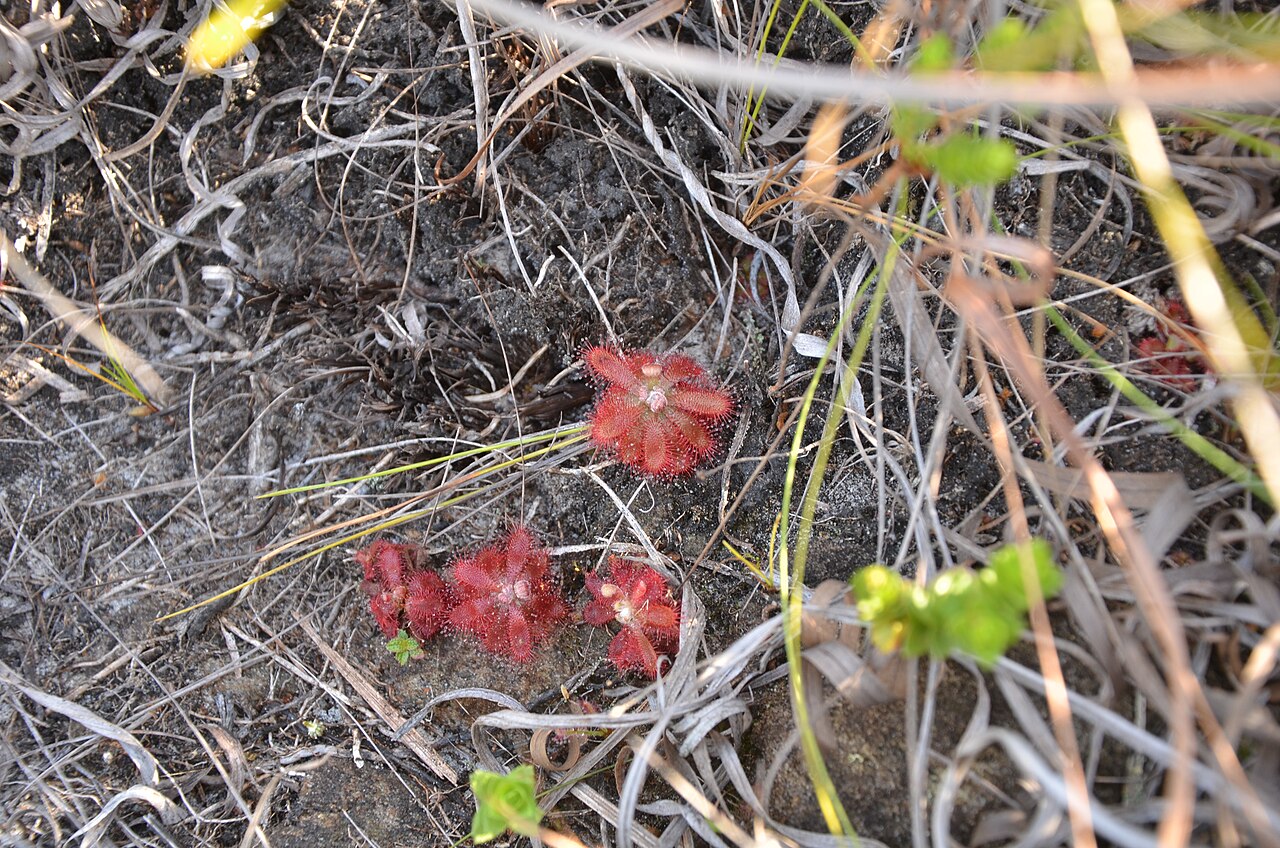
A compact perennial rosette of spatulate leaves with red tentacles, and a scape densely covered with long, woolly, non-glandular hairs; this felted covering, which gives the species its name, may also occur on petioles and leaves. Besides the typical, very hairy form, a less hairy variety is recognised. Measurements and a confirmed flower colour could not be checked here; the size fields are left empty.
Similar species
The closest relatives are Drosera montana, Drosera schwackei and Drosera spirocalyx, species that all used to fall under D. montana; the woolly hairs are the best distinction, though less pronounced in the balder variety. On the Espinhaço range D. tomentosa forms sterile hybrids with Drosera latifolia, intermediate between the parents. Drosera tentaculata and Drosera riparia also occur in the Chapada Diamantina.
The trap and how it works
An active flypaper trap. The tentacles on the blade catch small insects, after which the surrounding tentacles bend towards the prey. The woolly hairs on the scape carry no sticky droplets and play no part in trapping; they may protect the inflorescence against drying out or crawling insects.
Habitat and ecology
Wet places in the campos rupestres and high grasslands of eastern Brazil: seepage zones along rock slabs, wet sandy and peaty ground, and stream edges, in open, sunny vegetation (R1, W4, D2). The sites may partly dry out in the dry season.
Distribution and elevation
Endemic to Brazil: the north-east (Bahia, Sergipe), the south-east (Minas Gerais) and the centre-west (Goiás), as the area column of this guide also indicates. The centre of gravity lies in the Espinhaço range and the Chapada Diamantina. A published altitudinal range has not been adopted.
- Recorded (quarter-degree cells)
Forms and variation
Besides var. tomentosa a balder var. glabrata is recognised. The species is one of the core members of the D. montana complex; records of D. montana var. tomentosa in older literature belong to this species. Where it grows with D. latifolia, sterile natural hybrids arise.
Where and when to see it
In the wet season search seepages in the national parks of the Chapada Diamantina and the Espinhaço range. Look at the scape: a whitish woolly coat points strongly to this species. Where D. latifolia also grows, you may with luck find intermediates; they set no seed.
Conservation status
Not assessed for the global IUCN Red List and not listed in CITES. The range covers four states and some sites lie in protected areas, so the species does not appear directly threatened at species level. Fire, invasive grasses, mining, tourism and changes to the water regime damage sites locally.
Scientific name
Drosera tomentosa | Saint-Hilaire, 1906
Drosera tomentosa was described by the French botanist Augustin Saint-Hilaire, in his work Histoire des Plantes les Plus Remarquables du Brésil et du Paraguay, part 1(6), p. 261. Sources give the year of publication as either 1824 or 1826; the exact year could not be established with full certainty. The type material was collected by Saint-Hilaire himself during his travels through Brazil (1816–1822); an exact locality and collection date could not be established with certainty. The species is endemic to Brazil and occurs in the Espinhaço mountain range in the state of Minas Gerais. The name tomentosa is Latin for "tomentose, densely felted with hair" and refers to the dense hairiness on the lower half of the flowering scape in this species.
World Checklist of Vascular Plants (WCVP), via Plants of the World Online (POWO), Royal Botanic Gardens, Kew.