All species › Caryophyllales › Sundew family › Drosera tentaculata
Drosera tentaculata
A sundew that literally carries its tentacles in its name. Drosera tentaculata was described in 2003 by Fernando Rivadavia, in his paper on four new Brazilian sundews in Carnivorous Plant Newsletter, together with Drosera camporupestris, Drosera grantsaui and Drosera viridis. It is a species of the campos rupestres of the Espinhaço range, from Minas Gerais into Bahia.
Identification
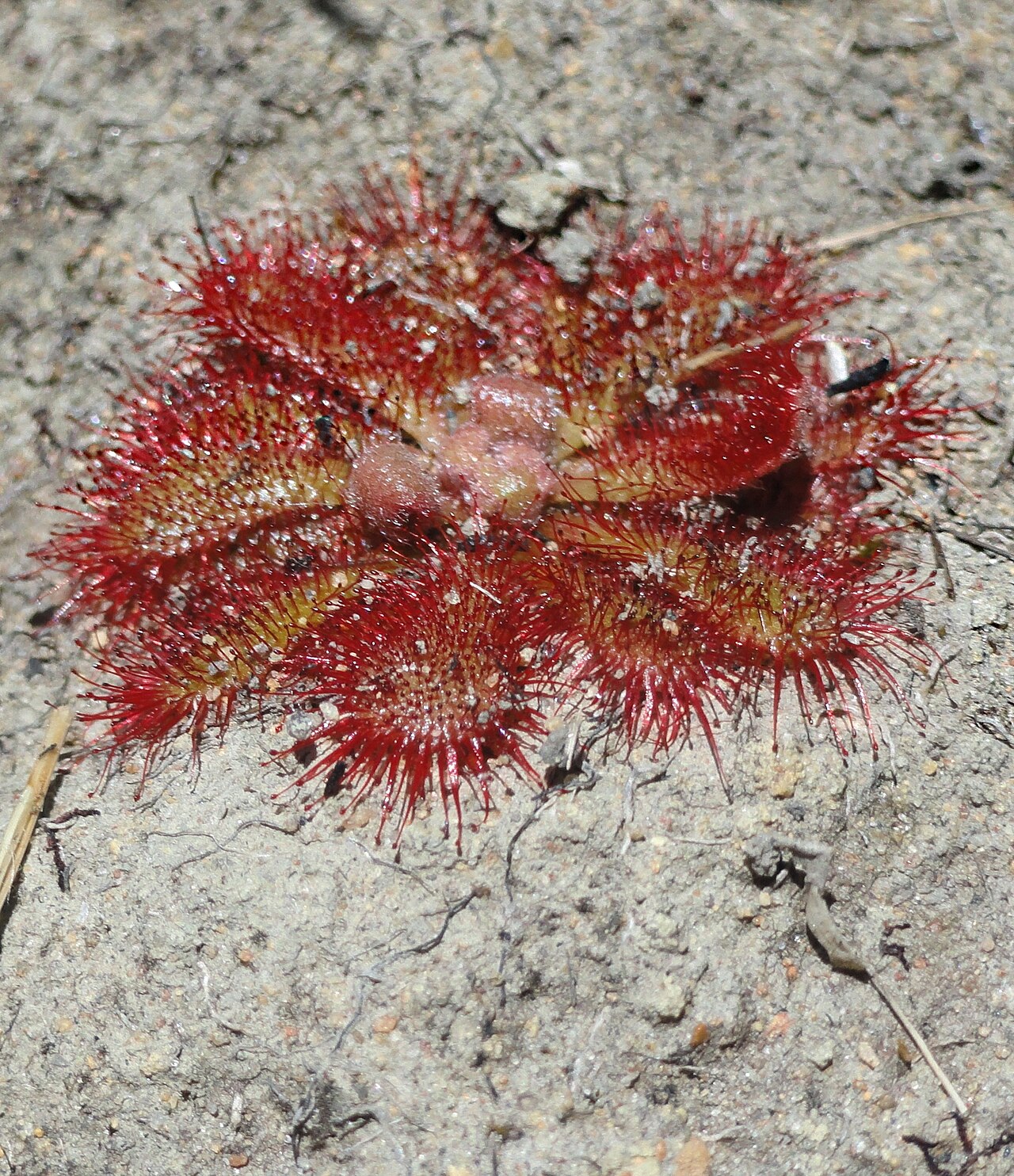
A perennial rosette plant whose leaves stand out for long red tentacles along the margins of the blade, projecting well beyond it and giving the rosette a gossamer, spiky look. In sun the plant turns red. The scape carries several flowers. Exact measurements and a confirmed flower colour could not be checked from the original description; the size fields are left empty.
Similar species
The long marginal tentacles separate it from most other sundews in the same area, such as Drosera communis, Drosera latifolia and Drosera tomentosa. Drosera riparia also grows in the Chapada Diamantina, along riverbanks. In young or shaded plants the marginal tentacles are less conspicuous, and then comparison with the original description is needed.
The trap and how it works
An active flypaper trap, in which the long marginal tentacles extend the leaf's reach. As in other sundews with long marginal tentacles, they can bend a captured insect towards the centre of the blade, where the short, more crowded glands take over digestion. Prey consists of small flying and crawling insects.
Habitat and ecology
Campos rupestres on quartzite and sandstone: wet sandy ground, seepages along rock slabs and the wet edges of streams, in open, sunny vegetation (R1, W4, D2). The landscape has a long dry season during which the sites partly dry out.
Distribution and elevation
Endemic to Brazil, in the highlands of the Espinhaço range in the states of Minas Gerais and Bahia, including the Chapada Diamantina. A published altitudinal range has not been adopted.
- Recorded (one-degree cells)
Forms and variation
No varieties are recognised. The 2003 paper in which the species was described marked the start of a series of publications in which Rivadavia, and later Gonella and Fleischmann, thoroughly revised the Brazilian sundew flora; the number of recognised Brazilian species has risen sharply since.
Where and when to see it
In the wet season search seepages and stream edges in the national parks of the Chapada Diamantina or the Espinhaço of Minas Gerais. Look at the rosettes from the side in low light: the long marginal tentacles show best then.
Conservation status
Not assessed for the global IUCN Red List and not listed in CITES. The range covers two states and lies partly in protected areas. Threats to the campos rupestres are fire, invasive grasses, mining and tourism.
Scientific name
Drosera tentaculata | Rivadavia, 2003
Drosera tentaculata was described in 2003 by the Brazilian botanist Fernando Rivadavia, in the article "Four New Species of Sundews, Drosera (Droseraceae), from Brazil", published in Carnivorous Plant Newsletter, volume 32(3), p. 79–92. The holotype was collected on 31 July 2002 by F. Rivadavia and R. Gibson in Brazil, in the state of Minas Gerais, Diamantina municipality, at the locality "at the top of the Cachoeira dos Cristais, on the road to Biribiri" (in the Espinhaço mountain range). The holotype (SPF 157000) is held at the Herbário da Universidade de São Paulo (SPF). The name tentaculata derives from Latin tentaculum ("tentacle, feeler") and means "furnished with tentacles". The name refers to the conspicuously developed, unifacial marginal glandular hairs ("snap tentacles") that characterise this species.
World Checklist of Vascular Plants (WCVP), via Plants of the World Online (POWO), Royal Botanic Gardens, Kew.