All species › Caryophyllales › Sundew family › Drosera subhirtella
Drosera subhirtella
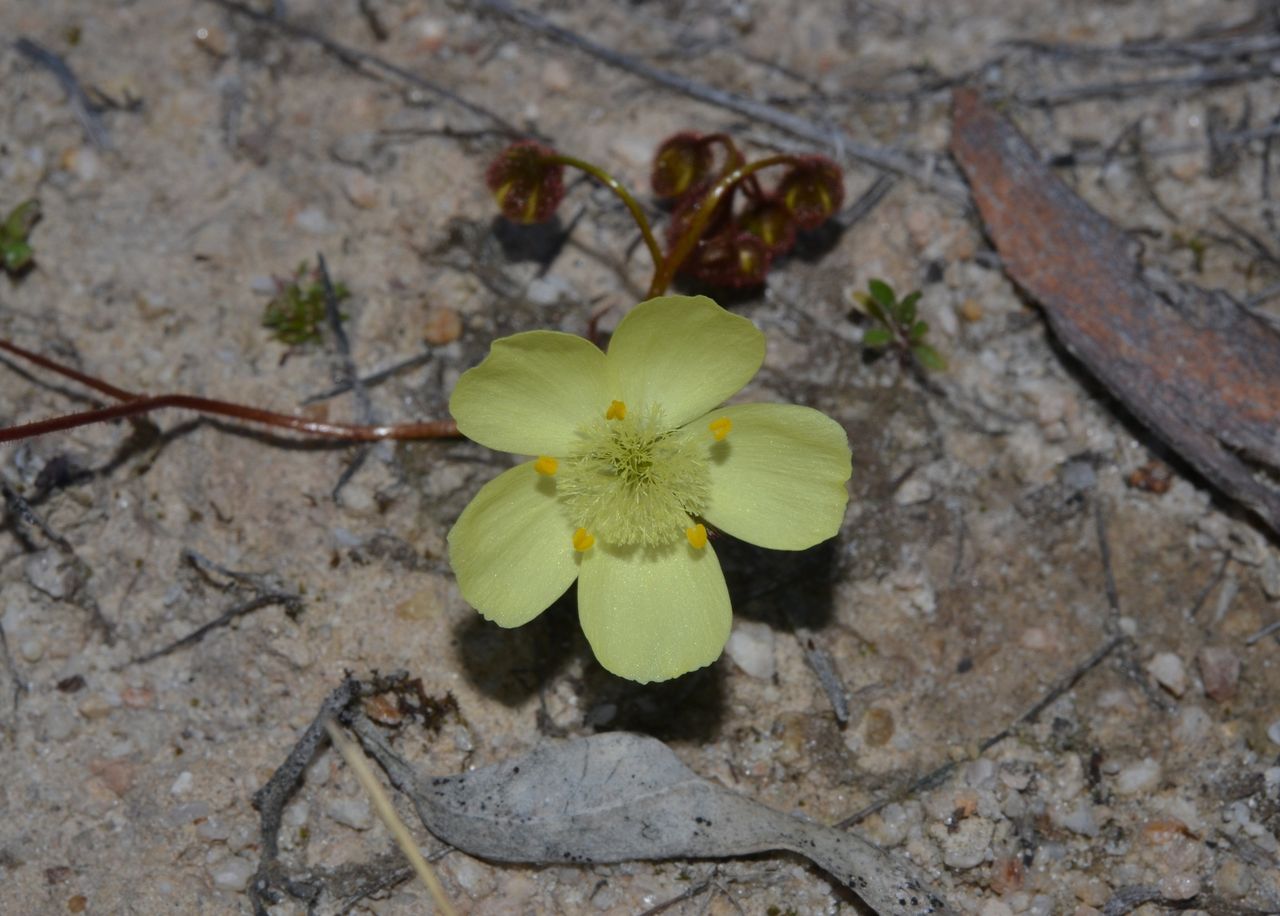
A climbing tuberous sundew with yellow flowers, and thus one of the comparatively few yellow-flowered sundews. In late winter and spring Drosera subhirtella scrambles to some 40 cm through the low vegetation of sandplains, granite outcrops and swamp margins in south-west Western Australia.
Identification
A scrambling or climbing perennial tuberous plant with stems up to 40 cm long, bearing small glandular trapping leaves. The flowers are yellow and appear from August to October. The epithet means 'somewhat hairy'. Exact leaf and flower measurements are not published in the sources consulted.
Similar species
There are more yellow-flowered climbing sundews in south-west Australia. Drosera sulphurea is larger (stems up to 40–60 cm), has peltate leaves and grows in coastal areas, often among Cephalotus; Lowrie regards it as only distantly related. Drosera moorei, formerly a variety and later a subspecies of D. subhirtella, has been a separate species since 1999; telling them apart calls for attention to hairiness and leaf characters. White- or pink-flowered climbers such as D. pallida and D. macrantha are recognised by flower colour.
The trap and how it works
An active flypaper trap, but held well above the ground. The leaves along the stem are small, peltate and often cup-shaped, with longer tentacles on the margin and shorter ones on the blade. Flying insects — midges, small flies, sometimes bees or butterflies drawn to the flowers — touch the droplets and stay hanging. The marginal tentacles then bend inwards and the blade partly closes around the prey, after which the glands secrete enzymes and absorb the dissolved nutrients. Because the traps are spread along an upright or climbing stem, the plant sweeps a much larger volume of air than a rosette on the ground.
Habitat and ecology
A wide range of sites: sandplains, granite outcrops and swamp margins, on sand, clay or loam (D1, R3, W7). The plant needs shrubs to scramble against.
Distribution and elevation
Endemic to Western Australia, in the south-west. A closer range boundary is not worked out in the sources consulted. Altitudinal limits are not published.
- Recorded (quarter-degree cells)
Forms and variation
Jules Émile Planchon described the species in 1848. In 1906 Ludwig Diels recognised a variety moorei, which N.G. Marchant made a subspecies in 1982 and Allen Lowrie split off as a separate species, D. moorei, in 1999. No further forms are recognised within D. subhirtella as now understood.
Where and when to see it
August to October, in sunshine: the yellow flowers can then be seen from afar above the low heath. Search by granite outcrops, on sandplains and at swamp margins, and look into the shrubs rather than at the ground. Leave the slender stems undisturbed.
Conservation status
Assessed as Least Concern (LC) on the IUCN Red List; not listed in CITES. The sources consulted name no specific threats. Its broad choice of habitat makes the species less vulnerable than many relatives.
Scientific name
Drosera subhirtella | Planchon, 1848
Drosera subhirtella was described in 1848 by the French botanist Jules Émile Planchon, in Annales des Sciences Naturelles, Botanique, 3rd series, volume 9, p. 292. The precise type locality and collector of the type material (presumably somewhere in Western Australia, where the species is endemic) could not be established with certainty. The name subhirtella is formed from the Latin prefix sub- ("somewhat, slightly") and hirtus ("hairy, rough"), with the diminutive ending -ella, meaning roughly "somewhat hairy". It is a descriptive name referring to the plant's fine hairiness.
World Checklist of Vascular Plants (WCVP), via Plants of the World Online (POWO), Royal Botanic Gardens, Kew.