All species › Caryophyllales › Sundew family › Drosera stricticaulis
Drosera stricticaulis
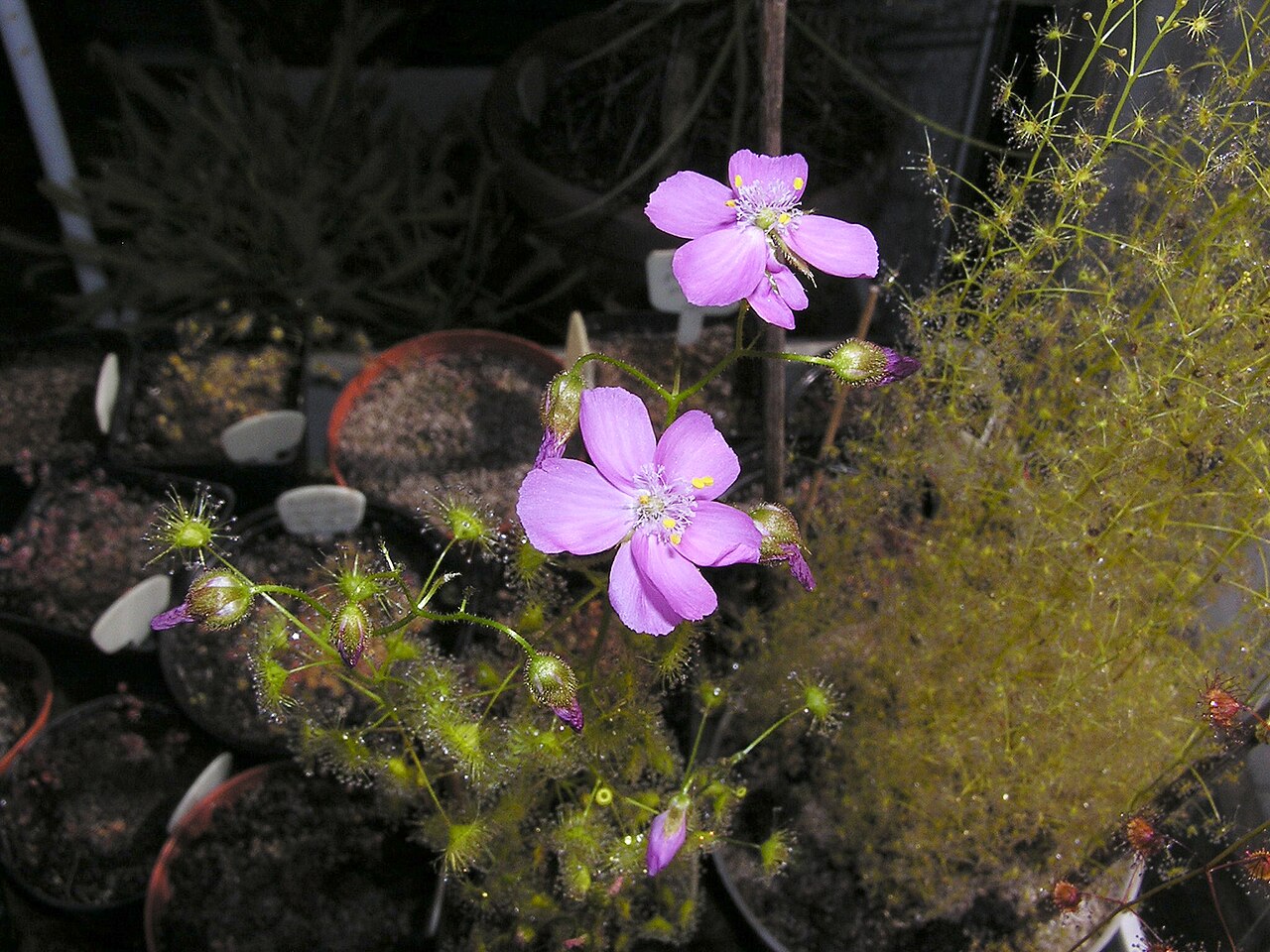
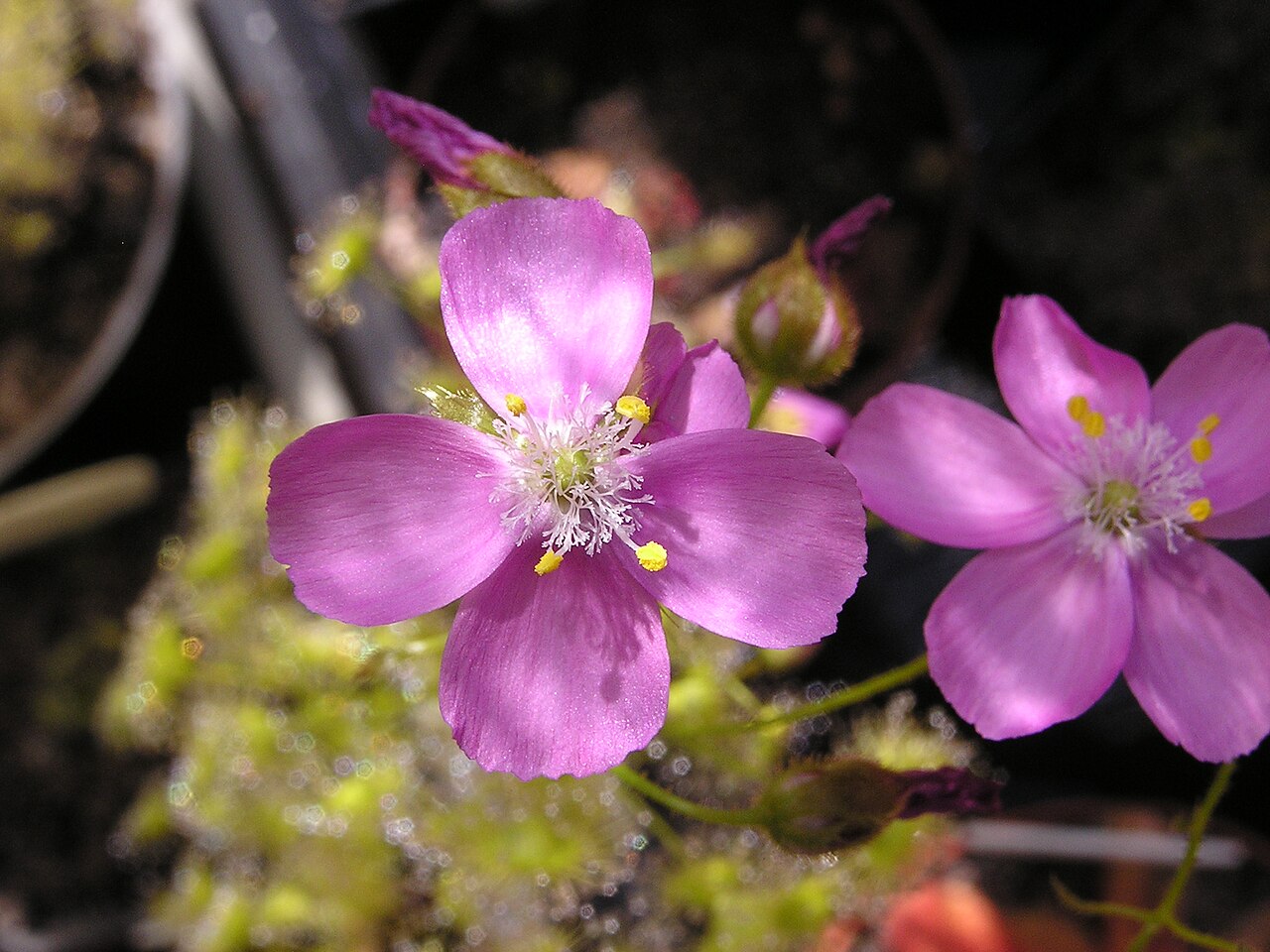
A robust, erect tuberous sundew with pink flowers which — unlike nearly every other plant in this series — is not confined to Western Australia. Drosera stricticaulis, 'with a straight stem', grows mainly in the south-west but also has outliers in South Australia: on the southern Eyre Peninsula and on the summit of Dutchmans Stern in the southern Flinders Ranges.
Identification
A robust, erect perennial tuberous plant with a green, glandular stem up to 25 cm tall. Along that stem stand small, cup-shaped trapping leaves. The flowers are pink and appear from July to October. The straight, non-climbing habit and the pink flowers together are the best field character. Exact leaf and flower measurements are not published in the sources consulted.
Similar species
Its closest relative is Drosera macrantha, of which D. stricticaulis was originally described as a variety; D. macrantha has a climbing or scrambling stem. Drosera pallida also climbs and flowers white; D. subhirtella and D. sulphurea climb and flower yellow. A straight glandular stem with pink flowers points to D. stricticaulis.
The trap and how it works
An active flypaper trap, but held well above the ground. The leaves along the stem are small, peltate and often cup-shaped, with longer tentacles on the margin and shorter ones on the blade. Flying insects — midges, small flies, sometimes bees or butterflies drawn to the flowers — touch the droplets and stay hanging. The marginal tentacles then bend inwards and the blade partly closes around the prey, after which the glands secrete enzymes and absorb the dissolved nutrients. Because the traps are spread along an upright or climbing stem, the plant sweeps a much larger volume of air than a rosette on the ground.
Habitat and ecology
Sandy clay and loam along watercourses and by granite outcrops (R3, W7), in open woodland (B6). These are places where water runs off or lies in winter: the foot of a granite dome, the bank of a seasonal creek.
Distribution and elevation
Mainly in south-west Western Australia — FloraBase lists the Avon Wheatbelt, Esperance Plains, Geraldton Sandplains, Jarrah Forest and Mallee bioregions; this guide's working list names the Darling Range. It also occurs in South Australia, on the southern Eyre Peninsula and on Dutchmans Stern in the southern Flinders Ranges. Because the species is thus not confined to south-west Australia, the 'endemic' field is set to false here. Altitudinal limits are not published.
- Recorded (quarter-degree cells)
Forms and variation
Ludwig Diels described the plant in 1906 as a variety of D. macrantha; Oswald Hewlett Sargent raised it to species in 1913. In 1996 Jan Schlauer placed the former D. macrantha subsp. eremaea as a subspecies under D. stricticaulis, but not all authors follow that treatment. Anyone using another flora may therefore find a different circumscription.
Where and when to see it
July to October, when the pink flowers are open. Search the foot of granite outcrops and along seasonal creeks in open woodland. The stems stand out among low shrubs because they point straight up and glisten with glands. In South Australia the species is a rarity; visitors to Dutchmans Stern should keep to the track.
Conservation status
Assessed as Least Concern (LC) on the IUCN Red List; not listed in CITES, and rated not threatened in FloraBase. The species has a large range. The isolated South Australian sites are small and therefore more vulnerable, but the sources consulted give no separate assessment of them.
Scientific name
Drosera stricticaulis | (Diels) Sargent, 1913
The taxon was originally described in 1906 by the German botanist Ludwig Diels as a variety, Drosera macrantha var. stricticaulis, in Engler's series Das Pflanzenreich (IV.112, Diels's Droseraceae treatment). In 1913 this variety was raised to full species rank by Oswald Hewlett Sargent, published in The Journal of Botany, British and Foreign, volume 51, p. 40, as Drosera stricticaulis (Diels) O.H.Sarg. The exact type locality of Diels's original 1906 description could not be established with certainty. A specimen registered as holotype was collected by Allen Lowrie on 1 July 1984, "30 km south of Mount Magnet" along the Great Northern Highway in Western Australia (herbarium PERTH 2344920) — however, this may represent later type material rather than Diels's original type. The name stricticaulis is formed from Latin strictus ("straight, rigid, upright") and caulis ("stem"), meaning "straight-stemmed" or "rigid-stemmed". It is a descriptive name referring to the notably upright, rigid stems of this species.
World Checklist of Vascular Plants (WCVP), via Plants of the World Online (POWO), Royal Botanic Gardens, Kew.