All species › Caryophyllales › Sundew family › Drosera stolonifera
Drosera stolonifera
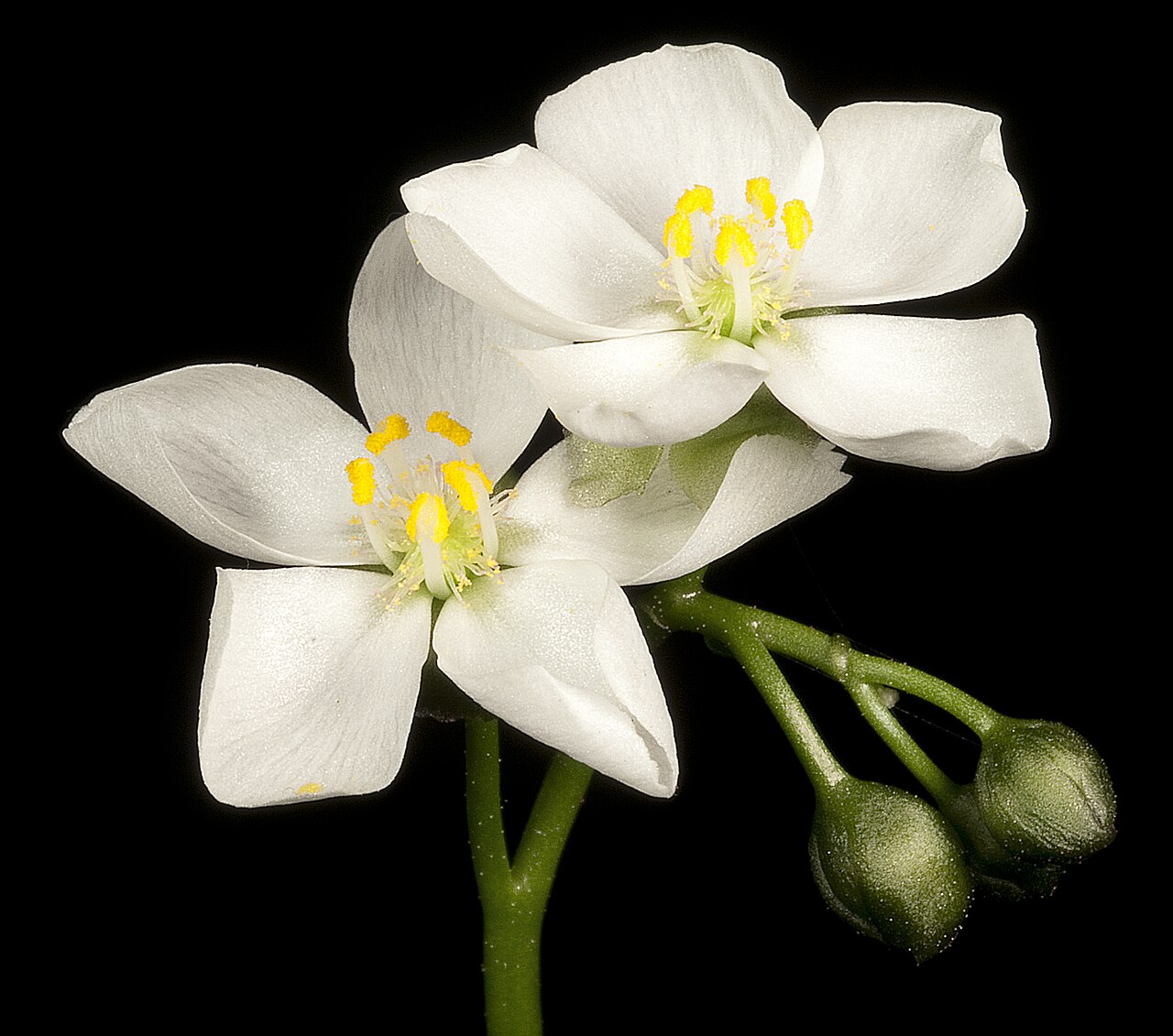
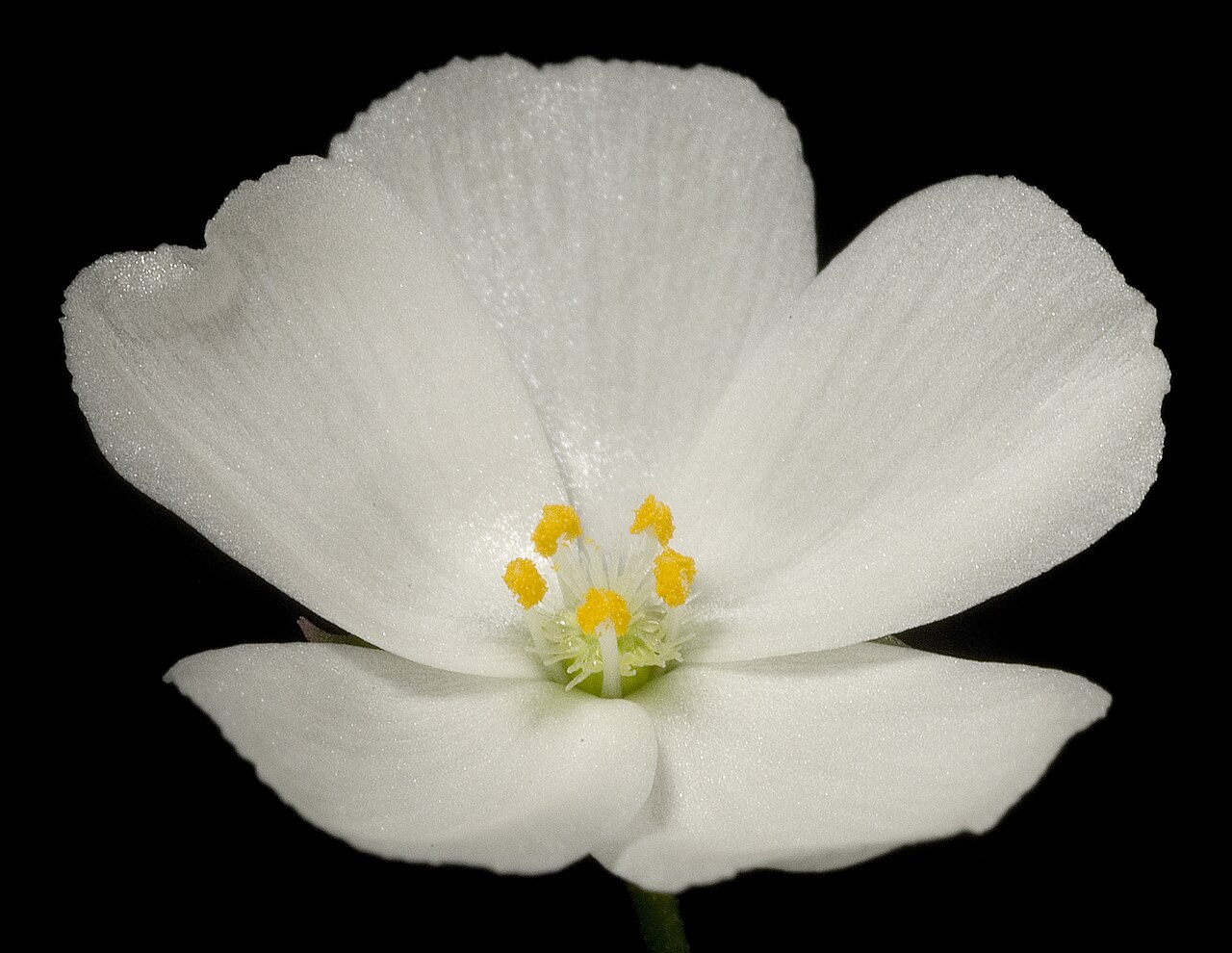
The namesake of section Stolonifera, and the first of the fan-leaved sundews that Europeans set eyes on: Charles von Hügel collected it on the Swan River in 1833. Drosera stolonifera is a plant of the wet heaths around Perth, which flowers en masse after a bushfire.
Identification
A perennial tuberous plant with two to three semi-erect lateral stems 10 to 15 cm long, bearing the fan-shaped trapping leaves of the section. The difference from its closest relative lies in the length of the petioles. Flowering in September and October; after fire the species often flowers in large numbers at once. Flower colour and exact measurements are not given in the sources consulted.
Similar species
Its closest relative is Drosera purpurascens, which differs mainly in petiole length. Within the section, D. prostrata (prostrate stems, northern sandplains), D. rupicola (turbinate tuber, mobile blade, inland granite outcrops), D. ramellosa (erect stems, inflorescences from the rosette) and D. platypoda (up to 20 cm, far south-west) also matter. Many of these names were formerly subspecies of D. stolonifera, which makes older literature confusing.
The trap and how it works
An active flypaper trap with a leaf shape of its own. The leaves are fan-shaped: a narrow base widening into a blade whose upper edge is set with long tentacles, sometimes in whorls of three or more along the stem. Small insects that walk into that edge or land on it stick to the droplets, after which the tentacles bend over the prey and the glands secrete enzymes. As in all tuberous sundews, much of the nitrogen and phosphorus absorbed goes into the tuber that has to carry the plant through summer.
Habitat and ecology
Two forms, each with its own habitat. The typical form grows on peaty soils saturated in winter in swampy heathland (W7, W4, B5); a 'hills variant' grows on well-drained clayey sand in the jarrah woodland of the hills (B6).
Distribution and elevation
Endemic to Western Australia, in swampy areas from around Perth south to Pinjarra, with the hills variant in the adjacent jarrah forest. Altitudinal limits are not published.
- Recorded (quarter-degree cells)
Forms and variation
Stephan Endlicher described the species in 1837 from material Charles von Hügel had collected in the Swan River district in 1833. During the twentieth century several subspecies were recognised under D. stolonifera — compacta, humilis, rupicola, monticola, porrecta and prostrata — which Allen Lowrie raised almost entirely to species rank between 1982 and 2011. What is still called D. stolonifera is thus a far more narrowly defined plant than in older floras. The 'hills variant' has not (yet) been formally named.
Where and when to see it
The best year to go is the first spring after a fire: the species then flowers en masse in September and October. Search wet heath on the coastal plain and the edge of the Darling Scarp. Keep to paths; wet heath recovers slowly from trampling, and after fire the soil is especially vulnerable.
Conservation status
Assessed as Least Concern (LC) on the IUCN Red List; not listed in CITES. The wet heaths around Perth have shrunk greatly through urban expansion, drainage and clearing; what remains lies largely in reserves and state forest. Because the species responds to fire, an appropriate fire regime is an important management issue.
Scientific name
Drosera stolonifera | Endlicher, 1837
Drosera stolonifera was described in 1837 by the Austrian botanist Stephan Endlicher, in his work on Baron Karl von Hügel's plant collections from southwestern New Holland, p. 5. The type material was collected in 1833 by Baron Charles von Hügel in the Swan River region, in southwestern Western Australia. The name stolonifera is formed from Latin stolo ("runner, stolon") and ferre ("to bear"), meaning "stolon-bearing". The name refers to the plant's growth habit, producing lateral stems or runners.
World Checklist of Vascular Plants (WCVP), via Plants of the World Online (POWO), Royal Botanic Gardens, Kew.