All species › Caryophyllales › Sundew family › Drosera sessilifolia
Drosera sessilifolia
The only American member of a small group of sundews whose only other member lives in tropical Asia and Australia. Drosera sessilifolia is the South American counterpart of the well-known Drosera burmannii, and shares a striking form with it: broad, wedge-shaped leaves without a distinct petiole, lying on the sand like a flat star. It is a fast, short-lived plant of seasonally wet savannas.
Identification
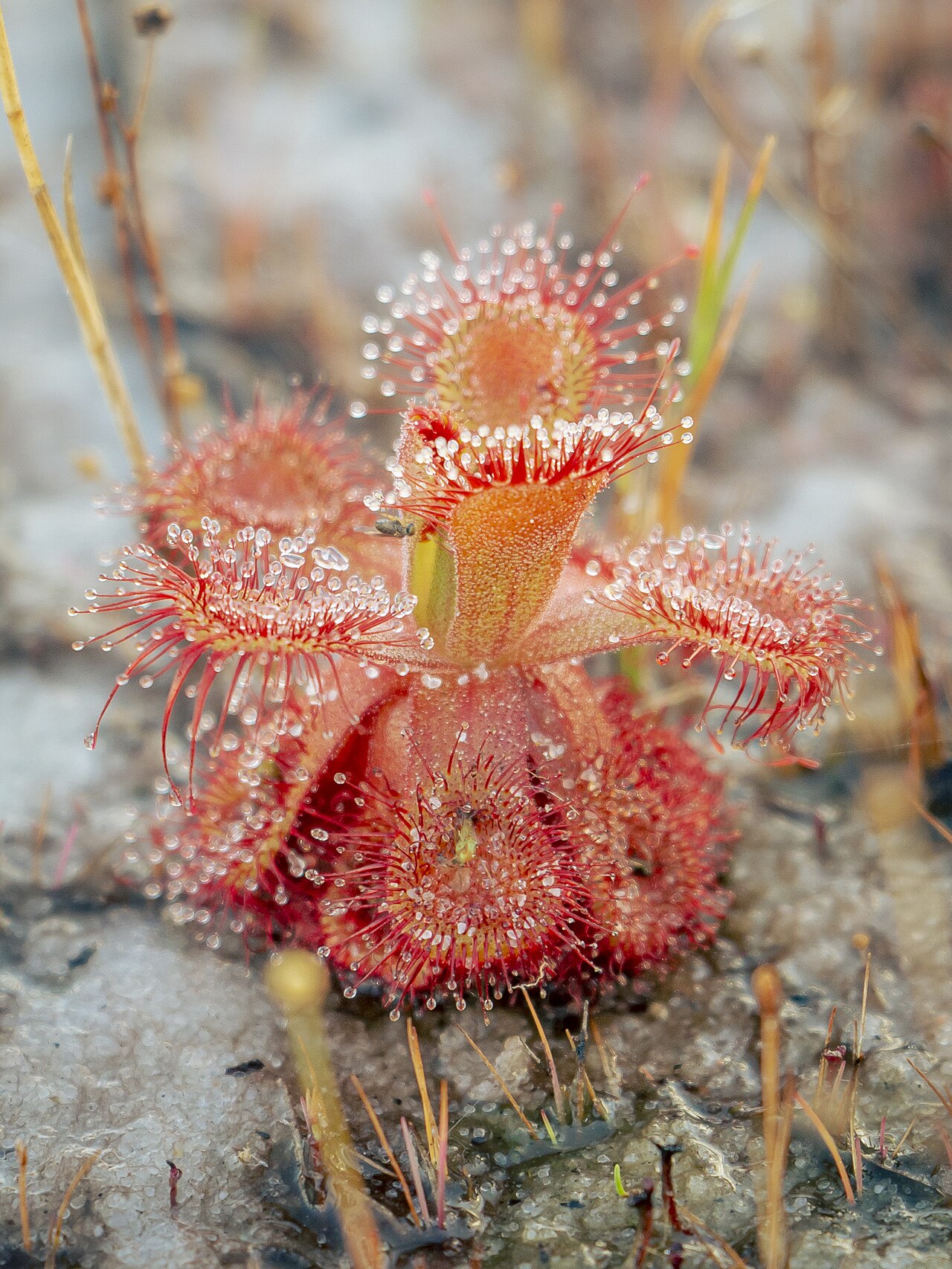
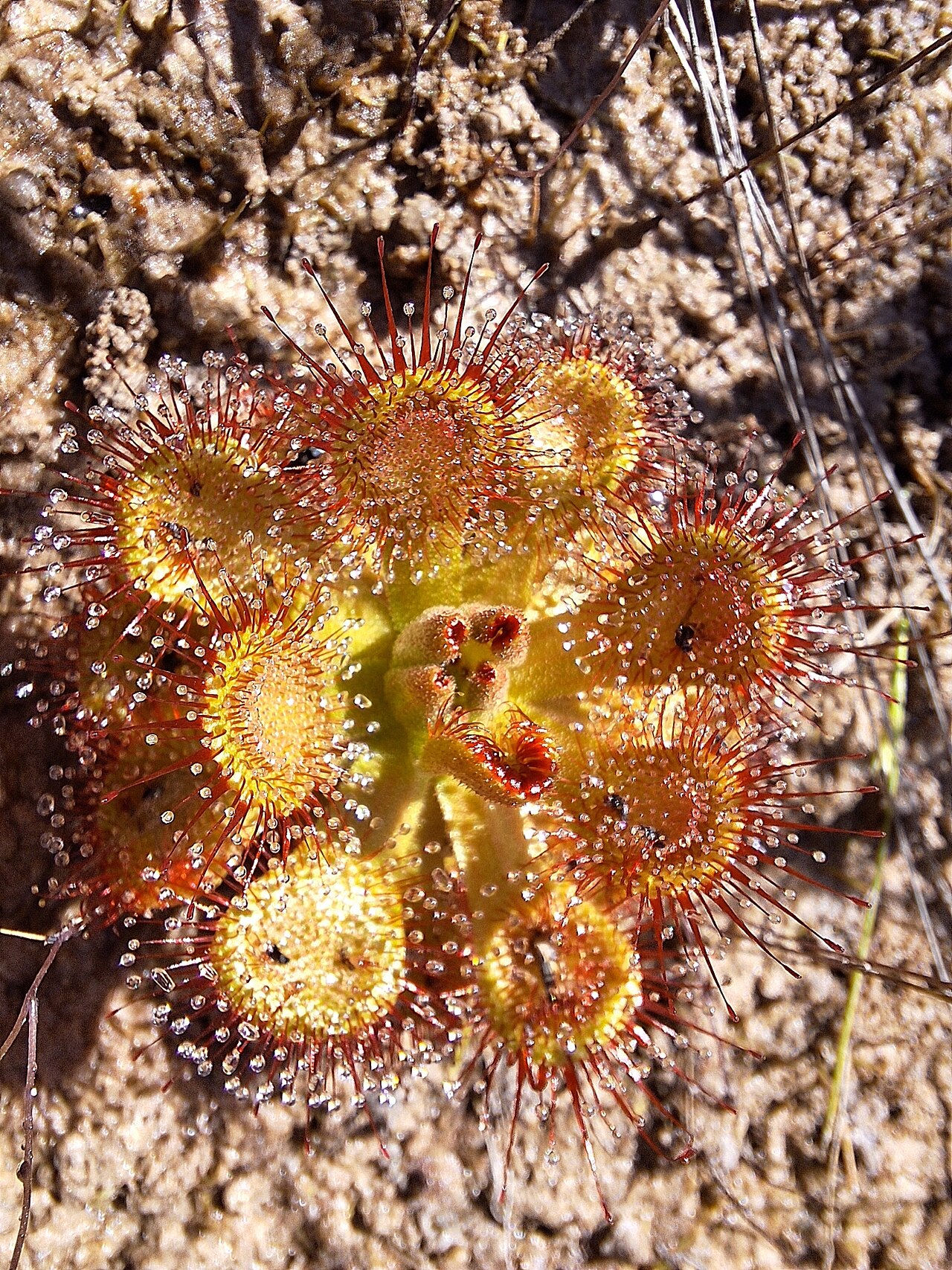
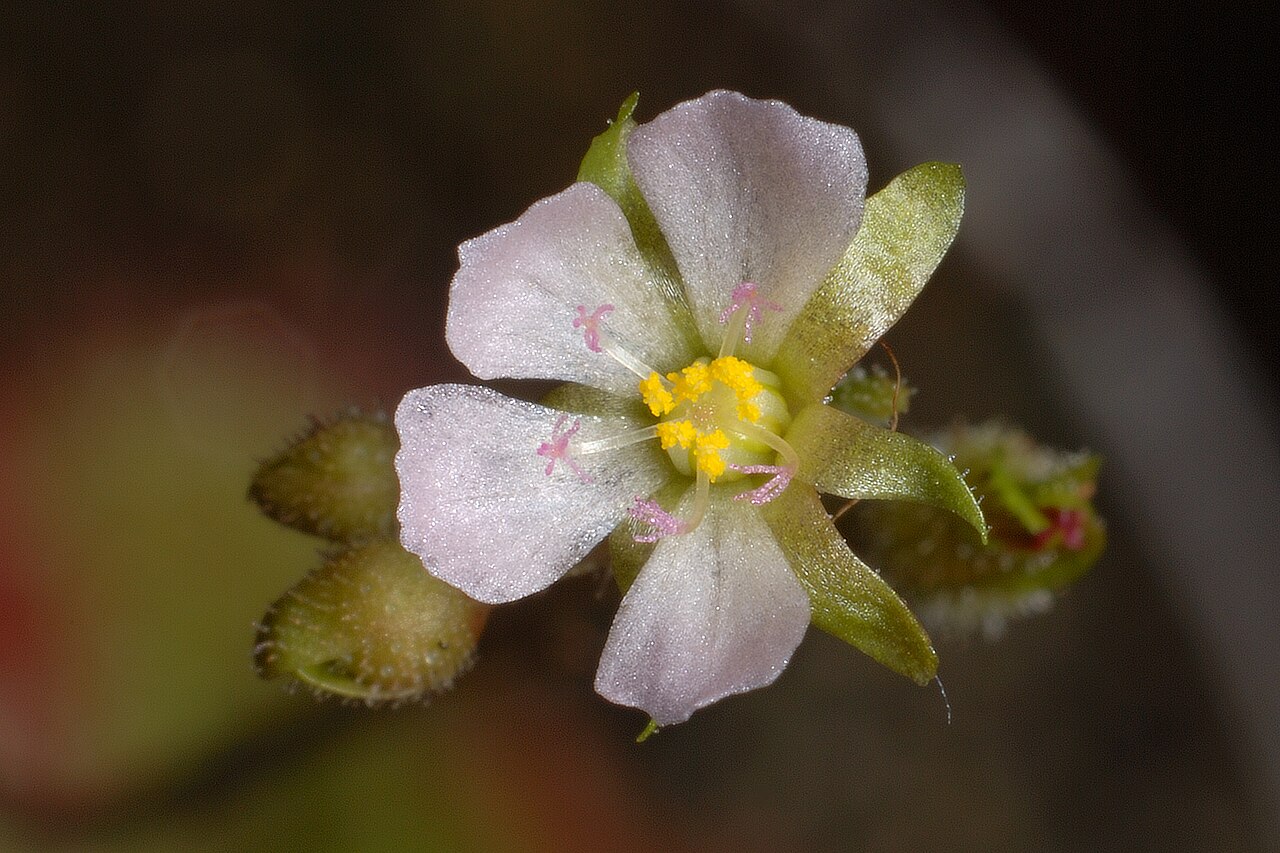
A flat rosette of sessile or nearly sessile, wedge-shaped to obovate leaves, carrying long red tentacles at the broad tip and margins and becoming gradually narrower and barer towards the base. In sun the whole rosette turns red to orange-red. One or more scapes with pink flowers rise from the rosette. A feature of the whole group is a flower with five styles instead of the three found in most sundews. Measurements have not been adopted here.
Similar species
The sessile, wedge-shaped leaves separate it well from most South American sundews, which have a distinct petiole. Drosera communis, Drosera cayennensis and Drosera grantsaui may grow in the same places but have spatulate leaves with a narrowed petiole. The very similar Drosera burmannii does not occur wild in the Americas.
The trap and how it works
An active flypaper trap, and one of the fastest in the genus. In the related D. burmannii the long marginal tentacles can fling prey towards the centre of the leaf within seconds to minutes; a similarly fast mechanism is to be expected in D. sessilifolia, but detailed measurements were not found. The catch consists mainly of ants and other insects walking over the sand.
Habitat and ecology
Open, sunny, nutrient-poor sandy ground that is boggy or even flooded in the rainy season and dries out in the dry season: wet hollows in savannas, sand flats and the edges of seasonal pools (W7, D1, B6). The plant probably survives the dry season mainly as seed, germinating again as soon as the rains begin.
Distribution and elevation
Tropical South America: much of Brazil, especially in the savannas of the centre and north, and the north of the continent, including Venezuela and the Guianas. The exact range outside Brazil is poorly documented.
- Recorded (quarter-degree cells)
Forms and variation
No varieties are recognised. The species belongs to section Thelocalyx, which otherwise contains only D. burmannii, a widespread species of tropical Asia and Australia. That distribution, with one species in South America and one in tropical Asia and Australia, is a classic example of a distribution that is still not fully explained.
Where and when to see it
In the rainy season search bare, wet sandy patches in savannas and along sandy tracks, where the red stars stand out clearly against the white or yellow sand. Because the plant is short-lived it can be abundant one year and almost absent the next; so preferably come back several times.
Conservation status
Not assessed for the global IUCN Red List and not listed in CITES. The species is widespread and, as a pioneer of open wet sand, not very vulnerable at species level. Conversion of savanna to farmland and plantations does, however, destroy many local sites.
Scientific name
Drosera sessilifolia | Saint-Hilaire, 1824
Drosera sessilifolia was described in 1824 by Auguste de Saint-Hilaire, in his work "Histoire des Plantes les plus Remarquables du Brésil et du Paraguay", volume 1: 259. The type locality lies in Brazil, in the state of Minas Gerais, near the São Francisco River. The material was collected by Saint-Hilaire himself during his Brazilian expedition; the exact year of the type collection could not be established with full certainty (herbarium records mention 1816 among others, but this is not certainly the type collection). The name is descriptive Latin: "sessilifolia" means "with sessile leaves" (sessilis = sessile/stalkless, folium = leaf), referring to the leaves lacking a petiole.
World Checklist of Vascular Plants (WCVP), via Plants of the World Online (POWO), Royal Botanic Gardens, Kew.