All species › Caryophyllales › Sundew family › Drosera quartzicola
Drosera quartzicola
A sundew of quartz gravel, as the name says, and one of the rarest in Brazil. Drosera quartzicola was described in 2011 by Fernando Rivadavia and Paulo Gonella, flagged already in the title of their paper as new and threatened. It grows only in a small area of the mountains of Minas Gerais, and at the last count the entire world population numbered about 340 plants.
Identification
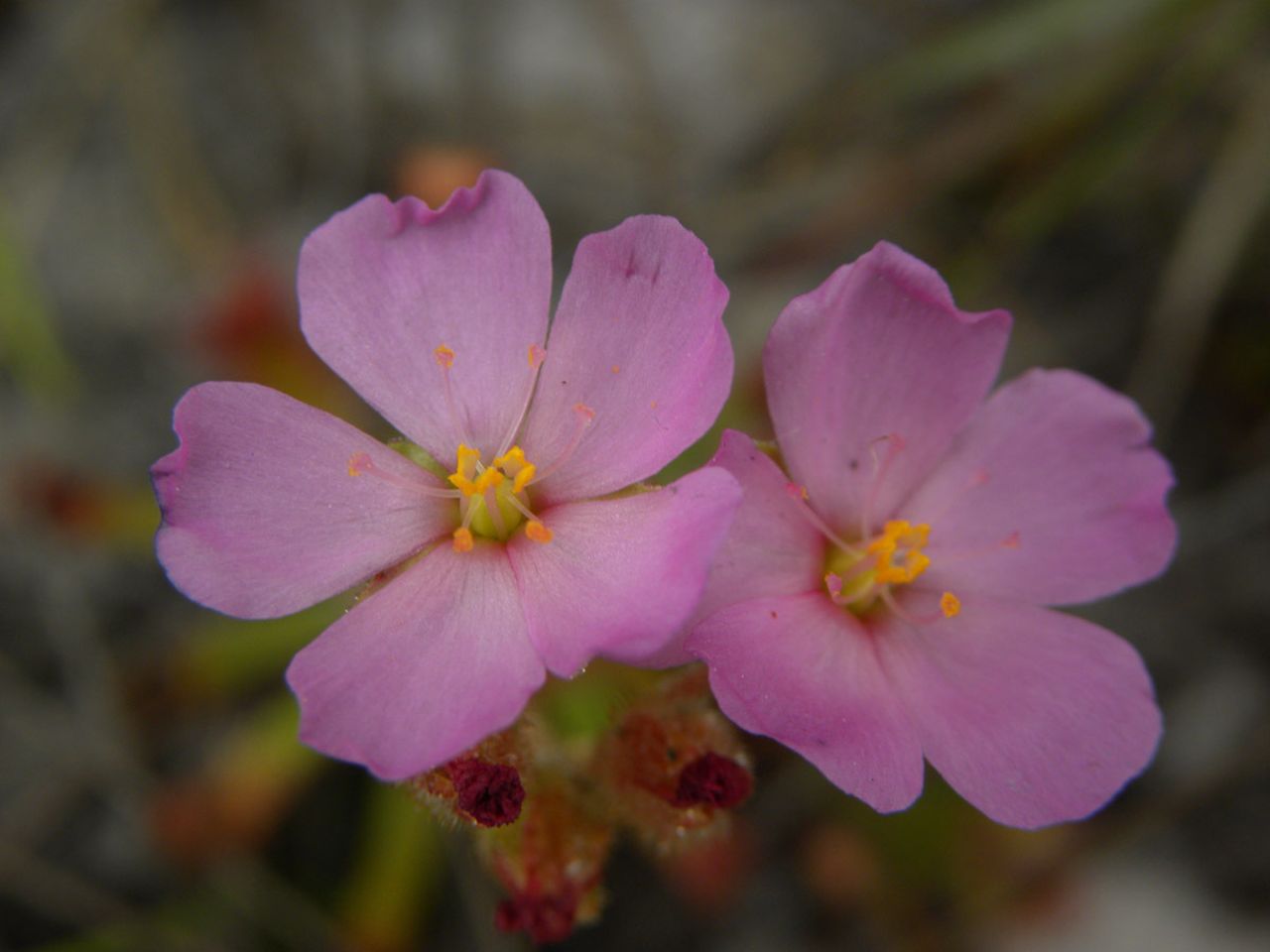
A perennial rosette, stemless or with short columns up to 40 mm tall. The leaves are semi-erect and lanceolate, with the petiole about as long and as wide as the blade. At the base are triangular, golden-brown stipules 6 to 8 mm long. The scape is 17 to 115 mm long and carries pink flowers; the pistil has three carpels with forked styles. The seeds are narrowly oblong-ovate, 0.7 to 0.8 mm, with a black, reticulate testa.
Similar species
The closest relative is Drosera chrysolepis, which also has golden-brown stipules. D. chrysolepis, however, forms distinct stems, has a petiole narrower than the blade and longer scapes. Other sundews in the same area almost always grow in wetter places; the combination of dry quartz-gravel ground and golden-brown stipules is characteristic of D. quartzicola.
The trap and how it works
An active flypaper trap. The semi-erect leaves catch small insects walking over the gravel or flying low above it. In this dry, open habitat ants and small flies are probably the main prey.
Habitat and ecology
Strikingly dry for a sundew: relatively dry parts of the campos rupestres, on fine silica sand mixed with white quartz gravel, at 1,100 to 1,360 m (D2, R3). Where most Brazilian sundews seek seepages and wet hollows, this species stands on open, quickly drying ground that stays moist only in the rainy season.
Distribution and elevation
Endemic to a small part of the southern Espinhaço range in Minas Gerais, south-eastern Brazil, divided over six small populations. Precise localities are not given in this guide because the species is considered critically endangered.
- Recorded (one-degree cells)
Forms and variation
No varieties are recognised. The species is one of the clearest examples of the extreme local endemism of the campos rupestres: a distinct, drought-tolerant lineage within a group of mostly marsh plants, confined to a single mountain massif.
Where and when to see it
Not a species to search for actively; the populations are small and the gravel ground is vulnerable to trampling. Anyone hiking in the mountains of Minas Gerais who sees pink-flowering sundews on dry white gravel in the rainy season, November to April, should leave them be and report the sighting to researchers.
Conservation status
Not assessed for the global IUCN Red List and not listed in CITES. The authors assessed the species as critically endangered: about 340 known plants in six populations. The main threats are human-caused fires, invasive grasses closing over the open gravel patches, and climate change altering the habitat. That is the authors' assessment, not an official IUCN category.
Scientific name
Drosera quartzicola | Rivadavia & Gonella, 2011
Drosera quartzicola was described in 2011 by Fernando Rivadavia and Paulo Minatel Gonella, in the journal Phytotaxa, volume 29, page 34. The species had already been rediscovered by Rivadavia and Gonella in 1996 (and collected without recognition even earlier, in the early 1990s), but was only formally published in 2011. The type specimen was collected on 19 April 2010 by Paulo M. Gonella, in the Travessão area near Santana do Riacho, municipality of Conceição do Mato Dentro, Minas Gerais state, Brazil, at an elevation of about 1,360 m, in the campo rupestre quartz-gravel landscape. The epithet quartzicola is composed of "quartz" and the Latin suffix -cola ("dweller of"), and thus means "quartz-dweller". It refers directly to this species' characteristic habitat: silica/quartz sand surrounded by white quartz gravel in the Brazilian campo rupestre.
World Checklist of Vascular Plants (WCVP), via Plants of the World Online (POWO), Royal Botanic Gardens, Kew.