All species › Caryophyllales › Sundew family › Drosera prostrata
Drosera prostrata
The northernmost and flattest species of the fan-leaved section Stolonifera. Drosera prostrata grows on the sandplains between Shark Bay and Binnu, on the dry northern edge of south-west Australia's winter-rainfall zone, and lays its stems flat on the ground instead of holding them up.
Identification
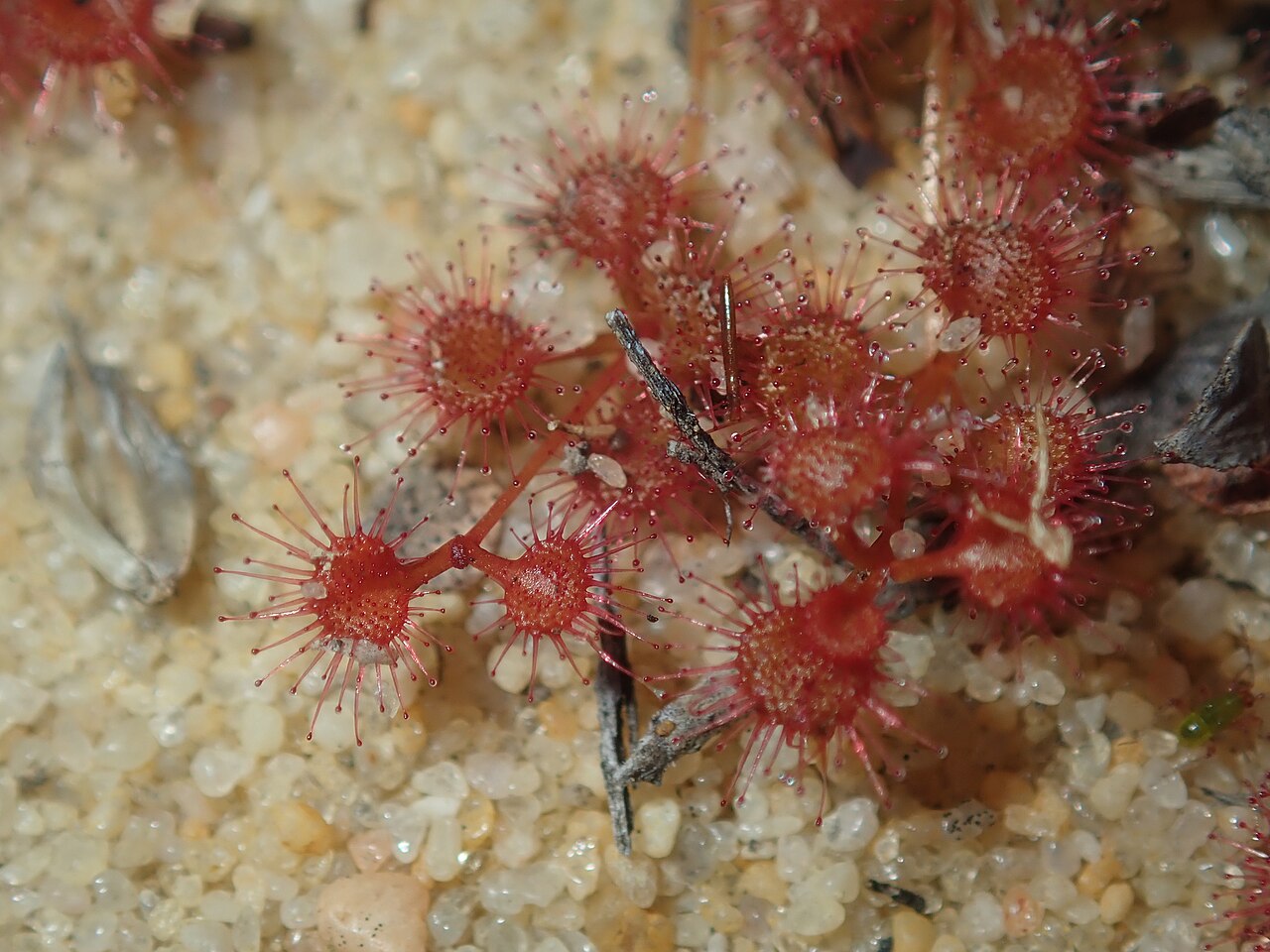
A perennial tuberous plant that spreads four to five prostrate lateral stems 3.5 to 15 cm long over the sand. Along them stand the fan-shaped trapping leaves typical of the section. This prostrate habit is the character that separates it from its relatives within section Stolonifera. Flowering in May and June; FloraBase records yellow flowers. Exact leaf and flower measurements are not published in the sources consulted.
Similar species
Its closest relative is Drosera stolonifera, under which it was originally placed as a subspecies; that has two or three obliquely ascending lateral stems and grows much further south, in wet heath around Perth. Drosera rupicola has semi-erect lateral stems and grows by granite outcrops inland; D. ramellosa and D. platypoda have erect stems. Within the northern range of D. prostrata, the prostrate habit is practically decisive.
The trap and how it works
An active flypaper trap with a leaf shape of its own. The leaves are fan-shaped: a narrow base widening into a blade whose upper edge is set with long tentacles, sometimes in whorls of three or more along the stem. Small insects that walk into that edge or land on it stick to the droplets, after which the tentacles bend over the prey and the glands secrete enzymes. As in all tuberous sundews, much of the nitrogen and phosphorus absorbed goes into the tuber that has to carry the plant through summer. Because the stems lie flat, the trapping leaves sit just above the sand and catch mostly crawling and low-flying insects.
Habitat and ecology
Well-drained sandy soils on sandplains: yellow sand, sometimes mixed with white or red sand (D1), with open, low heath and scrub (B5). This is a drier setting than that of most relatives, which grow in winter-wet hollows.
Distribution and elevation
Endemic to Western Australia: from the Tamala area near Shark Bay south to Binnu. FloraBase lists the Geraldton Sandplains and Yalgoo bioregions. Altitudinal limits are not published.
- Recorded (one-degree cells)
Forms and variation
N.G. Marchant and Allen Lowrie described the plant in 1992 as Drosera stolonifera subsp. prostrata; Lowrie raised it to species rank in 2005 in the journal Nuytsia. That fits a wider pattern: between 1982 and 2011 nearly all the former subspecies of D. stolonifera were raised to species. No further forms are recognised within D. prostrata.
Where and when to see it
May and June are the months: early in the wet season, when the prostrate stems have grown out and the plant is in flower. Search open patches in the heath of the northern sandplains and look low over the sand. In summer there is nothing to see above ground.
Conservation status
Assessed as Least Concern (LC) on the IUCN Red List; not listed in CITES, and rated not threatened in FloraBase. Part of the range lies in little-cleared country. The sources consulted name no specific threats.
Scientific name
Drosera prostrata | (Marchant & Lowrie) Lowrie, 1992
Drosera prostrata was first described in 1992 by Neville Gordon Marchant and Allen Lowrie as a subspecies, Drosera stolonifera subsp. prostrata, in Kew Bulletin, volume 47, page 320. In 2005 Lowrie raised the taxon to full species rank, in Nuytsia, volume 15(3), page 374. The type specimen was collected by Allen Lowrie on 14 June 1984, along the road to "The Loop" near Kalbarri, in south-western Western Australia. The specimen is held in the PERTH herbarium (number PERTH 4179005). The epithet prostrata is Latin for "prostrate" or "lying flat" (from prosternere, "to throw down"). It refers to the characteristic prostrate growth habit of the lateral stems, which sets this species apart from all other members of section Stolonifera. It is a descriptive name.
World Checklist of Vascular Plants (WCVP), via Plants of the World Online (POWO), Royal Botanic Gardens, Kew.