All species › Caryophyllales › Sundew family › Drosera neesii
Drosera neesii
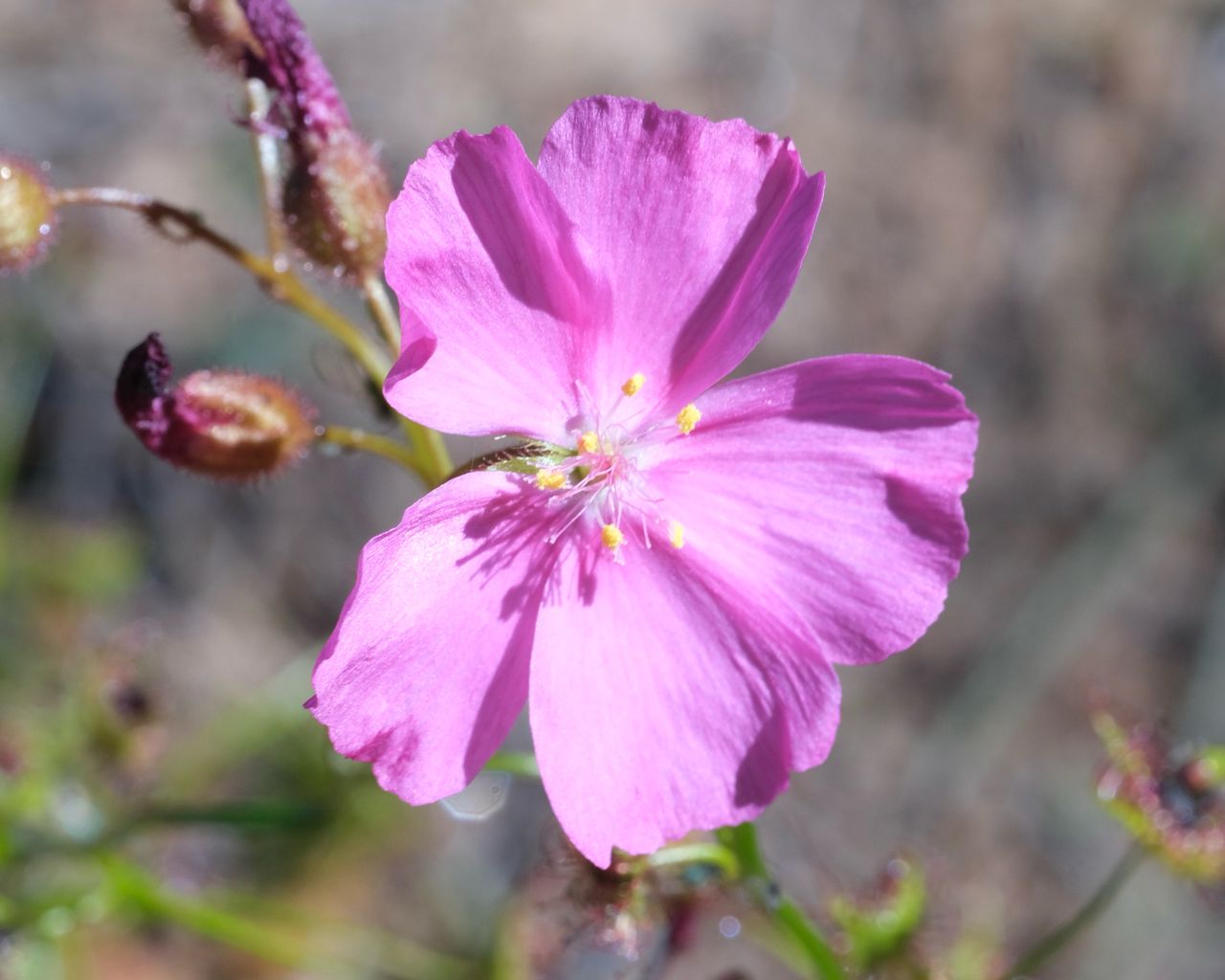
The Jewel Rainbow of Western Australia, an erect to twining tuberous sundew with pink flowers. Johann Georg Christian Lehmann described it in 1844, based on the collections made shortly before in the Swan River Colony by the German collector Ludwig Preiss; the name honours the German botanist Christian Gottfried Nees von Esenbeck.
Identification
A perennial that each year produces from an underground tuber an erect or twining stem 15 to 60 cm long. Along the stem sit small, cup-shaped trapping leaves in groups of three, a feature that separates the species from many relatives. The flowers are pink and appear over a long period, from August to December. We did not find precise leaf and flower measurements in any source consulted.
Similar species
Drosera menziesii also has pink flowers and grows in similar habitats, but has round rather than cup-shaped leaves and a wavy stem. D. sulphurea, with yellow flowers, was once placed by George Bentham as a variety under D. neesii, but that treatment has been reversed. The cup-shaped leaves in threes are the most useful character.
The trap and how it works
An active flypaper trap. The cup-shaped leaf blades carry marginal tentacles with sticky droplets that catch small flying insects. After a catch the tentacles bend inwards and press the prey into the cup, where digestion takes place. In twining plants the sticky leaves help the stem hold on to the surrounding vegetation.
Habitat and ecology
Places beside swamps and by granite outcrops, on sand, clay or laterite (W7, R3, D3, D1). The ground is wet in winter and dry in summer; the plant grows in the wet months, flowers until late spring and survives the summer as a tuber.
Distribution and elevation
Endemic to south-west Australia. Subspecies borealis is confined to the northern part of the range. We could not obtain a more precise distribution from FloraBase.
- Recorded (quarter-degree cells)
Forms and variation
In 1982 Neville Marchant described D. neesii subsp. borealis, which occurs only in the northern part of the range; alongside it stands the typical subsp. neesii. The species belongs to section Ergaleium.
Where and when to see it
Thanks to the long flowering period the species can be found from August into December, with the best chance in September and October. Search the edges of swamps and granite outcrops, and count the leaves: cup-shaped leaves in groups of three point to D. neesii.
Conservation status
On the global IUCN Red List the species is listed as Least Concern (LC). It is not listed in CITES. As for many tuberous sundews of wet hollows and granite outcrops, drainage, clearing, weeds and a changing fire regime are the main risks. Uncertainty: we could not check the exact range or the boundary between the subspecies.
Scientific name
Drosera neesii | Lehmann, 1844
Drosera neesii was described in 1844 by the German botanist Johann Georg Christian Lehmann, in Novarum et Minus Cognitarum Stirpium Pugillus 8, p. 42. According to GBIF data, a type specimen was collected by Ludwig Preiss in October 1840 at Princess Royal Harbour (near Albany, Western Australia) — a plausible origin, since Lehmann described many Western Australian species around this time based on Preiss's collections. Which specimen was precisely designated as the original type by Lehmann could not be established with full certainty. The name is likely an eponym, formed with "-ii" from the surname Nees, pointing to the German botanist Christian Gottfried Daniel Nees von Esenbeck (1776–1858), a contemporary of Lehmann. This could not, however, be confirmed with full certainty from the sources consulted.
World Checklist of Vascular Plants (WCVP), via Plants of the World Online (POWO), Royal Botanic Gardens, Kew.