All species › Caryophyllales › Sundew family › Drosera marchantii
Drosera marchantii
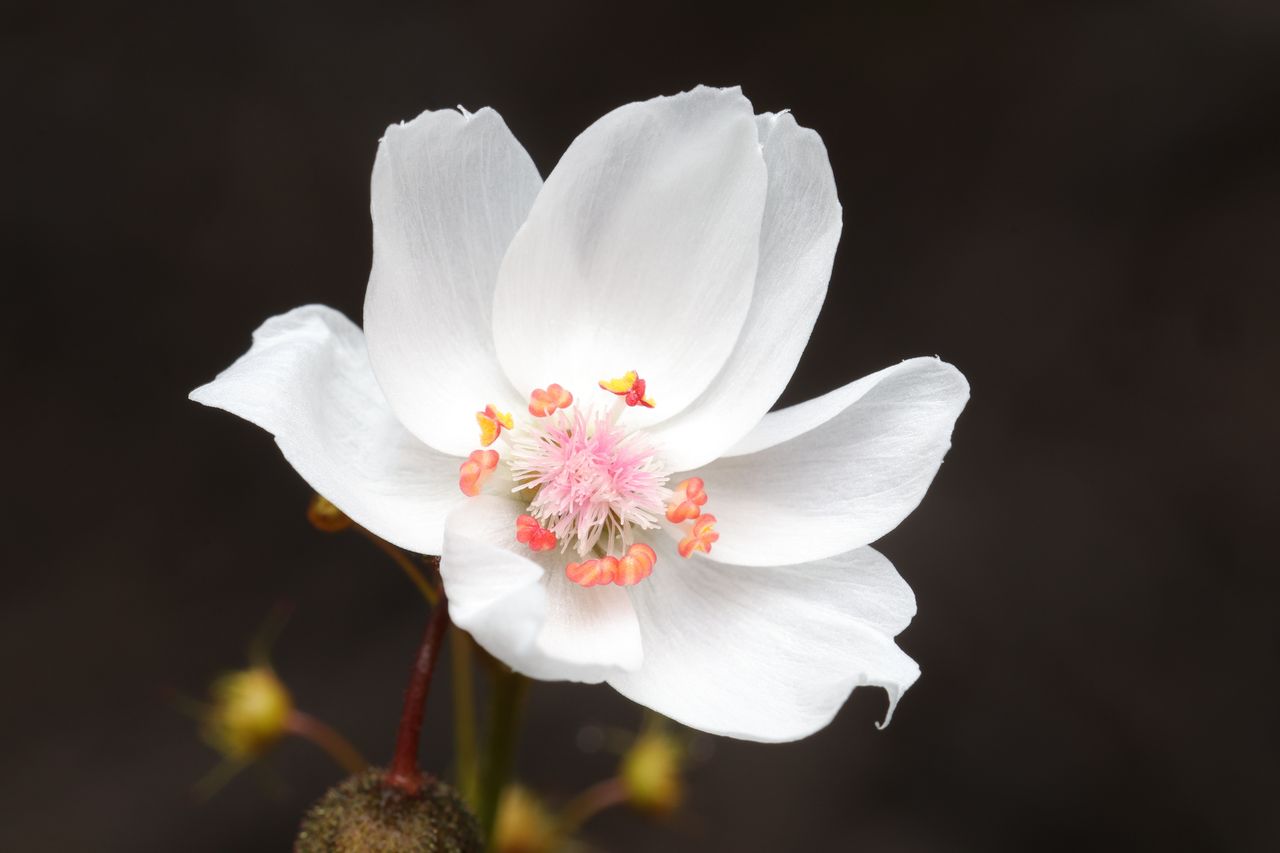
An erect tuberous sundew with pink flowers, described in 1975 by the American botanist Larry DeBuhr and named after Neville Marchant, the Western Australian botanist who with Allen Lowrie drew up much of the modern classification of Australian sundews. Drosera marchantii is a plant of the jarrah forest and coastal plain of the south-west.
Identification
A perennial that each year produces from an underground tuber a stiff, straight stem 10 to 40 cm tall. Along that stem sit small, circular, peltate trapping leaves on stalks. The flowers are pink to pinkish white and appear from June to October. We did not find precise leaf and flower measurements in any source consulted.
Similar species
Other erect tuberous sundews with round, peltate leaves, such as Drosera microphylla, D. peltata and D. huegelii, can look similar out of flower. D. microphylla has large golden sepals, D. huegelii white to cream flowers and bell-shaped leaves. White-flowered plants with many bracts at the base of the stem, from a small area north of Perth, are distinguished as subspecies prophylla (see forms).
The trap and how it works
An active flypaper trap. The round leaf blades carry marginal tentacles with sticky droplets that catch small flying insects. After a catch the tentacles bend to the centre of the leaf and digestive enzymes are secreted. The stiff stem holds the trapping leaves above the low vegetation, where small flies and gnats move about.
Habitat and ecology
Laterite and silica sand soils in damp, swampy places, but also on hilltops (W7, D3, D1), often in open jarrah forest (B1). That spread over wet hollows and drier tops is striking and shows how broad the species is in its choice of habitat. The plant grows in the wet winter and survives the summer as a tuber.
Distribution and elevation
Endemic to south-west Australia. FloraBase lists the Jarrah Forest (Northern and Southern Jarrah Forest subregions) and Swan Coastal Plain (Perth subregion) bioregions. Other sources restrict the typical form to the area between Harvey and Donnybrook; the difference may relate to the separation of subspecies prophylla.
Forms and variation
In 1992 Neville Marchant and Allen Lowrie described D. marchantii subsp. prophylla: smaller, with white flowers and numerous bracts (prophylls) on the lower part of the stem, known from a small area north of Perth and listed in Western Australia as Priority Three (poorly known). The species belongs to section Ergaleium.
Where and when to see it
Search in August or September in open jarrah forest and along the edges of wet hollows between Perth and the Bunbury district. The pink flowers on stiff stems rise above the low vegetation. With white-flowered plants look at the base of the stem: many bracts point to subspecies prophylla.
Conservation status
The species has not been assessed for the global IUCN Red List (NE); in Western Australia the species as a whole is regarded as not threatened, subspecies prophylla as Priority Three. It is not listed in CITES. Threats are those common to jarrah forest and coastal plain: bauxite mining, drainage, urbanisation and the root rot Phytophthora. Uncertainty: we could not confirm in a source the restriction to the area between Harvey and Donnybrook.
Scientific name
Drosera marchantii | De Buhr, 1975
Described by Larry Eugene DeBuhr in 1975, in Aliso, volume 8, no. 3, p. 263. The precise type locality could not be established. Probably named after Neil G. Marchant, the Western Australian botanist who appears repeatedly elsewhere in this guide as (co-)describer of related species (including D. lowriei, above) — a strong inference, but not literally confirmed in a source.
World Checklist of Vascular Plants (WCVP), via Plants of the World Online (POWO), Royal Botanic Gardens, Kew.