All species › Caryophyllales › Sundew family › Drosera magnifica
Drosera magnifica
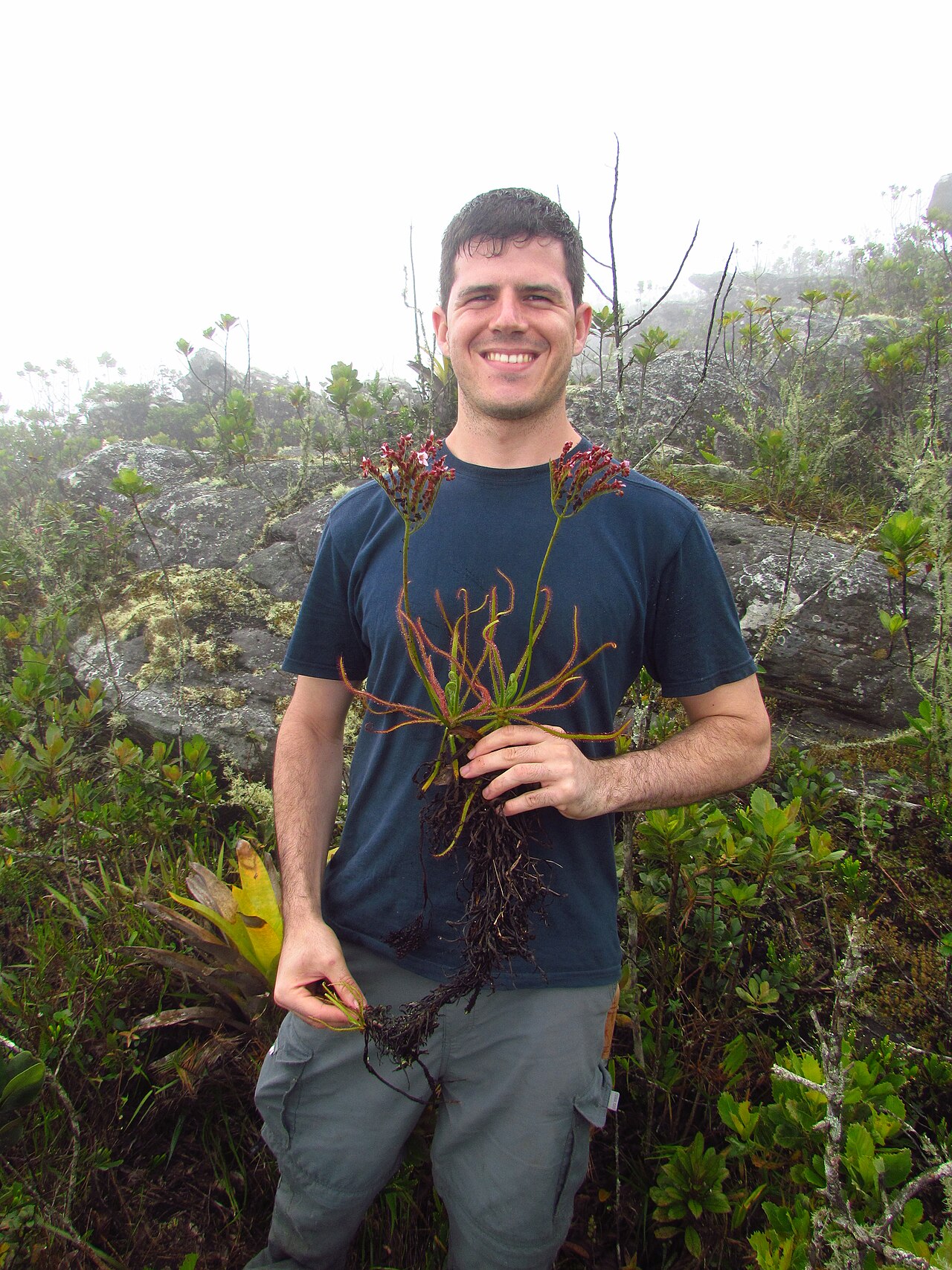
The largest sundew in the New World, and the first plant species discovered through photographs on social media. In 2012 an orchid enthusiast, Reginaldo Vasconcelos, posted pictures of a giant sundew on Facebook; Brazilian botanists recognised it as an unknown species. In 2015 Paulo Gonella, Fernando Rivadavia and Andreas Fleischmann described it as Drosera magnifica, in a paper with the telling title the largest New World sundew, discovered on Facebook.
Identification
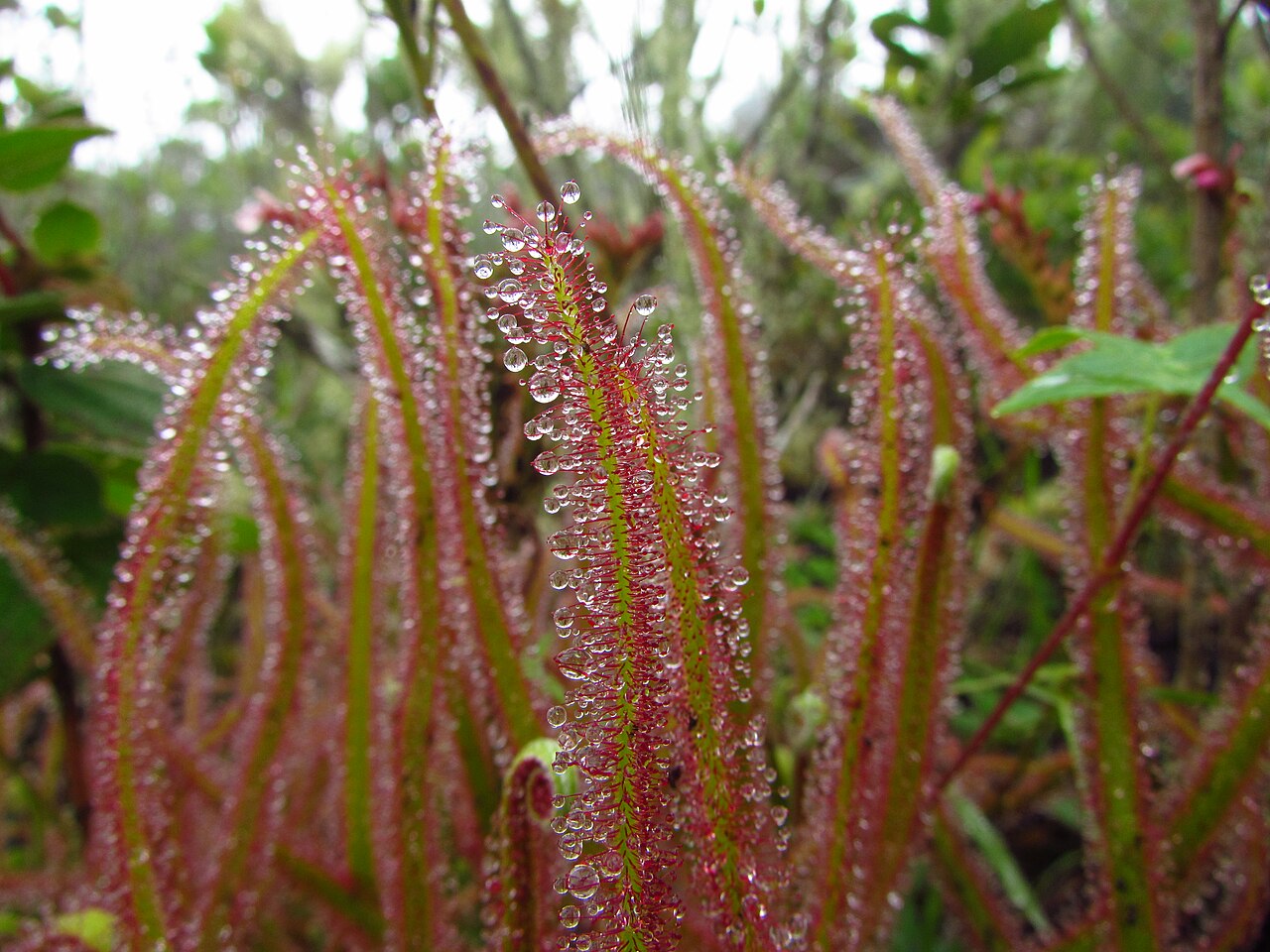
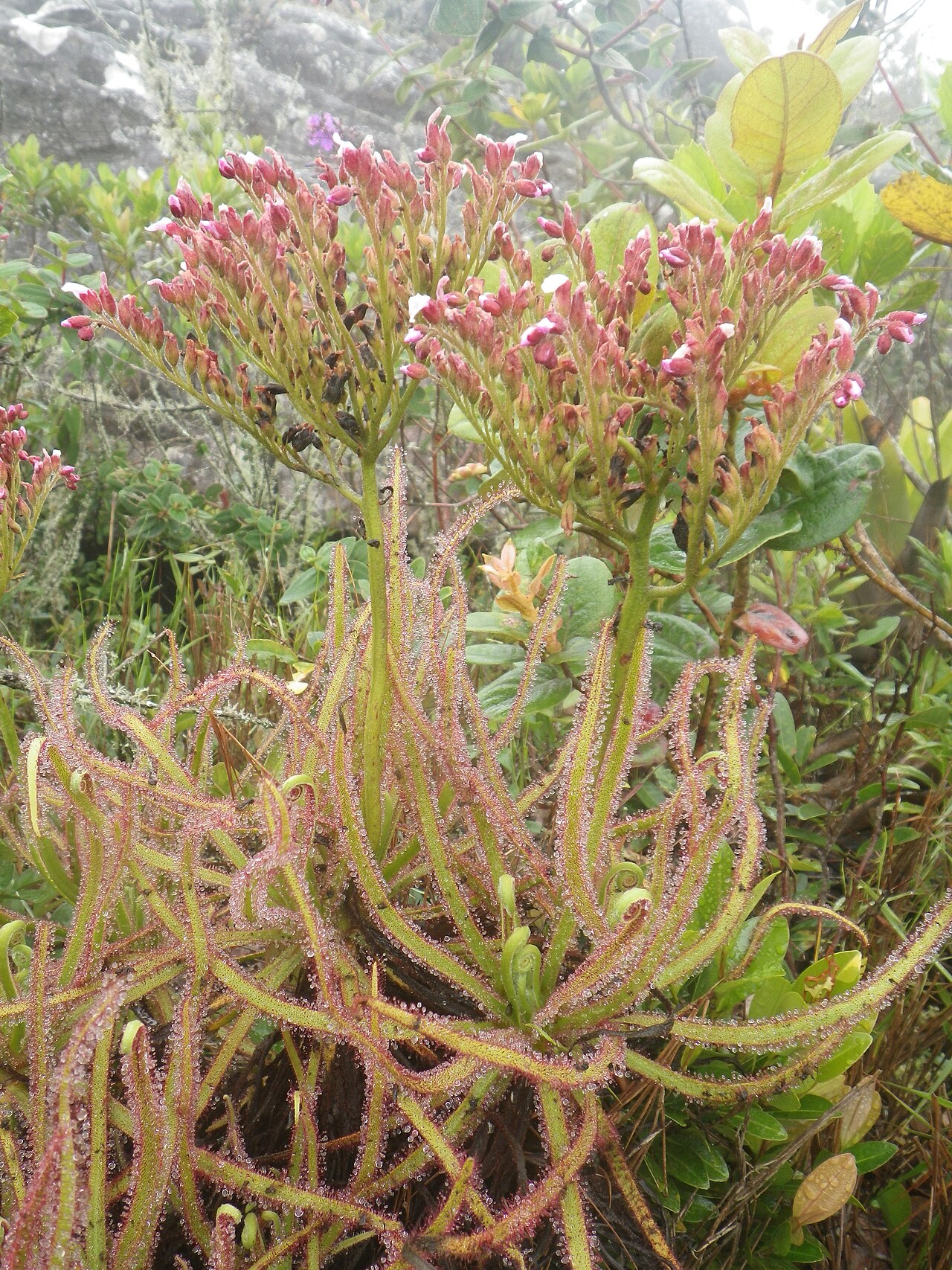
A perennial plant with sprawling to ascending stems up to 120 cm long, which including the leaves can exceed one and a half metres; that places it among the three largest sundews in the world, alongside Drosera regia of South Africa and Drosera gigantea of Australia. The long narrow leaves stand in a loose rosette along the end of the stem. A character unusual among Brazilian sundews is the inflorescence, branched like a candelabrum. Leaf measurements and flower colour are not adopted here.
Similar species
Its size means it cannot be confused with any other American sundew. The species of the Drosera villosa complex and Drosera graminifolia, which grow in the same region, also have long leaves but remain compact rosettes or form at most short columns, with unbranched scapes. Anyone who sees a sundew creeping over the rocks like a sprawling shrub is almost certainly looking at this species.
The trap and how it works
An active flypaper trap on a large scale. The long leaves catch not only gnats and small flies but also larger insects such as butterflies and dragonflies, as is known from the other giant sundews. The tentacles bend towards the prey, and the leaves can curl around the catch along part of their length.
Habitat and ecology
Rocky places on a mountaintop, among boulders and in herbaceous and shrubby vegetation, at 1,500 to 1,530 m (R3, B5). The plant leans its long stems on the surrounding vegetation and rocks. The climate is seasonal, with a wet summer and drier winter.
Distribution and elevation
Endemic to eastern Minas Gerais in south-eastern Brazil and known from a single mountaintop. The exact locality is not given in this guide, since the species is considered critically endangered by its discoverers and is popular with collectors.
- Recorded (one-degree cells)
Forms and variation
No varieties are recognised. The species belongs among the Brazilian mountain sundews; its gigantism is unique within that group. Remarkably, despite abundant seed set the discoverers found no seedlings: reproduction in the wild seems to take place mainly through new shoots sprouting from older plants.
Where and when to see it
Not a species to go looking for. The only known population is small and vulnerable, and every visit increases the risk of trampling and illegal collecting. For enthusiasts the plant is now available in cultivation from legally propagated material; that is the only responsible way to see it up close.
Conservation status
Not assessed for the global IUCN Red List and not listed in CITES. The authors of the description proposed the category critically endangered: the species is known from one mountaintop, the population is small and natural regeneration from seed seems to be lacking. Threats are fire, conversion of the surrounding land to pasture and plantations, and illegal collecting.
Scientific name
Drosera magnifica | Rivadavia & Gonella, 2015
Described by Fleischmann, Rivadavia & Gonella in 2015, in "Drosera magnifica (Droseraceae): the largest New World sundew, discovered on Facebook", Phytotaxa, volume 220, no. 3, p. 257-267 (24 July 2015) — the species was indeed first spotted in a photo on Facebook, before being tracked down in the field. Pico do Padre Ângelo, at 1500-1530 m elevation, eastern Minas Gerais, south-eastern Brazil. From the Latin magnificus ("magnificent, splendid") — refers to the plant's exceptional size: D. magnifica is considered one of the three largest Drosera species in the world and the largest sundew of the New World.
World Checklist of Vascular Plants (WCVP), via Plants of the World Online (POWO), Royal Botanic Gardens, Kew.