All species › Caryophyllales › Sundew family › Drosera macrophylla
Drosera macrophylla
The large-leaved one among the rosette-forming tuberous sundews: macrophylla means 'with large leaves'. Where most south-west Australian sundews are small or slender, this species lays a flat rosette of leaves several centimetres long on the ground in winter. John Lindley described it in 1839, in his sketch of the vegetation of the Swan River Colony; it is a common species east of Perth.
Identification
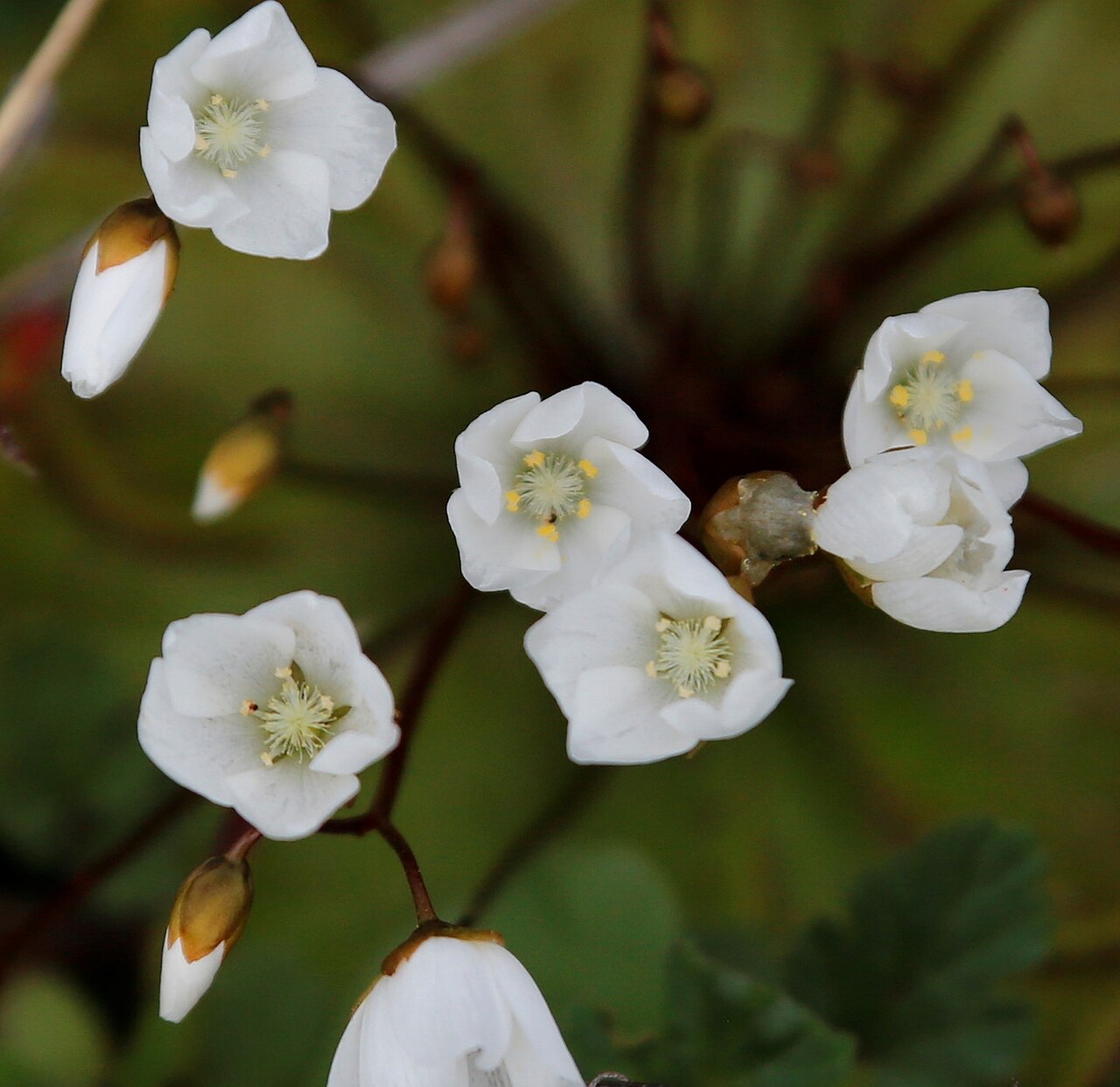
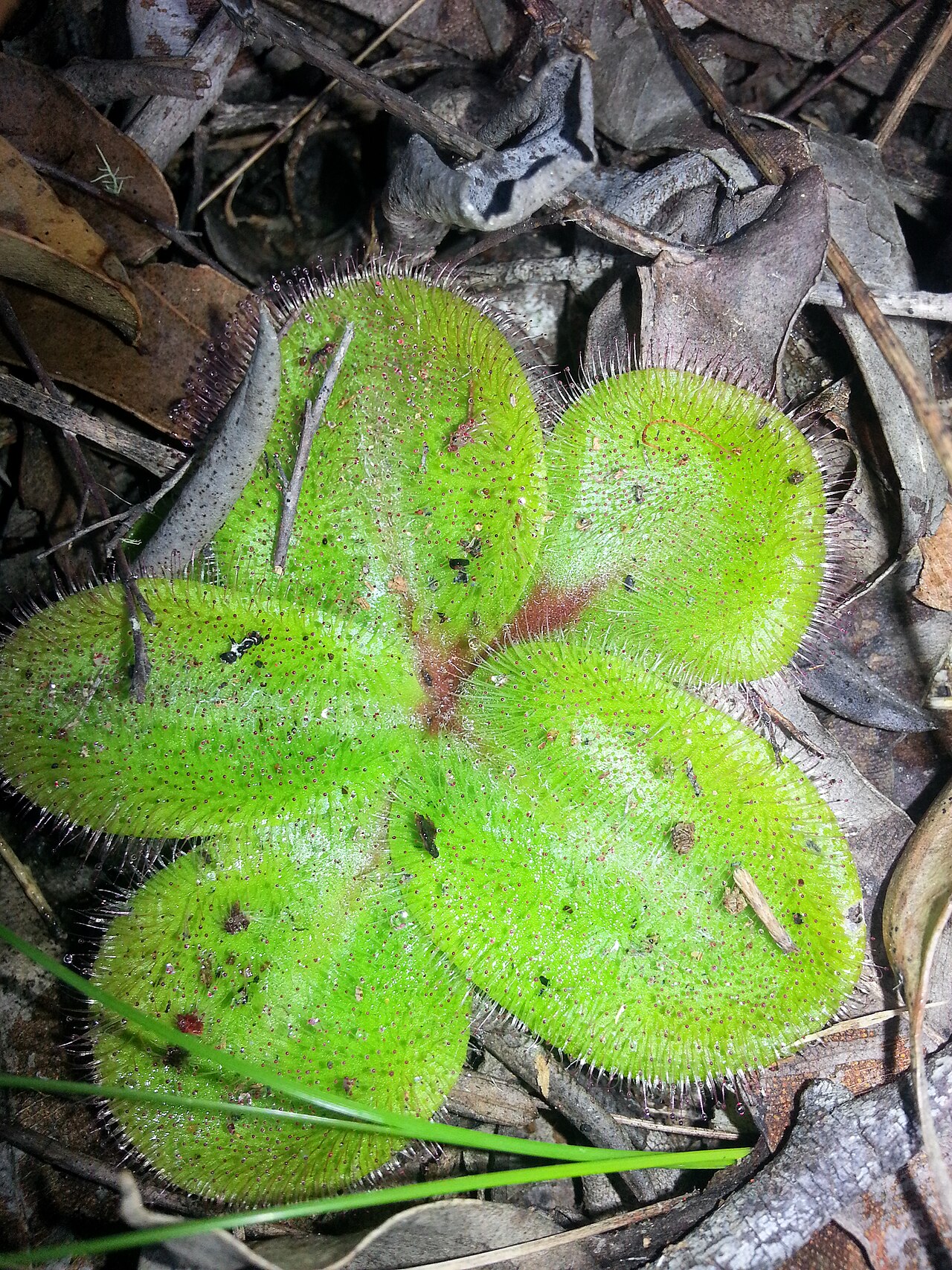
A perennial with an underground tuber from which each year a flat rosette up to 12 cm across grows. The leaves are about 4 cm long and 2 cm wide and lie flat against the ground, their upper surface densely set with tentacles. From the centre, between June and October, one or more short scapes rise with white flowers; in flower the plant is 3 to 15 cm tall. The combination of large, broad, flat-lying leaves and white flowers just above the rosette makes the species recognisable in the field.
Similar species
Other rosette-forming tuberous sundews of section Erythrorhiza look similar. Drosera erythrorhiza also has large flat leaves but a taller inflorescence with more flowers above the rosette. D. lowriei and D. zonaria are smaller. Plants from around Bruce Rock and Merredin with one, rarely two flowers per scape were described as a separate subspecies (see forms).
The trap and how it works
An active flypaper trap. The upper surface of the large leaves carries hundreds of stalked glands with sticky droplets that catch mainly crawling and low-flying insects: ants, springtails, small beetles and flies. The marginal tentacles bend towards the prey and the leaf secretes digestive enzymes. The plant stores its reserves in the tuber, which is renewed every year.
Habitat and ecology
Clay, sand and loam soils, often by granite outcrops (R3, D1, W7), in open woodland and heath of the western and central Wheatbelt. The ground is moist in winter and bone-dry in summer; the plant grows with the autumn rains, flowers in winter and early spring and survives the summer as a tuber.
Distribution and elevation
Endemic to south-west Australia, common east of Perth, in the Darling Range and the western and central Wheatbelt.
- Recorded (quarter-degree cells)
Forms and variation
In 1992 Allen Lowrie and Sherwin Carlquist described D. macrophylla subsp. monantha, with one- or rarely two-flowered inflorescences, common around Bruce Rock and Merredin. FloraBase now flags the name D. macrophylla subsp. macrophylla as not current, suggesting that the subspecific division has been abandoned and monantha is presumably treated as a species in its own right. The species belongs to section Erythrorhiza.
Where and when to see it
July and August are ideal: the rosettes are then fully grown and the first flowers appear. Search by granite outcrops and in open woodland east of Perth, in spots with some bare ground between the vegetation. The rosettes are large enough to spot standing up, especially when the leaves turn red in the sun.
Conservation status
On the global IUCN Red List the species is listed as Least Concern (LC); in Western Australia it is regarded as not threatened. It is not listed in CITES. The species is common, although much of its Wheatbelt habitat has been cleared for agriculture. Uncertainty: we could not check the current taxonomic status of subsp. monantha in the primary literature.
Scientific name
Drosera macrophylla | Lindley, 1839
Described by John Lindley in 1839, in "A Sketch of the Vegetation of the Swan River Colony", p. 20, no. 91. The precise type locality could not be established; given the publication title, the Swan River region, Western Australia, seems likely. From the Greek makros ("large") and phyllon ("leaf") — "large-leaved".
World Checklist of Vascular Plants (WCVP), via Plants of the World Online (POWO), Royal Botanic Gardens, Kew.