All species › Caryophyllales › Sundew family › Drosera gunniana
Drosera gunniana
Drosera gunniana is the newest member of the untangled D. peltata complex. Planchon described the plant in 1848 as variety gunniana of D. peltata, but only in 2018 did Miguel de Salas raise it to species rank. It is a robust, leafy tuberous sundew of grassy woodland in south-eastern Australia and Tasmania, and it also occurs in northern New Zealand, where it was previously recorded as D. peltata and then as D. hookeri.
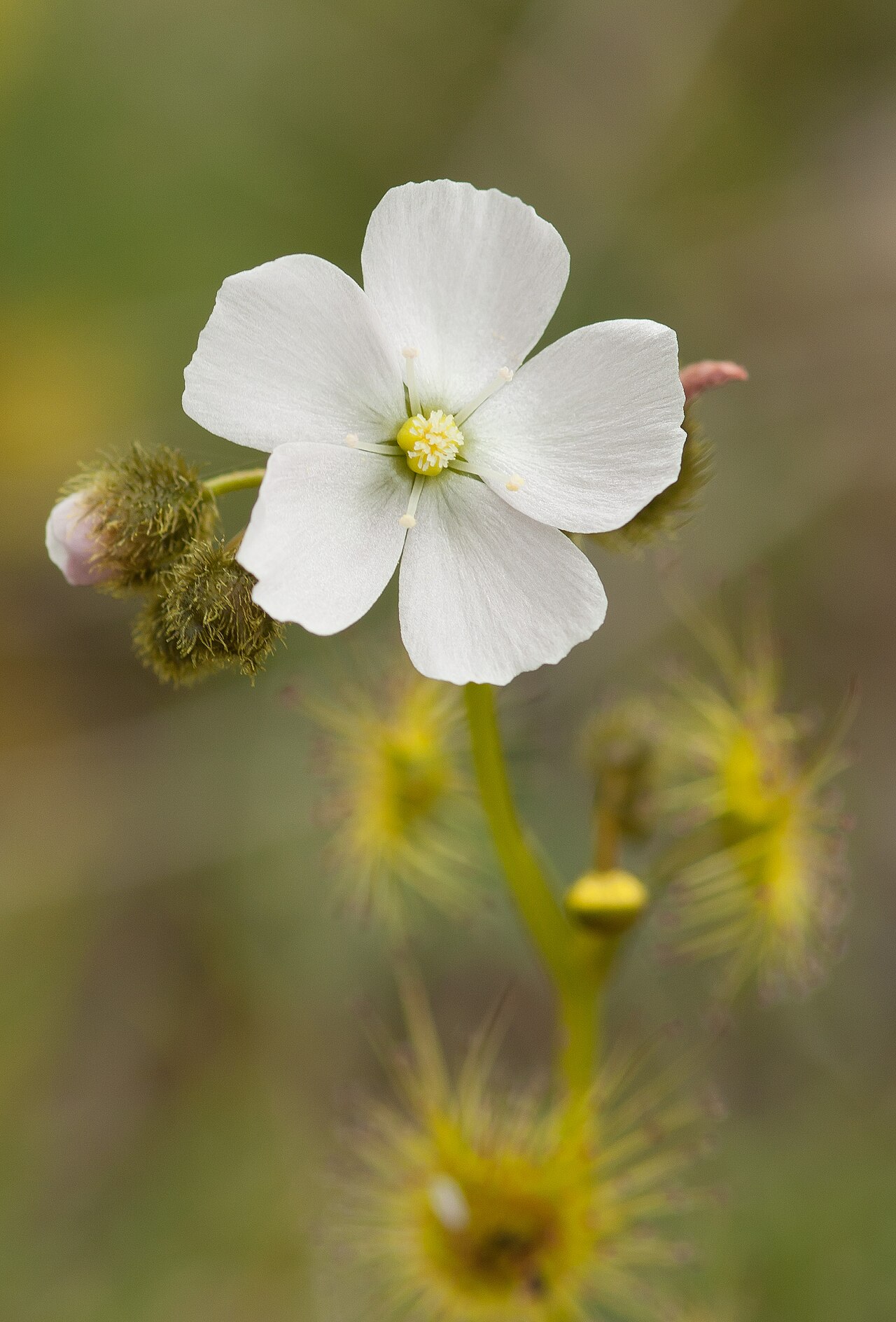
Identification
In winter a pink to red tuber produces a basal rosette of semi-orbicular to lunate, non-peltate leaves 5 to 10 mm across, usually still present at flowering. Then follows an erect stem usually 8 to 22 cm, sometimes over 30 cm, green to red and often flushed orange or red at the base, typically with one clear main stem branching only in its upper part. The cauline leaves are yellow-green, sometimes reddish, peltate and crescent-shaped with auricles, 5 to 6 mm, on stalks 7 to 10 mm long. The buds are almost spherical; the sepals are green or blackish and densely hairy with hairs 0.8 to 1.2 mm long. The petals are pink or white, 5 to 8 mm, and dry pink.
Similar species
Identification within the complex rests on details. Drosera hookeri is smaller (to about 10 cm), often repeatedly branched from the base, with white tubers, sparsely hairy sepals (hairs under 0.6 mm) and smaller white petals 4 to 4.5 mm long; it grows in damp, open grassland. D. peltata in the strict sense has very slender, often leafless stems. D. auriculata has entirely glabrous sepals. A hand lens on the calyx is therefore essential.
The trap and how it works
An active flypaper trap. The peltate, crescent-shaped cauline leaves carry marginal tentacles that are longest on the 'auricles' and bend quickly towards a stuck insect; shorter central tentacles digest the prey. Because the leaves are spread up the whole height of the stem, the plant catches both crawling and low-flying insects.
Habitat and ecology
Woodland, grassy woodland and open grassy places including lawns (B6, H2), in Australia at low to middle elevations. In New Zealand it grows on consolidated coastal dunes, clay pans and sometimes peat, usually in low gumland scrub and adjacent shrubland (B5); it is often abundant there after fires and favours frequently disturbed ground. In summer the plant rests as a tuber.
Distribution and elevation
South-eastern Australia — New South Wales, Victoria, South Australia and Tasmania (mainly the east) — and the North Island of New Zealand, from Te Paki south to northern Waikato. The range description does not mention New Zealand; according to the New Zealand Plant Conservation Network, however, the species does belong to the native flora there. Altitudinal limits are not precisely published; the elevation field is left empty.
- Recorded (quarter-degree cells)
Forms and variation
The combination D. gunniana (Planch.) de Salas is based on D. peltata var. gunniana Planch. of 1848. In the revisions by Gibson, Conn and colleagues (2010–2012), plants now assigned to D. gunniana were partly placed in D. hookeri; De Salas separated them on size, branching, calyx hairs, tuber colour and petal size. Sources from before and after 2018 therefore differ in how they delimit the two species, especially regarding the New Zealand plants.
Where and when to see it
Search in the Australian spring, September to November, in grassy eucalypt woodland and in open grassy places, even park lawns. The leafy stems with pink flowers stand out well among grass. In New Zealand the far north, in gumland and after fires, is the best place. Do not dig up tubers and do not walk on fragile coastal dune vegetation.
Conservation status
The species has not been assessed for the global IUCN Red List and is not listed in CITES. In New Zealand it has been rated unchanged since 2009 as 'Non-resident Native – Coloniser', a native species that probably established itself there naturally. In south-eastern Australia it appears widespread; because of the recent split, a separate status assessment there is not yet available.
Scientific name
Drosera gunniana | (Planchon) de Salas, 2018
Originally described as Drosera peltata var. gunniana by Jules Émile Planchon in 1848, in Annales des Sciences Naturelles, Botanique, series 3, volume 9, p. 297-298. Raised to full species rank as Drosera gunniana (Planch.) de Salas by Miguel de Salas in 2018, in Muelleria, volume 36, p. 92 (or p. 102, sources differ slightly). The precise type locality could not be established, neither for the 1848 basionym nor for the 2018 combination. Very likely named after Ronald Campbell Gunn (1808-1881), the well-known Tasmanian plant collector after whom numerous Australian species epithets were coined by his 19th-century contemporaries, including Planchon. This remains a strong contextual inference, however, not a literally confirmed fact for this specific name.
World Checklist of Vascular Plants (WCVP), via Plants of the World Online (POWO), Royal Botanic Gardens, Kew.