All species › Caryophyllales › Sundew family › Drosera dilatatopetiolaris
Drosera dilatatopetiolaris
Drosera dilatatopetiolaris carries one of the longest names in the genus, and it says exactly what matters: the petioles are broadened. It is a member of the D. petiolaris complex of tropical northern Australia that was illustrated by Ludwig Diels as early as 1906 but described as a species only in 1984, by the Japanese botanist Katsuhiko Kondo. Over time the plant forms large clumps of rosettes.
Identification
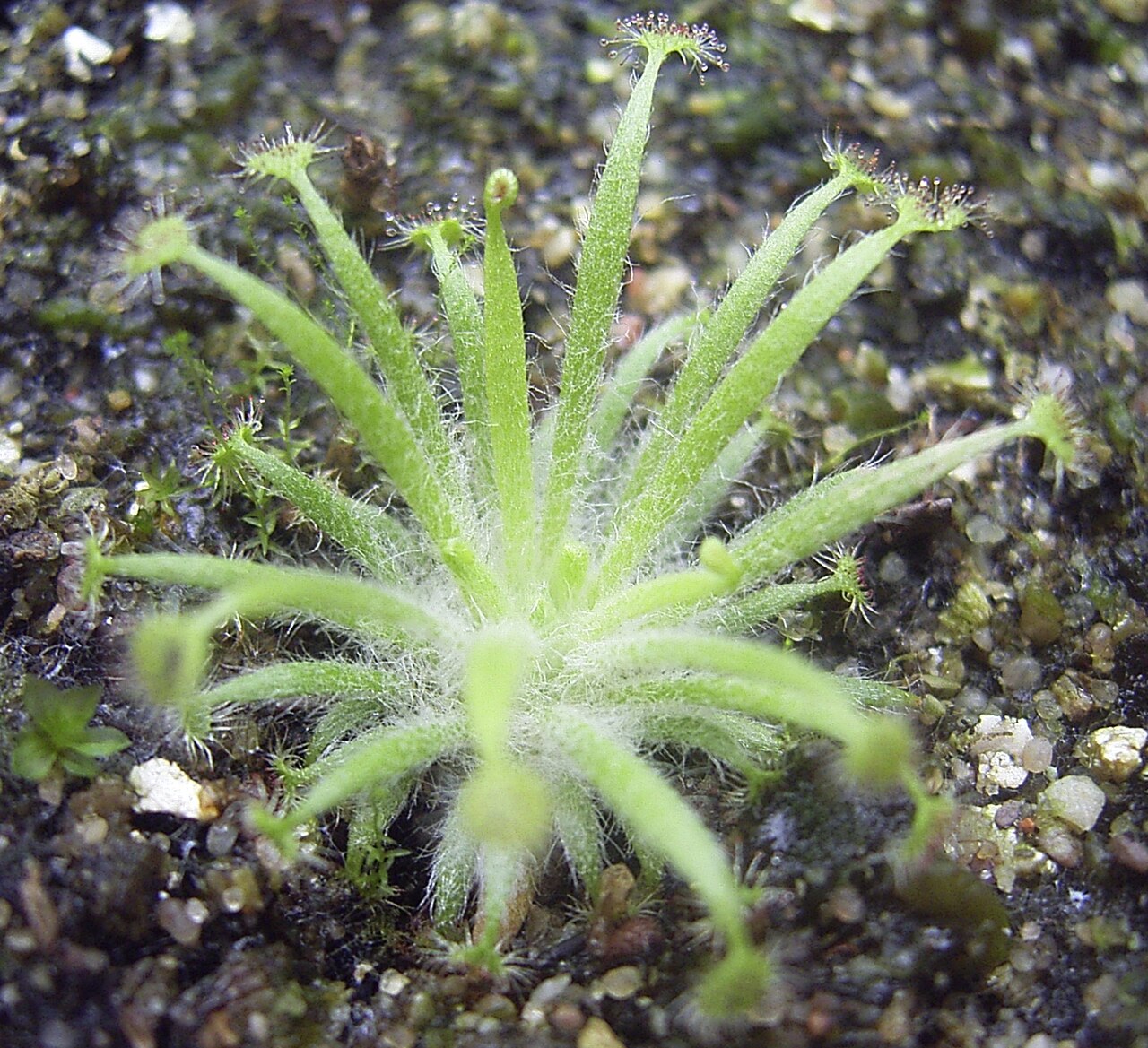
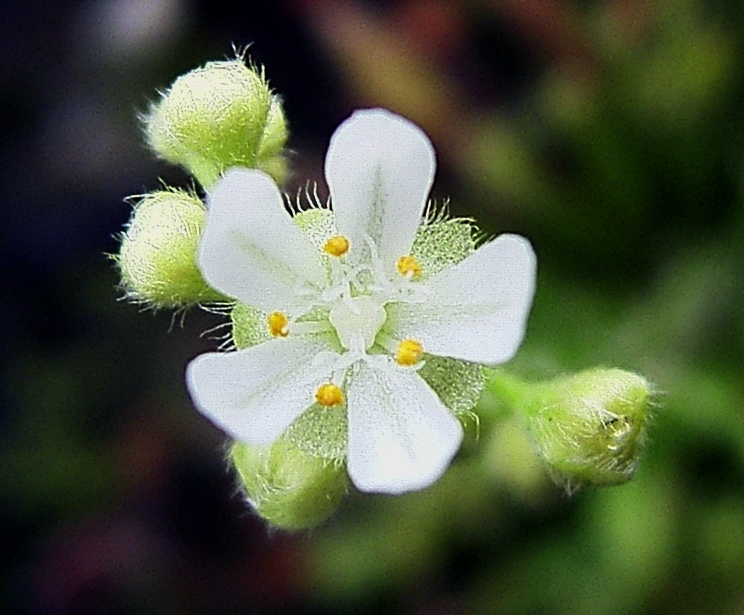
A perennial rosette whose leaves consist of strikingly broad green petioles 3 to 5 mm wide that fan out from the centre and lie mostly on the ground. At the end of each stalk is a small reddish trapping blade with glandular tentacles. The plant regularly produces offsets, so that after a few years dense clumps more than 30 cm across develop. The inflorescences are about 18 cm long and carry white flowers. The chromosome number is 2n = 12.
Similar species
The broad, green, almost glabrous petioles distinguish it from most relatives in the D. petiolaris complex. D. petiolaris has narrower stalks and grows lower and wetter in the landscape; D. ordensis also has broad stalks, but they are densely silvery-hairy; D. fulva and D. brevicornis have narrower stalks and taller inflorescences. The tendency to form large clumps is an additional field character.
The trap and how it works
An active flypaper trap. The small reddish blades lie at the ends of the broad stalks on or just above the ground, and with their sticky glandular tentacles catch mainly crawling and low-flying insects such as ants, springtails and gnats. The tentacles bend towards the prey, after which digestion follows. The broad green stalks probably contribute mainly to photosynthesis.
Habitat and ecology
Damp sandy ground on somewhat higher parts of the landscape than D. petiolaris, such as sandy plateaus and slopes above the wettest hollows, often on sandstone (D2), which become wet in the rainy season (W7), in open savanna woodland (B6).
Distribution and elevation
Endemic to northern Australia: the Darwin area in the Northern Territory and the northern Kimberley in Western Australia. The range description 'tropical northern Australia' fits. Altitudinal limits are not published in the sources consulted; the elevation field is left empty.
- Recorded (quarter-degree cells)
Forms and variation
No varieties are recognised. Kondo described the species in 1984 as one of three he distinguished within the D. petiolaris complex. The name was originally hyphenated ('dilatato-petiolaris'), but that form has been corrected under the rules of nomenclature. The low chromosome number (2n = 12) is notable within the genus.
Where and when to see it
Search in the late wet season and early dry, when the plants flower, on damp sandy ground on slightly higher parts of the savanna, for instance around Darwin. The green clumps with their fanning broad stalks are easy to recognise. Do not enter private or Aboriginal land without permission.
Conservation status
On the IUCN Red List the species is Least Concern (LC); it is not listed in CITES. The range spans parts of two states and lies mostly in little-developed country. Around Darwin urban growth and changes in fire regime are possible local threats.
Scientific name
Drosera dilatatopetiolaris | Kondo, 1984
Described by K. Kondo in 1984, in Boletim da Sociedade Broteriana, series 2, volume 57, p. 52. Ludwig Diels had already recognised and illustrated this taxon in 1906 in his Droseraceae monograph, but it remained formally undescribed for about 80 years until Kondo's publication. Northern Australia — coastal areas near Darwin (Northern Territory) and the northern Kimberley region (Western Australia), on damp sandy soils on higher ground. No precise type locality is known. From dilatato- ("widened, dilated") and petiolaris ("pertaining to the petiole") — refers to the distinctly widened leaf petioles (typically 3-5 mm wide).
World Checklist of Vascular Plants (WCVP), via Plants of the World Online (POWO), Royal Botanic Gardens, Kew.