All species › Caryophyllales › Sundew family › Drosera burmannii
Drosera burmannii
Drosera burmannii, the tropical sundew, is a small annual rosette with a reputation: it is one of the fastest trappers in the whole genus. Where most sundews take hours to wrap an insect, its marginal tentacles bend within seconds. The species has a wide tropical range, from India through southern China and South-East Asia to northern and eastern Australia, and often grows on open, seasonally wet ground.
Identification
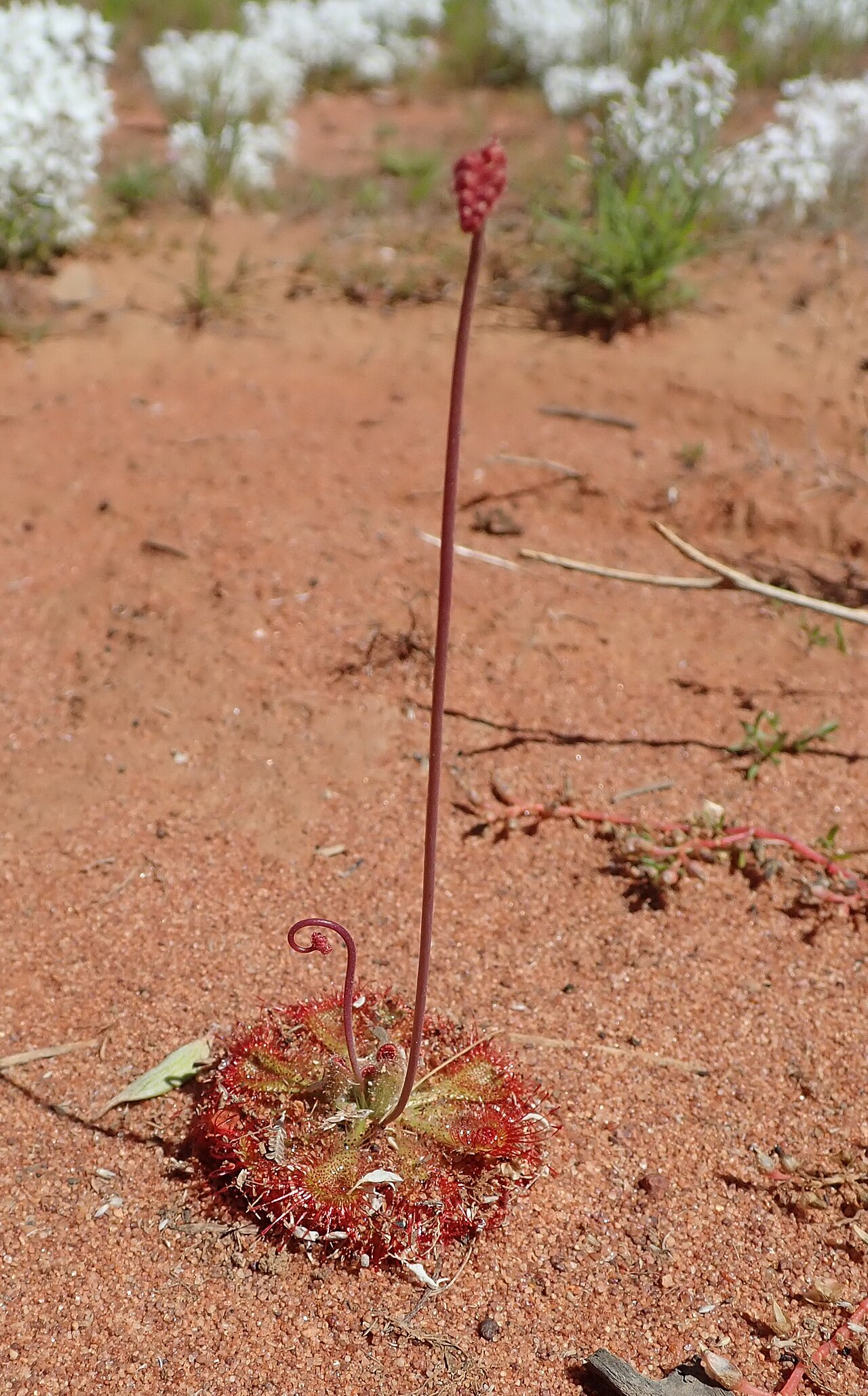
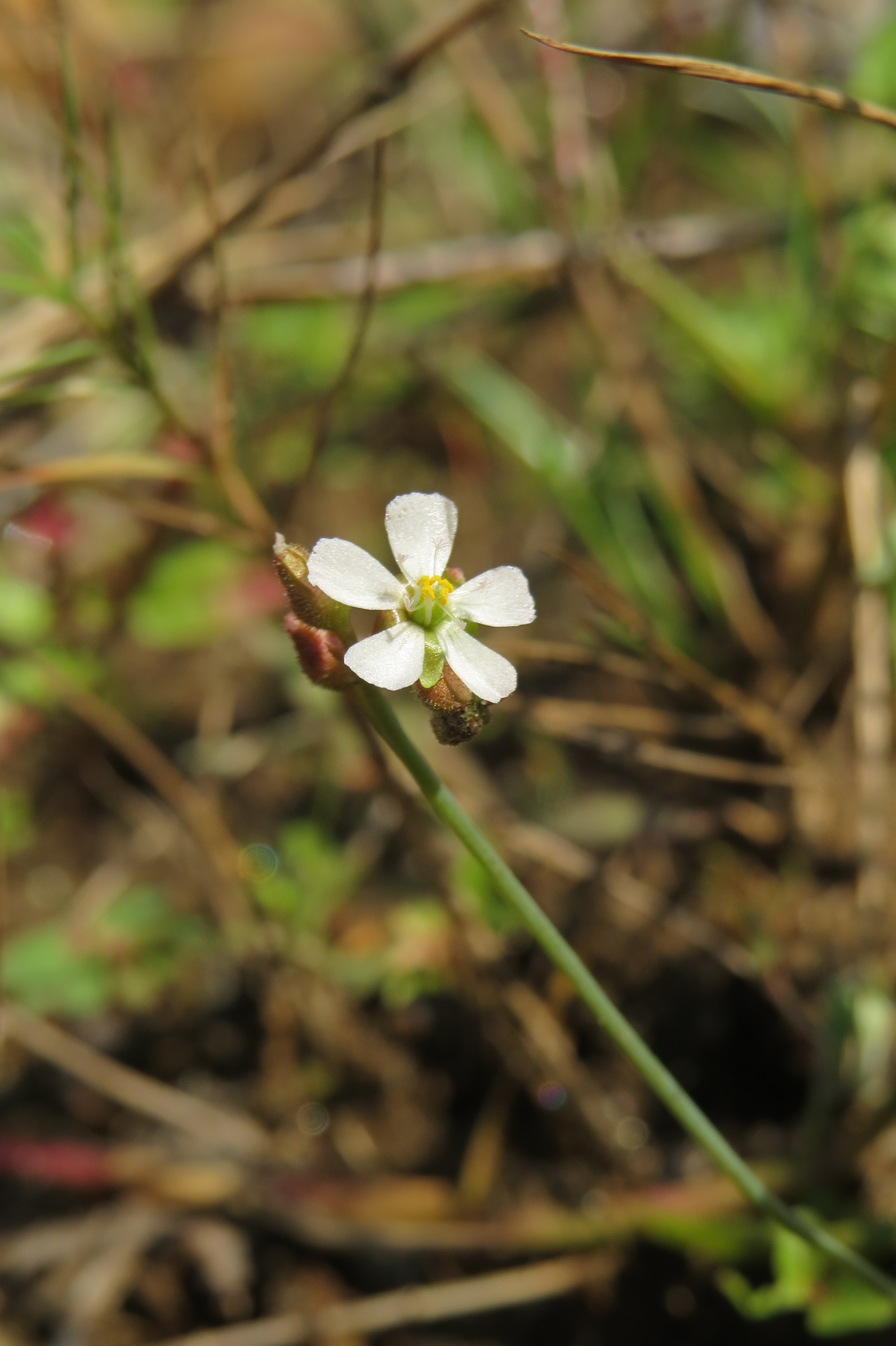
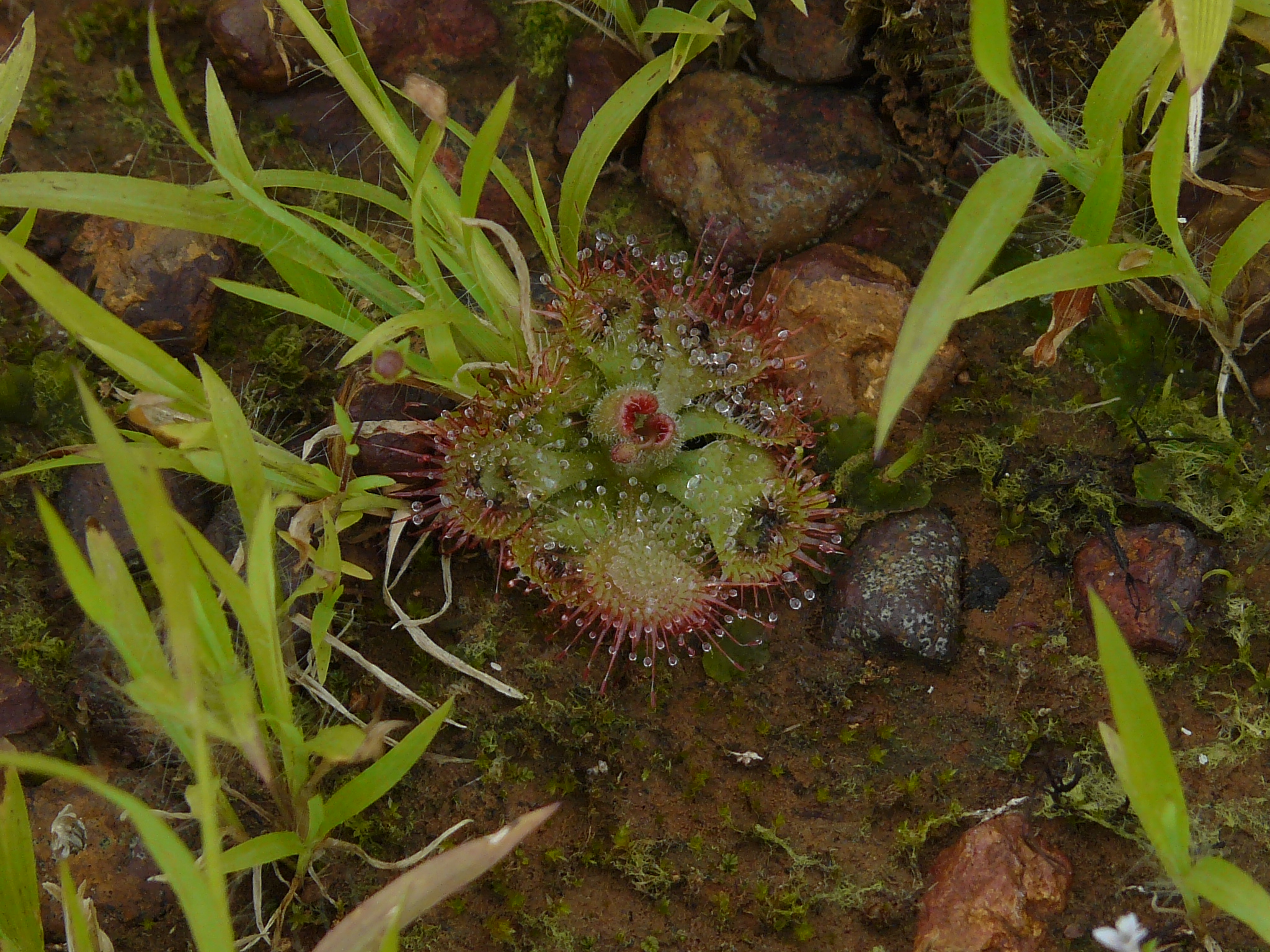
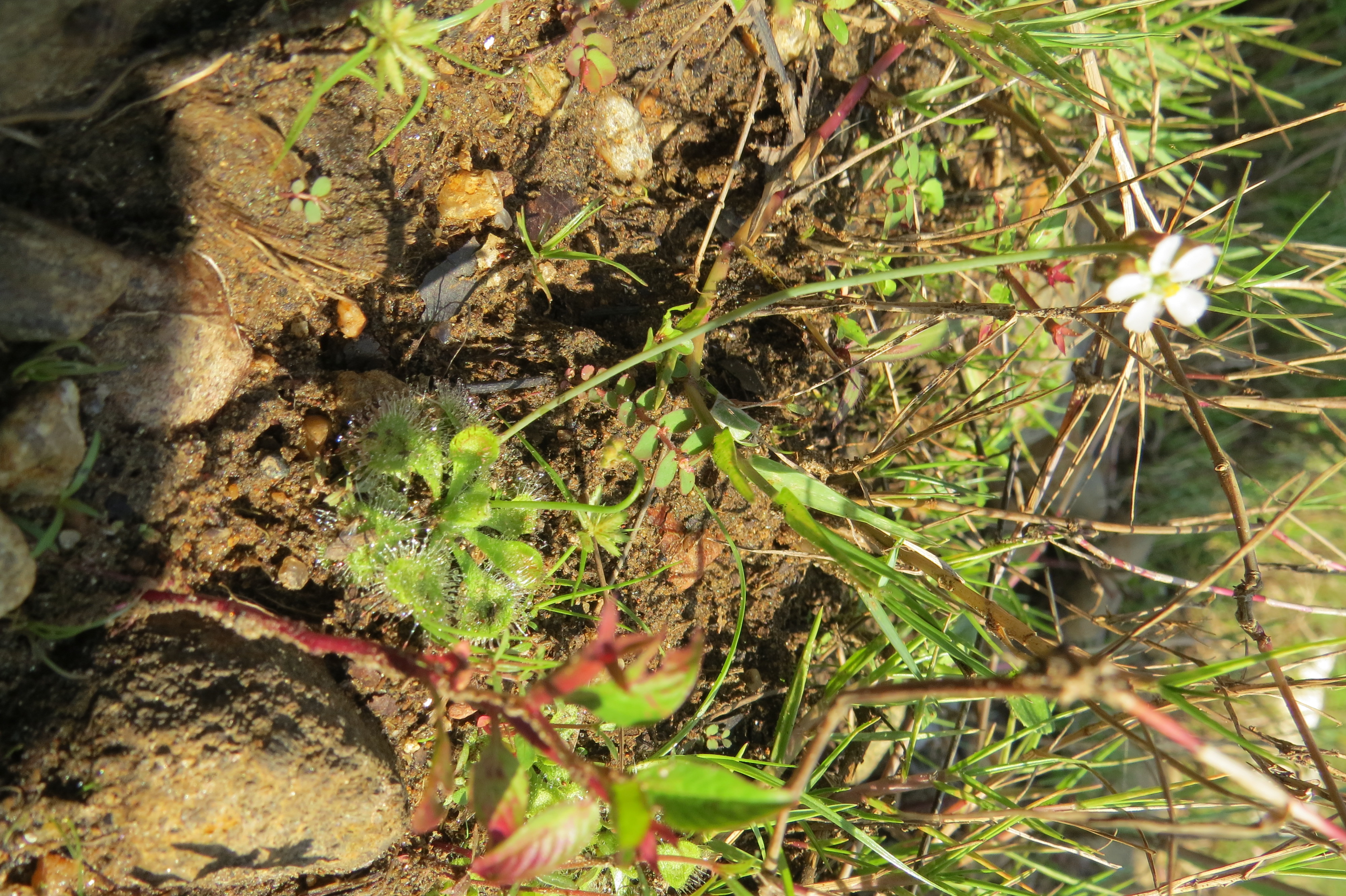
A compact rosette pressed flat to the ground, usually about 2 cm across, green or red in sun. The leaves are wedge-shaped to almost round, 6 to 10 mm long and 4 to 6 mm wide, without a distinct petiole. The marginal tentacles are characteristic: they are conspicuously long and stand like a crown around the leaf, while the tentacles on the blade are short. A plant produces one to three thin, erect flowering stems, each with three to ten small white flowers. The flowers have five separate styles, a feature of the small section Thelocalyx to which the species belongs.
Similar species
Drosera spatulata has elongate, spoon-shaped leaves on a distinct stalk and lacks the crown of long marginal tentacles. In northern Australia it may be confused with young rosettes of species in the D. petiolaris complex, but these have long, narrow petioles with a small round blade at the tip and often white hairs. The closely related Drosera sessilifolia from South America is the second member of the section; it does not occur in the same area.
The trap and how it works
An active flypaper trap with a whiplash. The long marginal tentacles are touch-sensitive and can snap towards the centre of the leaf within a few seconds, carrying an insect stuck at the edge to the short digestive tentacles in the middle. The leaf itself then curls somewhat around the prey. This rapid movement, comparable to that of Drosera glanduligera from southern Australia, allows the plant to hold even active prey such as ants and springtails.
Habitat and ecology
Open, sunny, nutrient-poor ground that is wet in the rainy season and may dry out afterwards: seasonal swamps and wet hollows (W7), open patches in savanna and tropical woodland (B6), sand flats (D1) and disturbed ground such as wet verges, tracks and old fields (H2). As an annual it survives the dry season as seed; after the first rains the seeds germinate en masse.
Distribution and elevation
Tropical and subtropical Asia — India, Sri Lanka, South-East Asia, Taiwan and the southern Chinese provinces of Guangxi, Guangdong, Yunnan and Fujian — and Australia, where it occurs mainly in the tropical north and along the east coast. Flowering times and altitudinal limits vary greatly by region and are not published consistently; those fields are left empty.
- Recorded (quarter-degree cells)
Forms and variation
No varieties are formally recognised, but the species varies in colour (green to deep red) and in how round or wedge-shaped the leaves are. Forms circulate in cultivation under the names of their origins. In the wild the plant is annual; under favourable conditions it can live longer. The name honours Johannes Burman, who described the plant in 1737; Vahl gave it its valid name in 1794.
Where and when to see it
Search after the start of the rainy season on open, wet sandy or loamy patches in savanna country, along tracks and in wet verges. The rosettes are small but catch the eye with their red colour and crown of glistening marginal tentacles. With patience you can watch the trapping movement itself: a touched marginal tentacle visibly snaps inwards. Do this gently with a grass stalk and no more than once per leaf — every movement costs the plant energy.
Conservation status
On the IUCN Red List the species is Least Concern (LC); it is not listed in CITES. Thanks to its huge range and its ability to colonise disturbed wet ground quickly, it is not threatened globally. Locally it declines where wet hollows are drained or fertilised. In Ayurvedic tradition the plant was used as a skin irritant, but collecting on a large scale is not a significant threat.
Scientific name
Drosera burmannii | Vahl, 1794
Described by Martin Vahl in 1794, in Symbolae Botanicae, volume 3, p. 50. The correct original spelling is "burmannii" (from the Latinised "Burmannus"), though the misspelling "burmanni" is frequently used. The precise type locality of Vahl's description could not be established. Earlier, pre-Linnaean descriptions (Paul Hermann, published posthumously by William Sherard; and Johannes Burman's more detailed 1737 account) were both based on material from Ceylon (Sri Lanka), but this is not confirmed as Vahl's own type locality. The species today occurs in India, Taiwan, South East Asia, China and Australia. Named in honour of Johannes Burman, the botanist who gave the first detailed description of the species in 1737.
World Checklist of Vascular Plants (WCVP), via Plants of the World Online (POWO), Royal Botanic Gardens, Kew.