All species › Caryophyllales › Sundew family › Drosera biflora
Drosera biflora
One of the longest-known sundews of northern South America. The name Drosera biflora, two-flowered, goes back to Carl Ludwig Willdenow and was published after his death in 1820 by Roemer and Schultes, probably based on material from the South American journey of Alexander von Humboldt and Aimé Bonpland. It is a small plant of open white sands in the savannas of the Orinoco and Amazon regions.
Identification
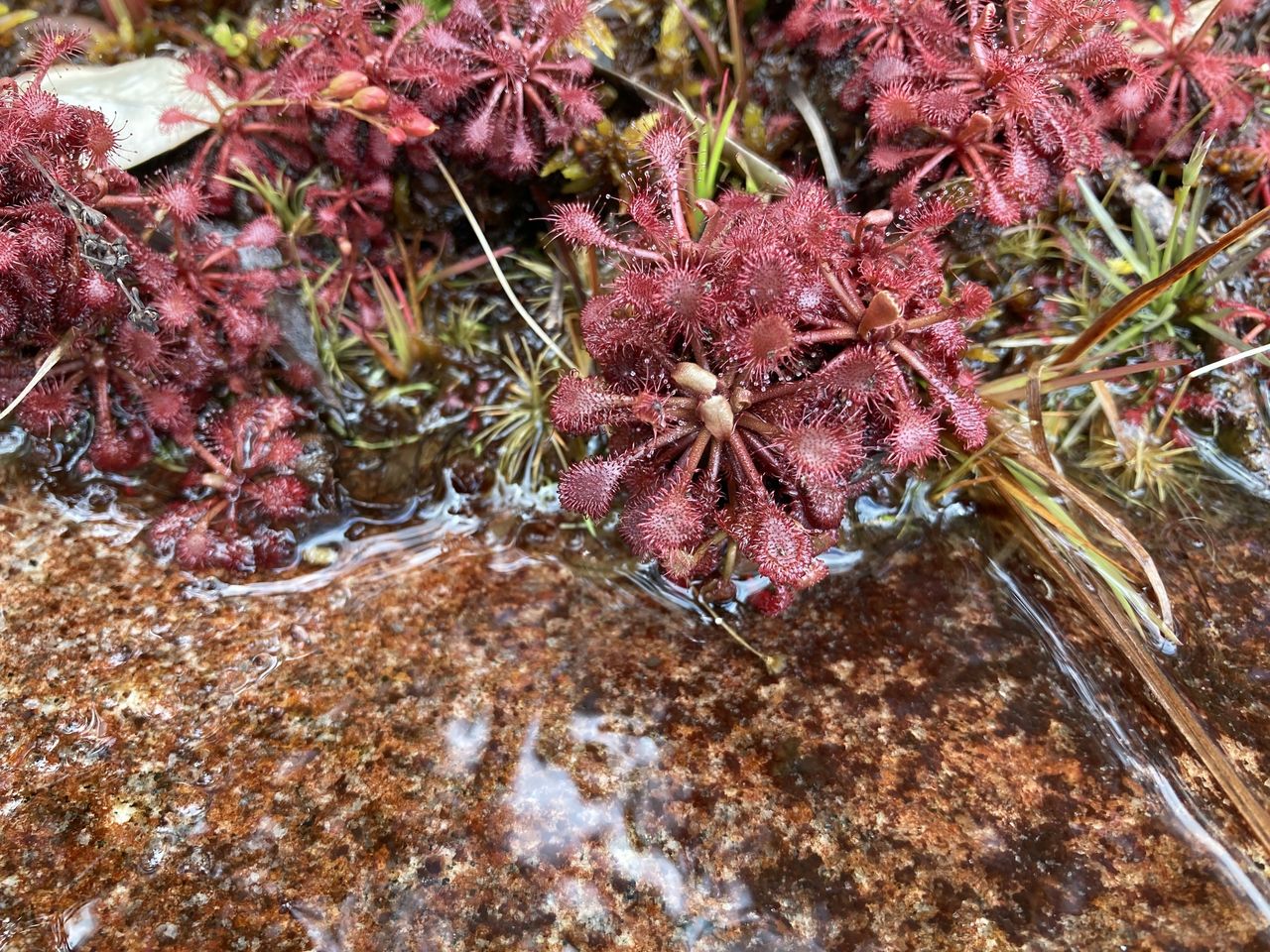
A small, flat rosette of short leaves densely set with tentacles, red in sun. The thin scapes carry few flowers; the species name refers to inflorescences often of only two flowers. Reliable measurements and a confirmed flower colour could not be checked in the available sources; the size fields are left empty.
Similar species
More small sundews grow on the same white sands: Drosera esmeraldae in Venezuelan Amazonia, Drosera sessilifolia with sessile, wedge-shaped leaves, Drosera cayennensis with spatulate leaves and more flowers per scape, and in the floodplains Drosera amazonica, which forms an elongated stem. The small number of flowers per scape is a clue, but not a conclusive character.
The trap and how it works
An active flypaper trap on a small scale. The tentacles catch ants, springtails and small flies moving over or just above the white sand; the rosette lies flat on the ground. On the heavily leached white sands this prey provides an important part of the nitrogen.
Habitat and ecology
Open, sunny and extremely poor lowland white-sand savannas and sand flats, with patches that are boggy or flooded in the rainy season and dry out in the dry season (D1, B6, W7). The plant grows among dwarf grasses, Xyris, Eriocaulaceae and bladderworts.
Distribution and elevation
Northern South America: Venezuela, Colombia, Guyana, Suriname and northern Brazil, mainly in the white-sand areas of the Orinoco and northern Amazon basins. A published altitudinal range has not been adopted.
- Recorded (one-degree cells)
Forms and variation
No varieties are recognised. As with many small sundews of the Guiana Shield, the boundary with related names is not clear everywhere, and a modern revision of the group with DNA work is still lacking.
Where and when to see it
In the rainy season search bare, wet white-sand patches in savannas, for instance along sandy tracks in the interior of Suriname or in Venezuelan Amazonia. Because the plant is so small it is most conspicuous with flowers open, on sunny mornings. Bring a hand lens.
Conservation status
Not assessed for the global IUCN Red List and not listed in CITES. The species is widespread across northern South America, so there appears to be no immediate cause for concern at species level. White-sand savannas are locally threatened by sand extraction, gold mining and road building.
Scientific name
Drosera biflora | Willdenow ex Roemer & Schultes, 1820
Manuscript name by Carl Ludwig Willdenow, validly published by Roemer & Schultes in 1820, in "Systema Vegetabilium", 15th edition (bis), volume 6, p. 763. "In arenosis humidis Rio Atabapo (Orinoco)" — wet sandy ground along the Río Atabapo (Orinoco basin); lectotype collected by Humboldt & Bonpland (no. 1100). The species occurs in Venezuela, Colombia and the Brazilian Amazon. From the Latin bi- ("two") and flora/florus ("flower") — "two-flowered"; a transparent name, though the exact explanation is not literally confirmed in a source.
World Checklist of Vascular Plants (WCVP), via Plants of the World Online (POWO), Royal Botanic Gardens, Kew.