All species › Caryophyllales › Sundew family › Drosera acaulis
Drosera acaulis
One of the earliest-described sundews of the Cape: Linnaeus the Younger published Drosera acaulis in 1781, in the same work as D. cuneifolia. The name means 'stemless' and refers to the rosette lying flat on the ground with no visible stem. Despite that long history it is a poorly documented species.
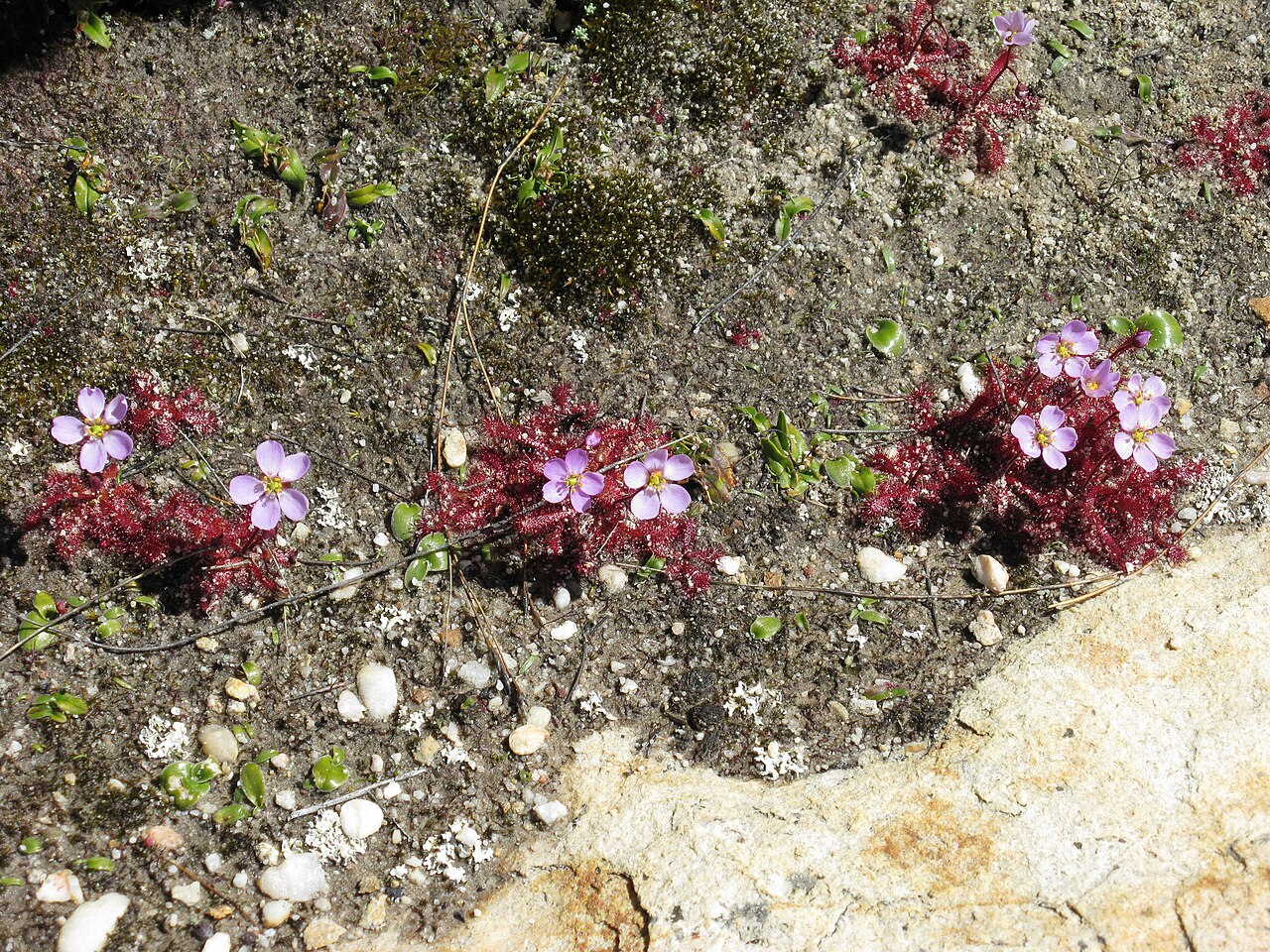
Identification
A small, flat-lying rosette without a stem, with glandular trapping leaves and a short scape. Reliable published measurements and a flower colour from a flora were not available for this text; the measurement fields are left empty.
Similar species
Confusion is possible with other small Cape rosette species such as D. trinervia and D. alba, and with young rosettes of D. cistiflora and D. pauciflora before they flower. Note: English Wikipedia lists a name D. acaulis as a synonym under D. pauciflora; that is presumably a homonym, not this species.
The trap and how it works
An active flypaper trap: stalked glands with sticky droplets catch small insects on the wet ground, after which tentacles bend towards the prey and digestive enzymes are secreted.
Habitat and ecology
As far as is known a winter grower of open sandy places in fynbos that are wet in winter (W7, D1, B5). Detailed habitat data are lacking.
Distribution and elevation
Endemic to the Cape Provinces of South Africa. A more precise range could not be established from the sources consulted; altitudinal limits were not found.
- Recorded (one-degree cells)
Forms and variation
The species appears in Kew's lists and in the Wikipedia list of Drosera sect. Drosera as an accepted Cape species. The application of the name in the eighteenth and nineteenth centuries was not consistent, however, and older literature may mean other Cape rosette species by D. acaulis. Caution is needed here.
Where and when to see it
Anyone who finds a small stemless rosetted sundew in the Cape that does not match the familiar species should photograph rosette, leaf base and flower and have the record checked by a specialist.
Conservation status
Not assessed for the global IUCN Red List and not listed in CITES. The state of its populations is insufficiently known. Cape lowland habitats are generally under pressure from agriculture, building and invasive alien plants.
Scientific name
Drosera acaulis | Linnaeus filius, 1781
A nuanced case: Drosera acaulis L.f. was described by Carl Linnaeus the Younger in "Supplementum Plantarum", p. 188 (1781/1782). Thunberg later independently described a Drosera acaulis Thunb. in 1794, in "Prodromus Plantarum Capensium", volume 1, p. 57 — sources disagree on whether this is the same name or a synonymous one. The precise type locality could not be established with certainty. The species occurs in the south-western Cape Province, South Africa. From the Latin a- (privative prefix) and caulis ("stem") — "stemless", referring to the leaf rosette that grows flat on the ground without a visible stem.
World Checklist of Vascular Plants (WCVP), via Plants of the World Online (POWO), Royal Botanic Gardens, Kew.