All species › Lamiales › Rainbow plant family › Byblis guehoi
Byblis guehoi
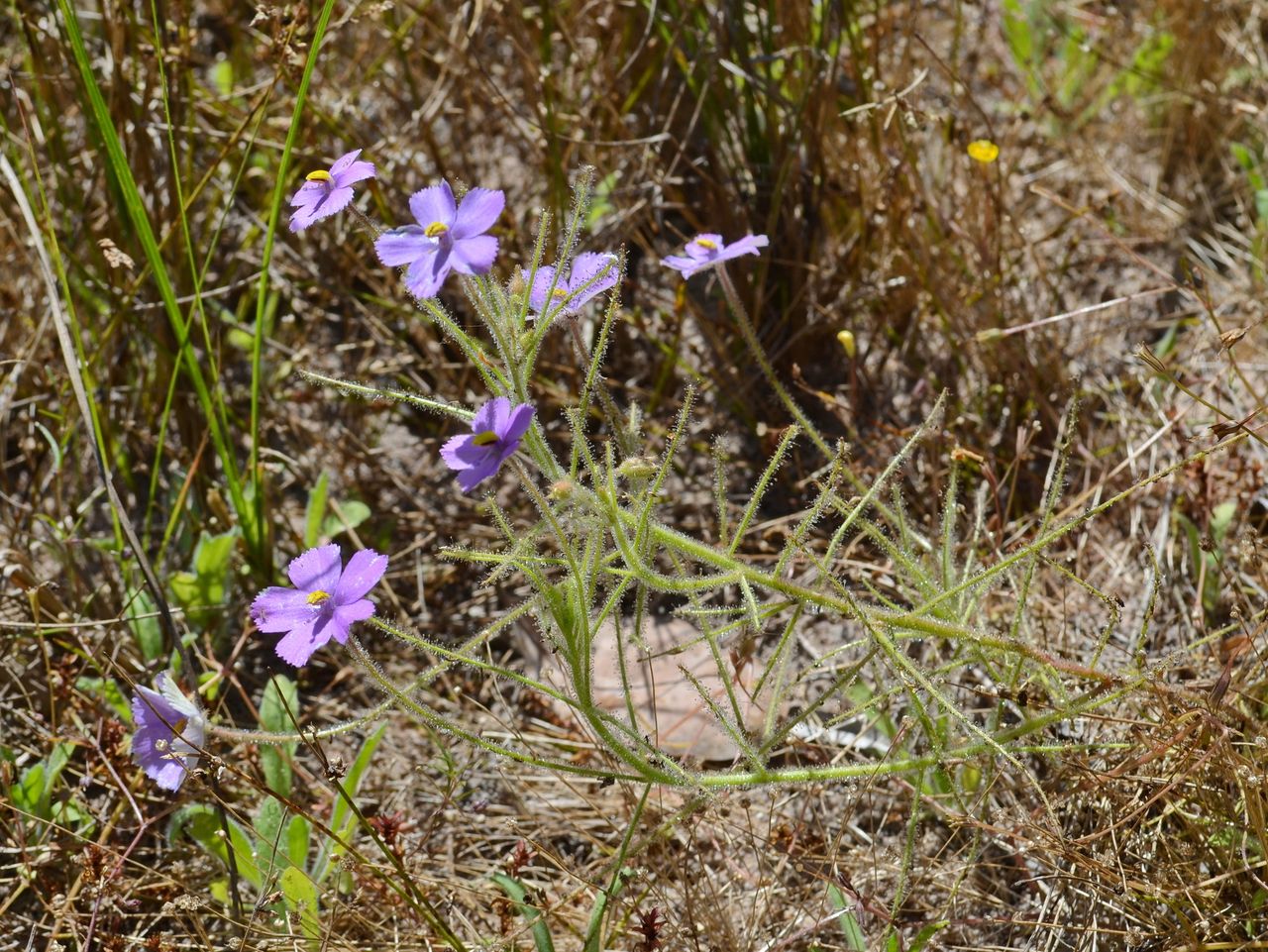
This is the youngest species of the genus in Australia and at the same time the most contested. Byblis guehoi was described only in 2008, from the Dampier Peninsula in the western Kimberley, and differs from the common Byblis filifolia in seed structure and chromosome number but hardly at all in appearance. What does make it recognisable is the growth form: instead of a single straight stem the plant produces one or more decumbent axes, each ending in a densely flowered head-like shoot, so that a well-grown individual may carry ten or more shoots at once — a candelabrum of sticky threads on the red pindan sand.
Identification
An annual with one or more decumbent main axes 15 to 18 cm long, branching at random along their length and each ending in an erect, leafy, many-flowered head-like shoot 6 to 8 cm tall. Often there are three or four compact clusters of short-stemmed flowering shoots besides. The whole plant is covered in a dense coat of translucent long and short glandular hairs, which in sunlight lay a haze around it. The leaves are thread-shaped, 2.5 to 3.3 cm long, elliptic in cross-section — about 1 mm wide by 0.5 mm thick — and glandular along their whole length; they are shorter than the flower stalks. The petals are obovate, 9 to 12 mm long, pinkish mauve above and white beneath, with an irregularly serrate to dentate tip. The anthers are 4 to 6 mm long and therefore longer than the purple, closely clustered filaments of 1.5 to 2 mm.
Similar species
The problem with this species is Byblis filifolia, which shares the country and the same floral build, with anthers longer than the filaments. The differences lie in the seed and the chromosome number — B. guehoi is tetraploid, B. filifolia diploid — and those are not field characters. What can be used in the field are the decumbent main axes with head-like flowering shoots and the short leaves, which stay shorter than the flower stalks; B. filifolia grows erect to 60 cm and is woody at the base. Byblis rorida carries glandular setae of 0.7 to 1.5 mm on the sepals, far longer than here. Byblis liniflora is smaller and has anthers shorter than the filaments; with that species guehoi does share chromosome number and long flower stalks, which leaves relationships within the genus unresolved for now.
The trap and how it works
A passive flypaper trap, as everywhere in the genus. The long stalked glands carry a clear droplet and hold whatever they touch; leaf and gland do not move and no stimulus is processed. The far smaller sessile glands on the leaf surface do the digesting: they go to work only once prey is lying on them, release enzymes and take up the liberated nitrogen and phosphorus. What stands out in this species is how far the glandular covering extends: not only the leaves but also the stems, flower stalks and sepals are densely set with long and short glandular hairs, which gives the plant a haze in backlight and at the same time keeps crawling animals off the flower. The catch consists mostly of small flying insects.
Habitat and ecology
Pindan: the deep, reddish sand of the Dampier Peninsula, a soil with low water-holding capacity and a low nutrient content. The sites are saturated or flooded in the wet season and then dry out quickly and completely. The species turns out to be less particular than assumed: field workers have found it in freshly burnt, bone-dry eucalypt savanna, in depressions that stand under water during the wet, and even along permanently wet swamps. What is never missing is full light. In the fixed codes: seasonally dry ground (D4) on a sand plain (D1) that works as a seepage swamp during the monsoon (W3).
Distribution and elevation
The Dampier Peninsula in the western Kimberley, Western Australia. The species was originally reported only from the type locality near the Beagle Bay mission, where it is locally abundant, and later field observations extended that to the peninsula as a whole; the herbarium records it from the Dampierland region. It is therefore endemic to Australia and within Australia confined to an area of a few tens of thousands of square kilometres. It is a lowland plant; no documented altitudinal limit exists, so the elevation field is left empty.
- Recorded (one-degree cells)
Forms and variation
Branching varies a great deal. On the best sites a plant makes ten or more shoots at once, but many individuals in the field are barely branched or not branched at all, so the character that gives the species its character in the description is in practice erratic. Flower size also varies within one season: while the soil is still moist the flowers are larger, and as the dry season advances they get smaller. No varieties or colour forms are recognised and no natural hybrids are known. Some field workers do suggest that this species, together with B. rorida and possibly B. pilbarana, merges into a highly variable B. filifolia; that is a hypothesis, not an accepted arrangement.
Where and when to see it
The months after the monsoon, roughly April to August, offer the best chance: the plants are in flower and the pindan sand is drivable. Search open patches in the eucalypt savanna, along sand tracks and on recently burnt ground, and look with the sun low behind you. At any find, note the growth form of the whole plant — decumbent axes with head-like flowering shoots — and photograph the leaf cross-section and the calyx as well; only that makes a record separable from B. filifolia afterwards. The Dampier Peninsula is largely Aboriginal land; seek permission for access in advance.
Conservation status
The Red List treats the species as Vulnerable, and the Western Australian Herbarium gives it the highest attention category for poorly known taxa. The reason is not demonstrated decline but the combination of a small range, few confirmed sites and virtually no data on population sizes. Changes in fire regime and damage to the pindan soil from roads, clearing and grazing are the main concerns, together with the simple fact that a species so hard to tell from its common relative is easily overlooked in surveys.
Scientific name
Byblis guehoi | Lowrie & Conran, 2008
Described by Allen Lowrie and John G. Conran in 2008, in the paper "Byblis guehoi (Byblidaceae), a new species from the Kimberley, Western Australia", published in Telopea 12(1): 23–29. The species is endemic to the Kimberley region of Western Australia. The species name guehoi honours a person with the surname Gueho; the precise background of this dedication could not be established with certainty.
World Checklist of Vascular Plants (WCVP), via Plants of the World Online (POWO), Royal Botanic Gardens, Kew.