All species › Even-toed ungulates › Pigs › Wild Boar
Wild Boar | Sus scrofa
Wild zwijn | Jabalí
The wild boar is numerous across much of Europe but is seldom seen because of its nocturnal habits. Its signs are large and unambiguous: a churned forest ride, a wallow with fresh mud and a trunk with black bristles show that boar are present, roughly how many, and how recently they were there. No other European mammal leaves a comparable combination of signs.
Tracks
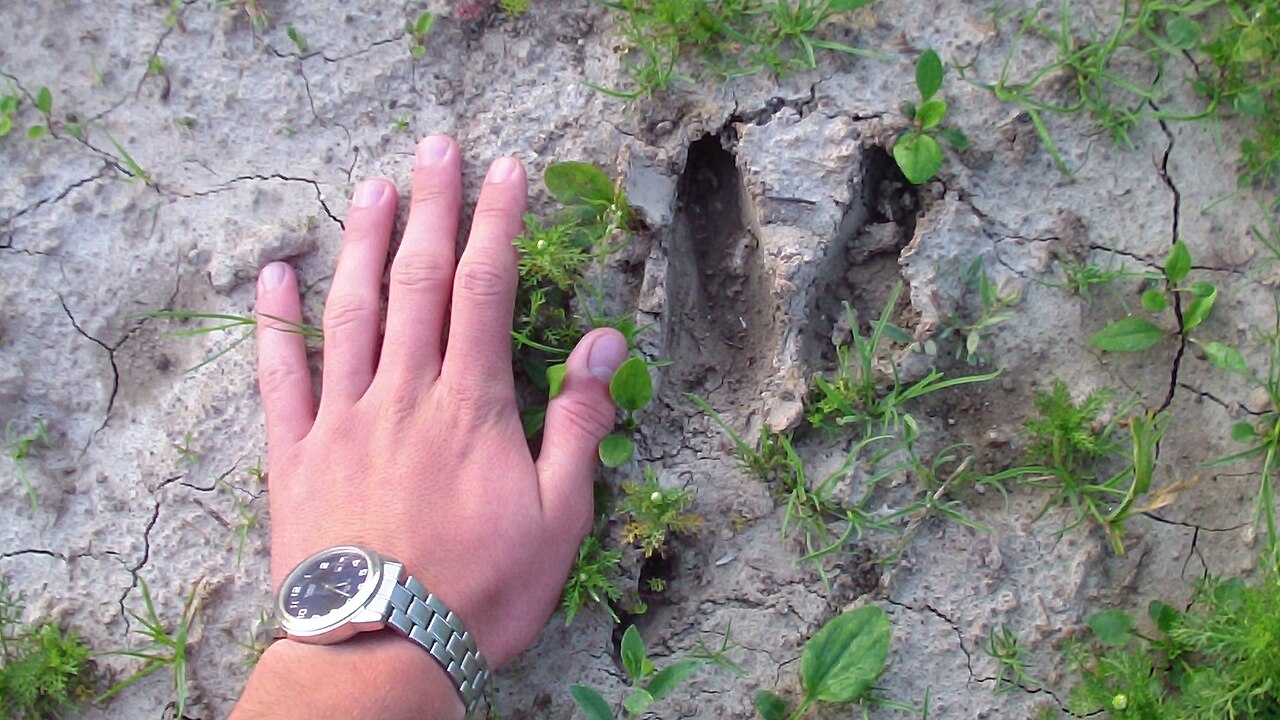
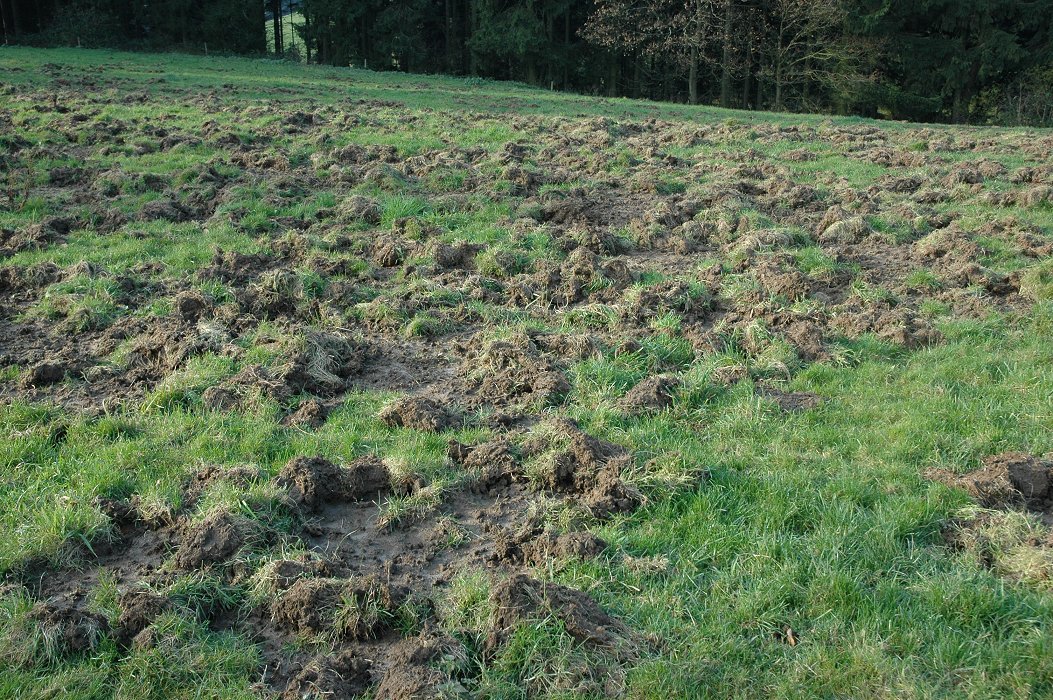
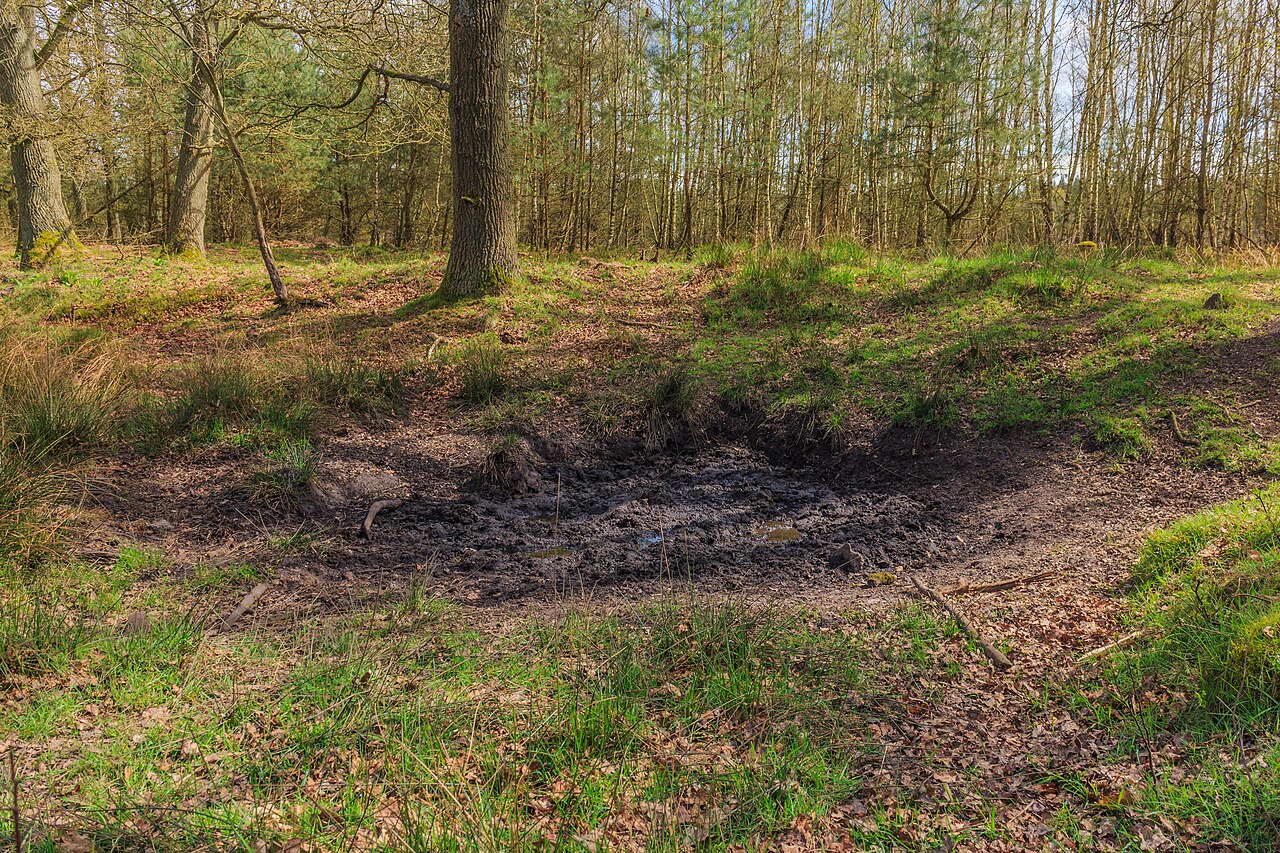
The wild boar leaves the most varied signs of any European mammal, because it turns over the soil of its habitat. Rooting is the principal sign: over anything from a square metre to half a hectare the turf is turned over in slabs with the roots uppermost and the soil loose, and on the woodland floor the litter layer is churned in a broad band. Rooting occurs on forest rides, in meadows, on golf courses, lawns and verges, and in autumn is deepest under oak, holm oak and beech, where acorns and mast are sought. The second sign is the wallow: a shallow churned pool in a wet hollow, used for years, with a trampled rim and mud spattered on the vegetation around it. Beside almost every wallow stands a rubbing tree, usually a spruce, pine, juniper or solitary trunk, plastered with dried mud to 60 to 100 cm, the bark worn smooth and shiny at shoulder height and coarse black bristles stuck in the resin and the mud; above them the oblique gashes of tusks are sometimes visible. The combination of rooting, wallow and rubbing tree occurs in no other European animal. The slot is cloven but far rounder and blunter than a deer's: 4 to 8 cm long and nearly as wide, the two halves spread apart and rounded at the tips. Behind it the two dew claws register almost every time, even at a walk on level ground, and they stand wider than the hoof itself: two round dots outside the slot to left and right. In roe deer the dew claws register only in a bound or in mud. A sounder leaves a broad trampled path. The dropping is an irregular compressed cylinder 4 to 7 cm thick, made of pellets stuck together, crumbly and dark, with acorn cups, grain or maize in it. There are also mud smears on wire and along the underside of fences where the animals push through, bristles caught on the wire, and the farrowing nest: a mound of dragged-together bracken, grass and branches in which a sow gives birth, with clear hollows where the animals lay.
In its habitat
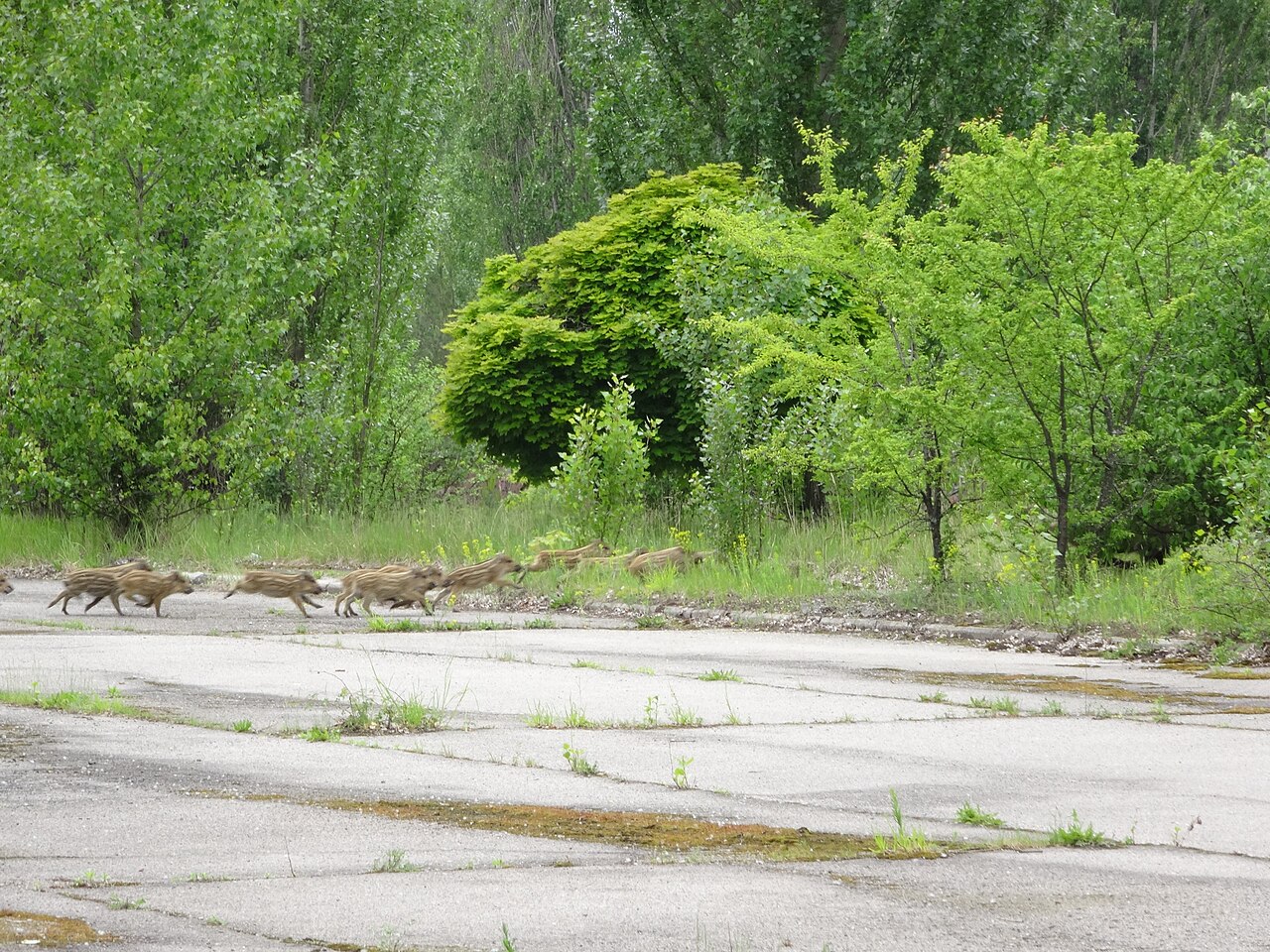
The young
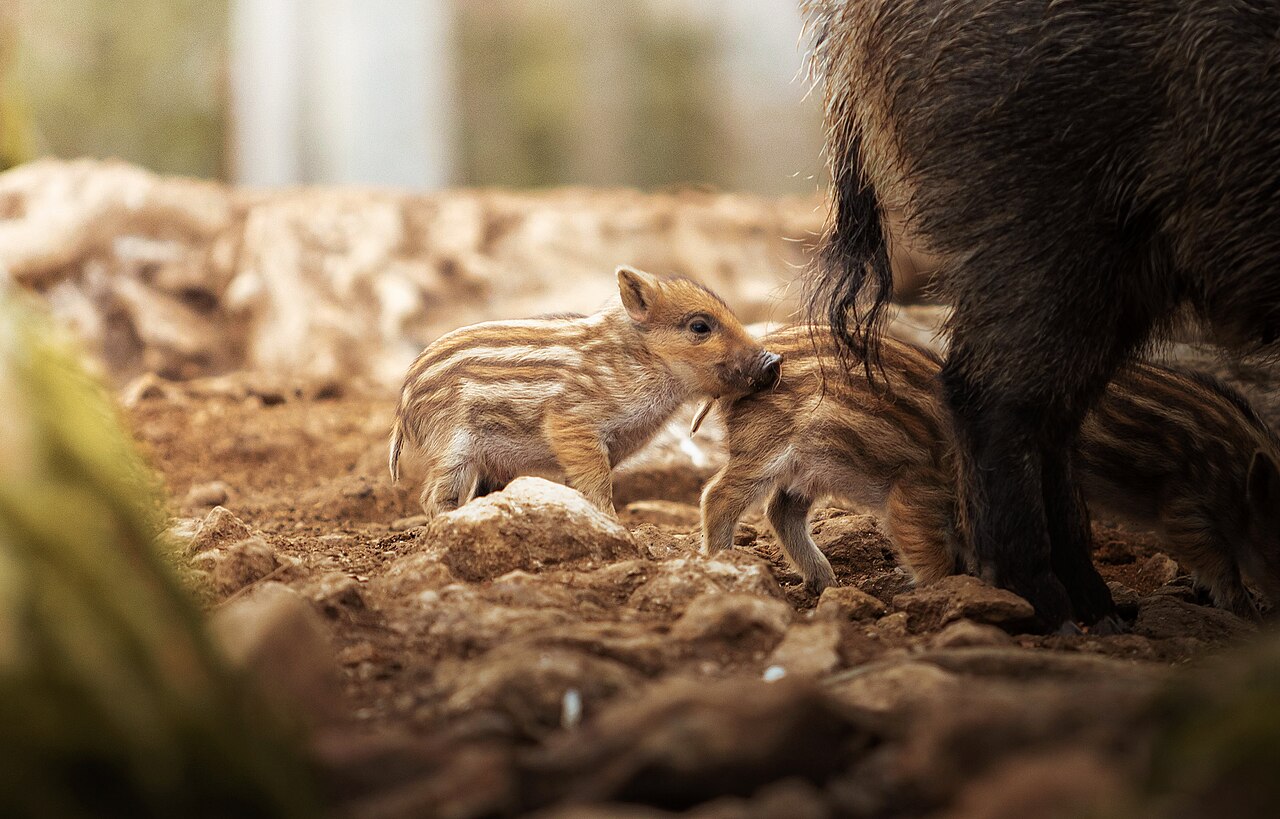
Identification
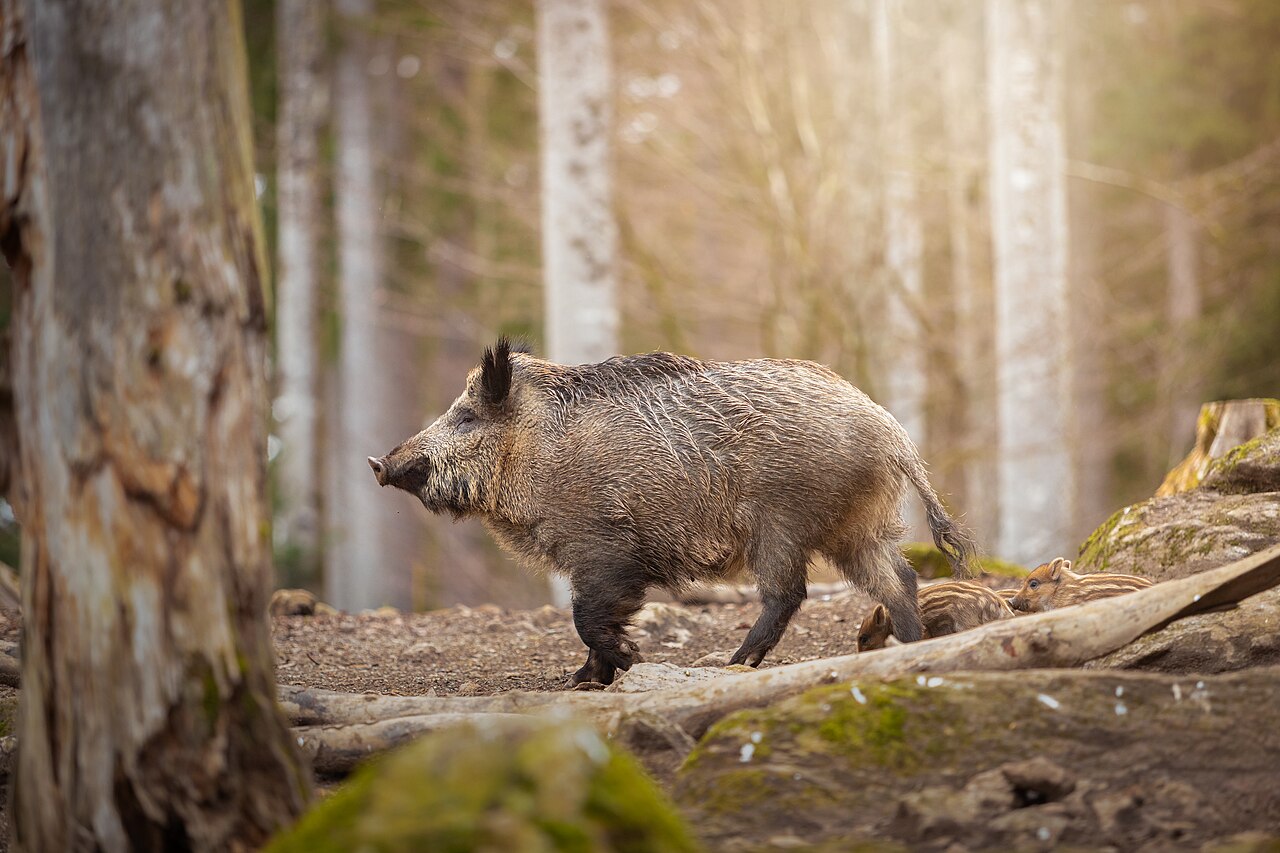
A stocky, wedge-shaped animal: high at the shoulder, low at the rump, with a big head running into the body without a visible neck. Head-body 90 to 200 cm, shoulder height 55 to 110 cm, tail 15 to 40 cm with a tuft at the end, weight 44 to 320 kg; in central and eastern Europe the heaviest boars reach two to three hundred kilos, while Mediterranean animals weigh barely half as much. The coat is coarse bristle, grey-brown to nearly black, fuller and greyer in winter, with a mane along the spine that rises when the animal is roused; the summer coat is thin and browner. The eyes are small and set high, the ears large, and the long mobile snout ends in a hard cartilage disc used for rooting. Adult boars carry tusks: the lower canines grow throughout life, project 5 to 12 cm beyond the lip and are worn sharp against the upper canines, the 'whetters'; in sows they stay inside the mouth. Piglets are pale brown with longitudinal light stripes for the first three or four months, then reddish-brown for a season. The animal trots with the head low and the back straight.
Similar species
An adult wild boar cannot be confused with any other wild animal in Europe; mistakes arise in the dark and with young animals. The feral domestic pig — scarce in Europe, abundant elsewhere — is pink, blotched or piebald, with a sagging back, a curly tail and a straighter snout; it interbreeds with the wild boar, so intermediates exist, and a piebald pig is not a wild boar. In the dehesas of the Iberian Peninsula the black Iberian pig, ranging free among the holm oaks, is the commonest confusion at a distance; the line of the back, the tail and the absence of a mane decide. A badger on a night ride is far lower and broader, with black-and-white face stripes and a rolling gait. In the Carpathians and the Balkans a black boar in poor light can resemble a bear cub, and vice versa; the outline decides: the boar has a straight back, a pointed head, no visible neck and no shoulder hump. Large black dogs along a wood edge at dusk are the most frequent misidentification.
Habitat
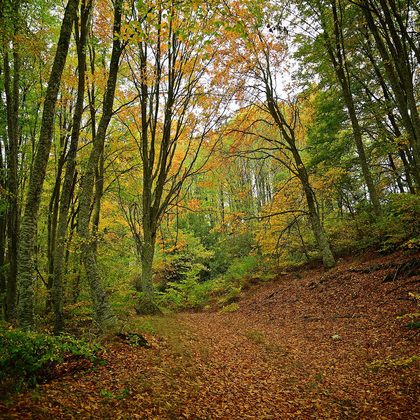
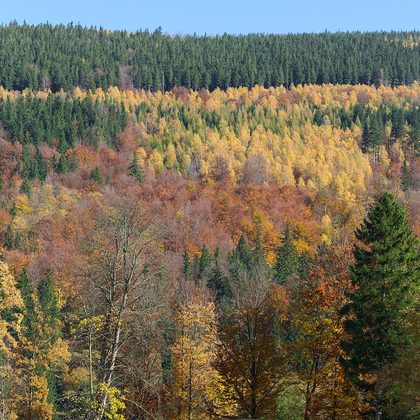
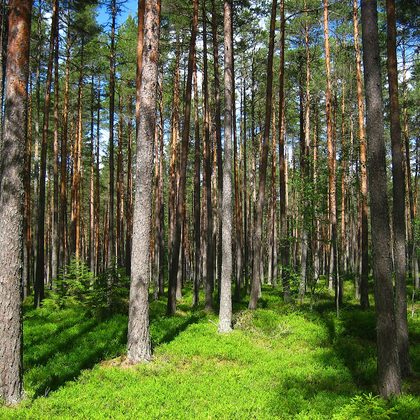
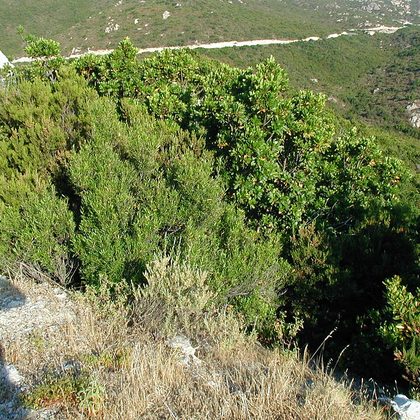
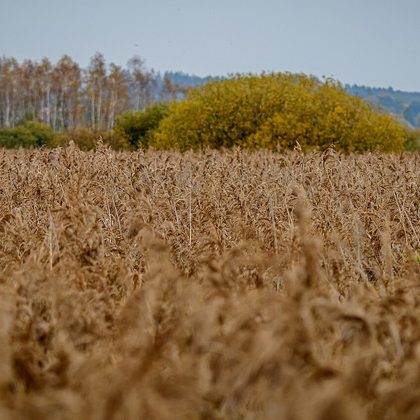
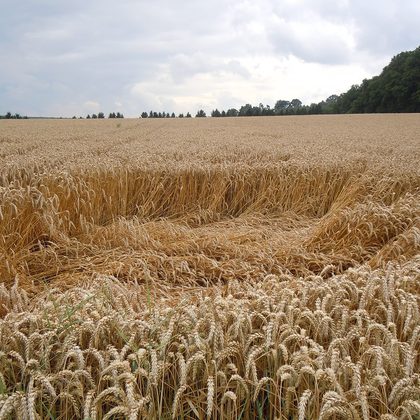
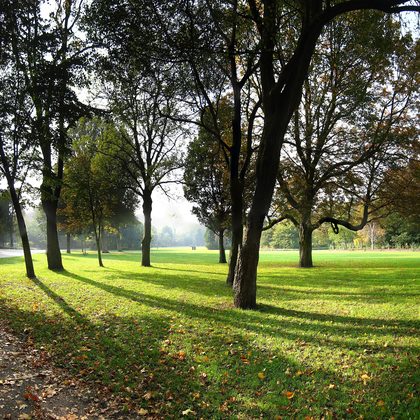
The wild boar lives in broadleaved and mixed woodland with a dense shrub layer, above all oak, holm oak and beech with a good mast crop, and in conifer woodland with an understorey. It also inhabits reed and sedge marsh and riverine scrub, where it lies dry and undisturbed, Mediterranean scrub and cork-oak woodland, and the adjacent arable land: maize has become the main food in central Europe, and a maize field in August and September is a habitat in its own right. For some decades the species has also lived in towns: in gardens, parks, playing fields and verges in the suburbs of Barcelona, Rome, Genoa, Berlin and Haifa among others, boar turn over lawns at night and feed on refuse.
Where the animal is most at home, classified with EUNIS — the European standard for habitats.
Distribution
The wild boar occurs from Portugal to Japan and from southern Scandinavia to North Africa, and has been introduced beyond that to the Americas and Australia; it is one of the most widely distributed large mammals on earth and is increasing almost everywhere. In the Iberian Peninsula it occupies the whole of mainland Spain, from sea level to high mountains, and has increased strongly there since the 1970s with rural depopulation, the spread of scrub and irrigated maize; Mallorca has feral pigs, which the Balearic government has allowed to be controlled since 2012 along with feral dogs and cats, but no free-living wild boar population is documented there; the species is absent from the Canary Islands. In the Netherlands it was exterminated in the nineteenth century and returned on the Veluwe and in the Meinweg; outside those two areas the law requires a zero population, meaning that any boar appearing elsewhere is shot. In practice boar now also occur in Limburg, Noord-Brabant and the Achterhoek. In Belgium it is common in the Ardennes and the Gaume, and in Flanders it has returned since 2006 from Wallonia and Dutch Limburg and spread across Limburg and the Kempen. In Britain the wild boar was exterminated, probably by the thirteenth century in England and later in Scotland, and seventeenth-century attempts to restock the royal forests failed. Since the early 1990s animals have escaped or been released from wild-boar farms, and self-sustaining populations now live in the Forest of Dean, in the Kent and East Sussex Weald and in west Dorset, with smaller groups elsewhere in England and Scotland; they are legally feral rather than protected, and their management is contested. In Ireland repeated escapes have not produced an established population, and policy is to remove them.
- Native
- dark = core range, pale = thinly spread
Way of life
The wild boar is nocturnal where it is hunted and also active by day where it is not; the difference is learned. It is an omnivore with plant food as its base: roots, tubers, bulbs, grass, acorns, beech mast and chestnuts, cereals and maize, with earthworms, insect larvae, chafer grubs, mice, eggs, nestlings, carrion and, in towns, refuse. Rooting takes up much of the active time: a sounder turns over hundreds of square metres in a night. The social structure is matriarchal: the sounder is a group of related sows with their piglets and young animals, led by the oldest sow, while adult boars live alone and join a sounder only in the rut. The rut falls from November to January; gestation follows the traditional formula of three months, three weeks and three days, about 115 days, and in March or April the sow gives birth to four to eight, sometimes twelve piglets in a large built nest. With abundant food, young sows breed in their first year and a population can double in one year; as a result hunting nowhere keeps pace with the numbers. The wild boar does not rest in winter and is active all year, rooting through snow. In the wild it seldom lives beyond five to ten years.
Where and when to look
Waiting at a fixed point is the most suitable method. The best place is a wood edge against a maize field or meadow at dusk, with the wind in the observer's face: a boar sees poorly, hears moderately and smells well, and only smell is decisive. A first check of the wallow is informative: fresh wet mud on the rubbing tree indicates recent use, dried mud from a week earlier does not. Suitable areas include the rides and clearings of the Forest of Dean at first light, the Veluwe's wildlife-area edges and high seats at sunset, wood edges along arable land in the Ardennes and the Eifel, the holm-oak woods of the Sierra Morena and the Montes de Toledo at dusk, the Cantabrian beech forests, the riverine scrub along the Ebro, Białowieża and the Danube delta. In the Parc de Collserola above Barcelona whole sounders come into the streets in the evening. Rooting usually leads to the wallow, with the rubbing tree beside it.
Conservation status
Least Concern (LC, 2019) and one of very few large mammals increasing across nearly all of Europe. The causes are milder winters, the large expansion of maize, winter feeding by hunters, increasing woodland cover, the loss of large predators, and a rate of reproduction far above that of any other European ungulate. As a result the wild boar is one of the most contested mammal species in Europe: damage to crops, including vineyards, maize fields and olive groves, road collisions, rooted-up playing fields and gardens, and boar approaching people for food in towns. In Spain it is the most hunted big-game species; the Parc de Collserola above Barcelona holds the best-studied urban population in Europe, with animals entering the districts of Sarrià and Sant Gervasi at night. Since 2014 the situation has been dominated by African swine fever, which has spread from the east through the Baltic states, Poland, Germany, Czechia, Italy and Belgium; the disease is harmless to people but almost always fatal to pigs, and the response — large-scale culling, fences hundreds of kilometres long and organised carcass searches — is the largest wildlife management programme in Europe. For countries with a large pig herd, such as Spain with the largest in the European Union, the disease is also a serious economic threat. Food scraps should not be left in boar country, because the virus survives in sausage and ham and travels with people.
Scientific name
Sus scrofa | Linnaeus, 1758
Linnaeus described the species in 1758 and placed it straight away in the genus where it still stands. Sus is the Latin word for 'pig', cognate with Greek hys. scrofa is the Latin word for 'breeding sow'. The specimen the first description was based on came from Germany.