All species › Rodents › Squirrels and marmots › Tauren Ground Squirrel
Tauren Ground Squirrel | Spermophilus taurensis
Spermophilus taurensis | Spermophilus taurensis
Spermophilus taurensis was described only in 2007, from the limestone slopes of the western Taurus above Antalya, and is the least known species of the genus. It is redder and longer-tailed than the other ground squirrels of Turkey. Its range is small, and nothing has been published on its reproduction.
Tracks
As in all ground squirrels, the colony is the main sign; in stony mountain country it is less conspicuous than on the steppe. The burrow entrances are five to eight centimetres across and often lie between or beneath limestone blocks and in the grassy patches between them, where the soil is deep enough; on open pasture flats they lie in the turf, with a low fan of paler, gritty material in front. Around the entrances the grass is grazed short, producing low, flower-rich patches among the spiny dwarf shrubs. Narrow paths run over the grit between the entrances. Loose limestone blocks next to an entrance are used as lookouts and are worn smooth there. Droppings are small, dark and dry. The signs are strongly seasonal: from late August into March the entrances are plugged from within and little is visible. The alarm call is a sharp whistle, usually given from a stone.
In its habitat
Identification
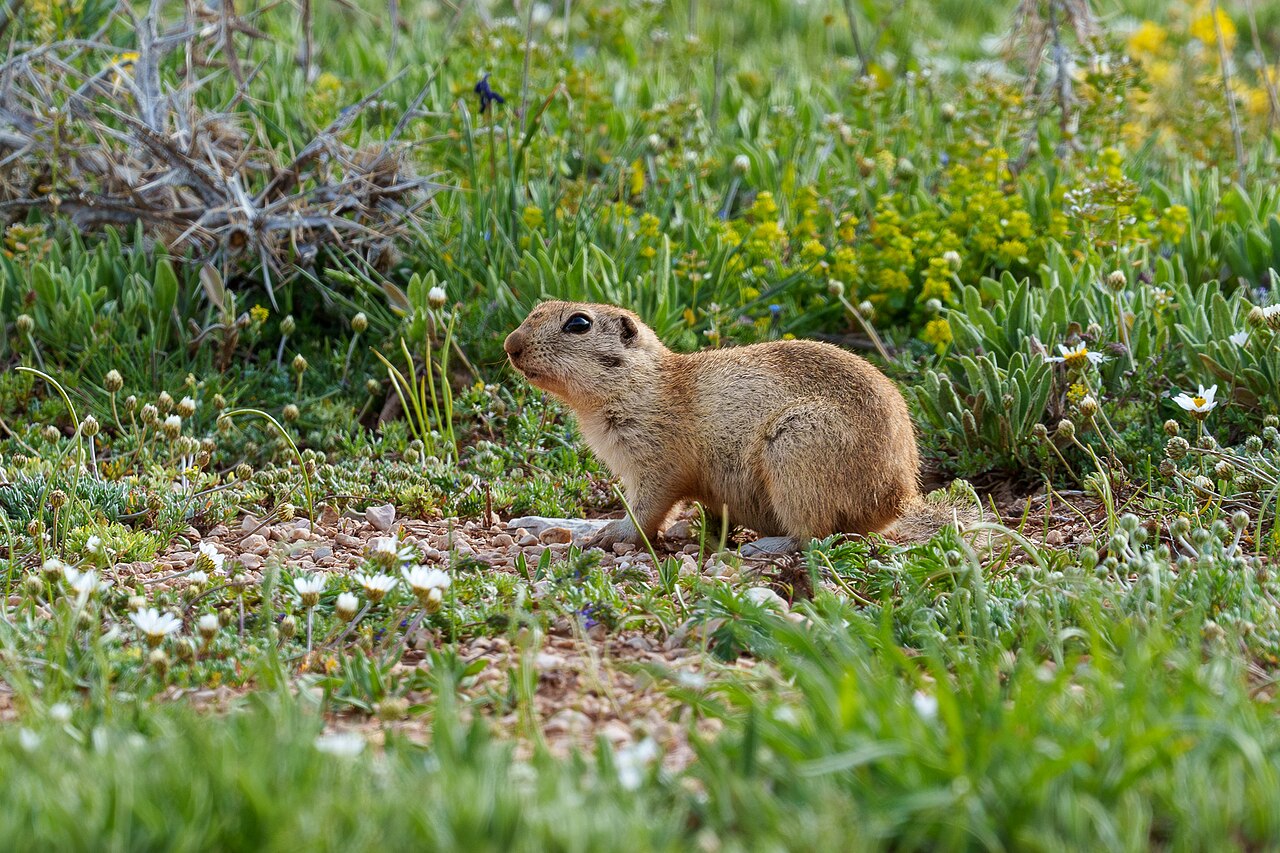
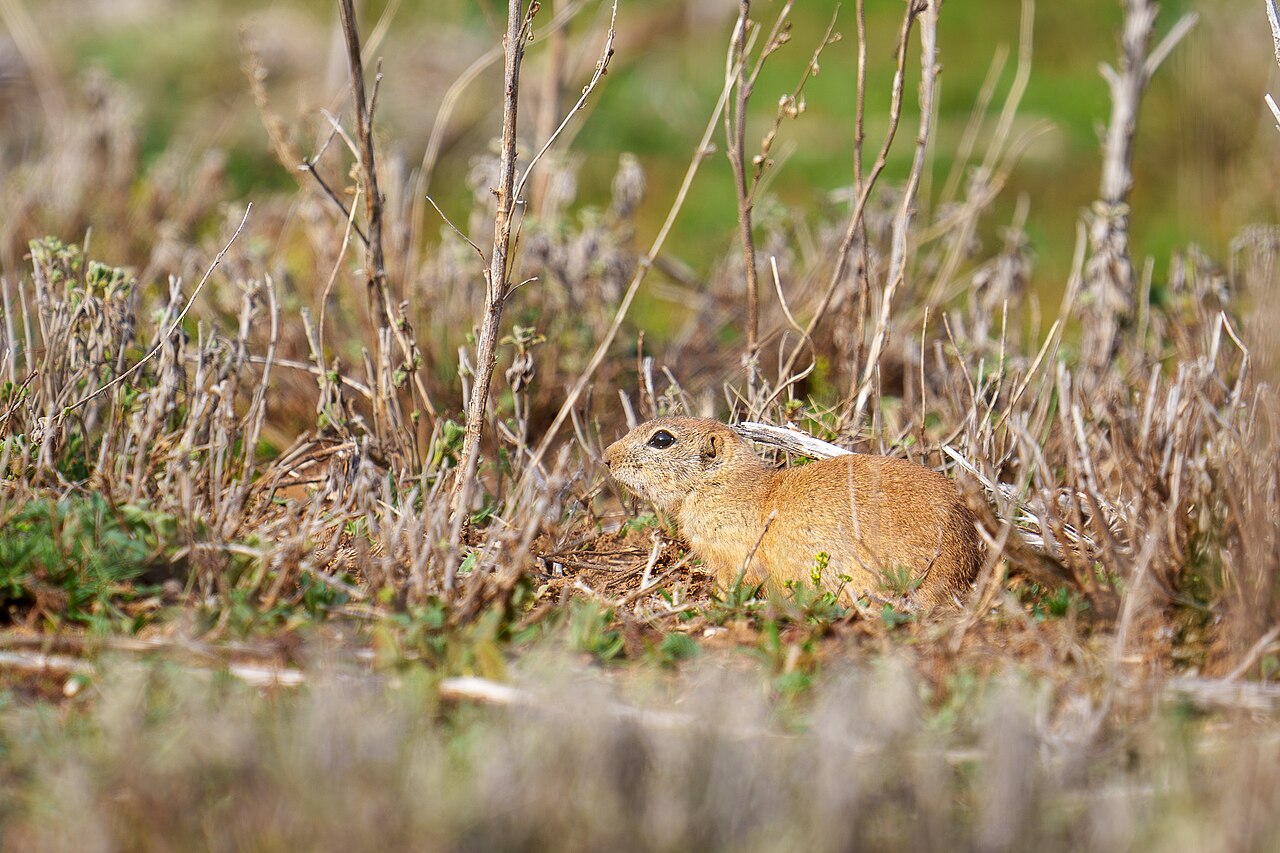
Head-body 19.4 to 20.1 cm, tail 6.2 to 6.5 cm, weight 201 to 260 g; as long as the European souslik, but with a tail long for a ground squirrel, nearly a third of the body length, which is visible as soon as the animal stretches out. The back is distinctly rufous to cinnamon brown, warmer and redder than in the other European sousliks, finely pale-speckled but without true spots. The belly is yellowish white to cream, the flanks orange-brown, and the head slightly greyer than the back, with a pale eye-ring. The hind foot is long, 39 to 44 mm, longer than in the European souslik. The ears are small and rounded. In the field the species is a rufous, fairly slim souslik with a visible tail, on stony mountain pasture among limestone blocks.
Similar species
Range determines the identification: the western and central Taurus above about a thousand metres, from Akseki and Yarpuz east of Antalya via Seydişehir and Erenkaya to Mut in the south-east. This is a strip of at most two hundred by sixty kilometres in which no other ground squirrel occurs. The only species with which confusion is possible is S. xanthoprymnus of the Anatolian plateau to the north and east; the nearest records of that species lie more than a hundred kilometres further north, and where the ranges approach each other the two have never been found together. When comparing them, for example on a photograph without locality, the useful differences are: taurensis has a redder back, a longer tail and a longer hind foot; xanthoprymnus is greyer and more ochre, with a clearly shorter tail. The European souslik, the only other souslik in Turkey, occurs only in European Thrace, west of the Bosphorus. The other European species live more than a thousand kilometres further north. Outside the genus no other animal of this size lives in diurnal colonies on the ground in the Taurus; the Caucasian Squirrel, which occurs in the same mountains, lives in trees and has a long bushy tail.
Habitat
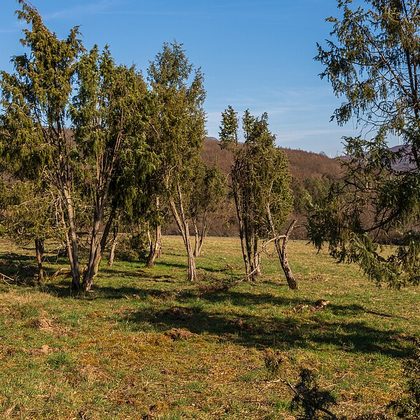
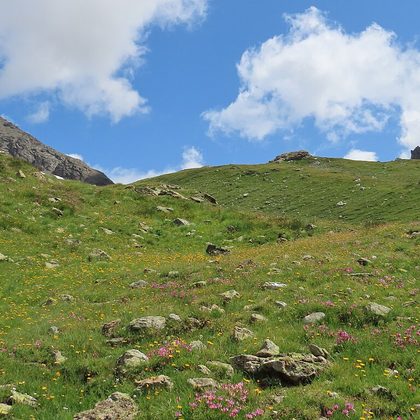
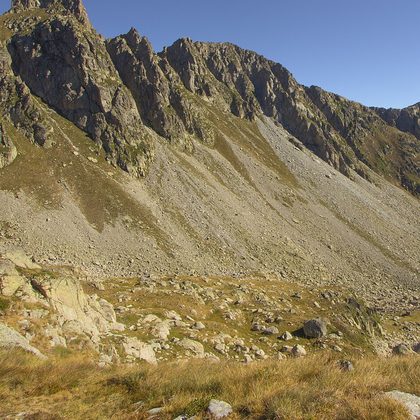
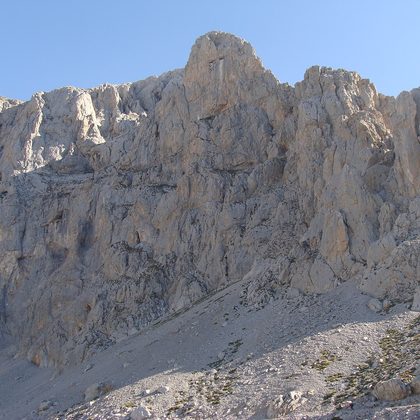
Stony mountain pasture, short-grass high steppe and open patches between dwarf shrubs and limestone blocks in the Taurus, from about a thousand metres to well above two thousand metres. The type locality lies at 1,542 m. The species depends on the same combination as the Alpine Marmot: soil deep enough to dig, low vegetation, and rocks that provide overview and cover. Grazing by sheep and goats keeps the grass short and is favourable, as long as stocking density does not become so high that the vegetation disappears. On the adjacent plateaux the species also occurs on field margins and fallow land.
Where the animal is most at home, classified with EUNIS — the European standard for habitats.
Distribution
The species is endemic to southern Turkey. All known localities lie in the western and central Taurus, in the provinces of Antalya, Konya, Karaman and Mersin: from Akseki and Yarpuz, where the type was collected in 2007, 111 km east of Antalya, via Seydişehir, Erenkaya and the Morca yayla to the Salamut plateau and Mut. There are fewer than seventy documented localities. In 2007 the species was described a second time almost simultaneously, as Spermophilus torosensis; that name is a junior synonym.
- Native
- dark = core range, pale = thinly spread
Way of life
The species is diurnal, most active in the morning; on sunny south-facing slopes the animals stay underground in the middle of the day. It lives in colonies in which each adult has its own burrow system. Food consists of grasses, herbs, flowers, seeds, bulbs and tubers of the mountain pasture, supplemented with insects. Like all sousliks it has a long hibernation, for which fat reserves are built up in summer; the entrance is plugged from within. The duration of hibernation has not been measured in this species; in the neighbouring Anatolian species S. xanthoprymnus it is about half a year. Nothing is known of its reproduction: no data on gestation, litter size or age at sexual maturity have been published. Predators are fox, stone marten, stoat and the eagles and falcons of the mountains.
Where and when to look
The best period is May and June, between seven and eleven in the morning, on the plateaux around Akseki and Yarpuz, just over a hundred kilometres east of Antalya, or on the yaylas near Seydişehir. Drive the mountain roads above a thousand metres and watch for short, flower-rich pasture flats among limestone blocks; stop, search with binoculars for the pale patches next to the blocks and wait. The animals often sit on stones and are then visible from a distance. Preferably photograph the whole body including the tail, because tail length and red back colour distinguish this species from S. xanthoprymnus, and record the coordinates: the locality is decisive for identification. After mid-August the animals are no longer above ground.
Conservation status
Least Concern (2017), with an unknown trend. The assessment rests on few data: the IUCN assumes that human pressure in the high-altitude habitat is low. The range is, however, small and the number of known colonies is in the tens, which makes the species sensitive to changes within that area. Possible threats are the conversion of plateaux to arable land, the construction of roads and summer settlements on the yaylas, and changes in grazing: too intensive grazing leaves little vegetation, too little grazing leads to overgrowth. Data on population size, density and reproduction are almost entirely lacking.
Scientific name
Spermophilus taurensis | Gündüz, Jaarola, Tez, Yeniyurt, Polly, & Searle, 2007
Gündüz, Jaarola, Tez, Yeniyurt, Polly, & Searle described the species in 2007 and placed it straight away in the genus where it still stands. Spermophilus is Greek, from sperma, 'seed', and philos, 'loving': the seed-lover, after the food the animal carries to its burrow in its cheek pouches. taurensis means 'of the Taurus', the mountain range in southern Türkiye where the species was found. The specimen the first description was based on came from Türkiye.