All species › Carnivores › Dogs, wolves and foxes › Rüppel's fox
Rüppel's fox | Vulpes rueppellii
Zandvos | Vulpes rueppellii
Rüppell's fox is a small fox of the sand and stone deserts of North Africa, the Arabian Peninsula and the Middle East east to Pakistan. The area of this guide touches only the northern edge of its range; almost all records within the window come from Israel. There the species has been displaced in the Negev by the red fox, which has expanded with the establishment of settlements in the desert.
Tracks
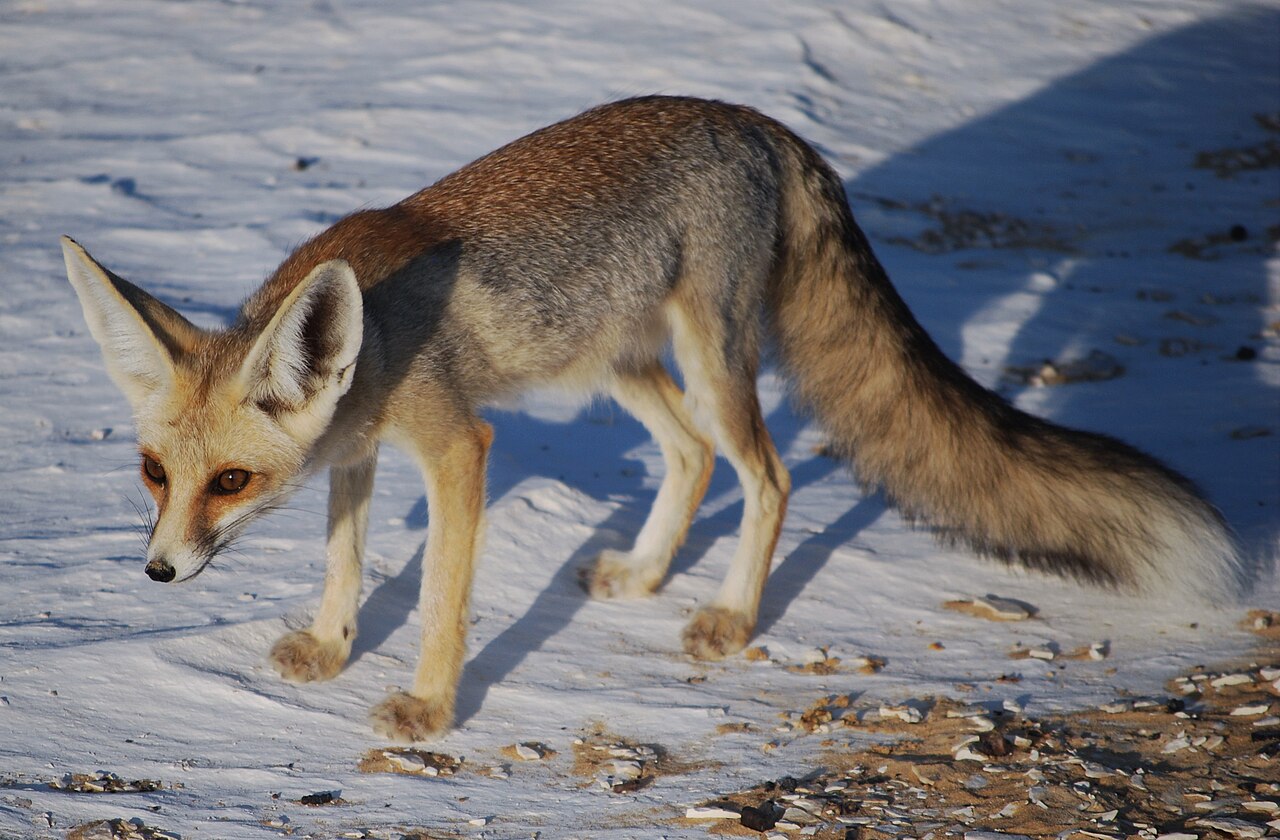
The almost entirely furred soles and toes give the tracks blurred outlines; in loose sand the individual pads often cannot be distinguished. Dens are usually under rock slabs or dug at the base of trees or bushes; where shelter is scarce the species also uses dens in the middle of open plains, sometimes dug by honey badgers. In shallow scrapes in packed silt, midday temperatures 12 to 15 °C lower than outside have been measured. In Oman radio-tracked animals changed dens frequently. Around camps and permanent settlements the species scavenges for refuse.
Identification
A small, slender fox with short, thin legs and long, broad ears that are large in relation to the head. The head is beige to pale sand-coloured; most animals have a black whisker patch running up to the eye. The back varies from pale sandy to greyish, sometimes reddish, with a silvery sheen from black-tipped hairs; the flanks and belly are paler, the legs beige to fawn. The black speckling of the back ends in a black patch at the base of the tail. The tail is bushy and usually has a white tip. The soles and toe pads are almost entirely covered with hair. The backs of the ears lack dark markings. The fur is fine and soft, thicker and darker in winter, paler in summer.
Similar species
The red fox is considerably larger and more heavily built, with black backs to the ears and black fronts to the legs; it also has a white tail tip. In the Negev and the Arava the two species occur side by side. The fennec fox is smaller, with even larger ears and a shorter tail with a dark tip, and lives in sand desert; within the area of this guide only in North Africa. Blanford's fox is smaller, with a tail almost as long as the body, lives on steep rocky slopes and has naked soles. Decisive for Rüppell's fox are the black patch at the tail base, the white tail tip and the black whisker patch.
Habitat
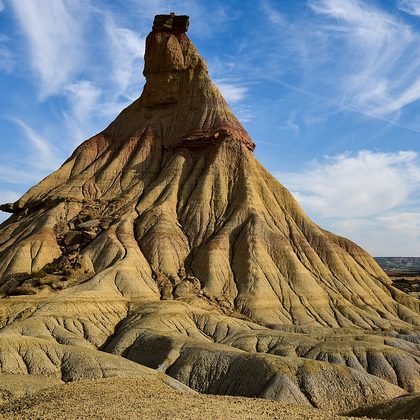
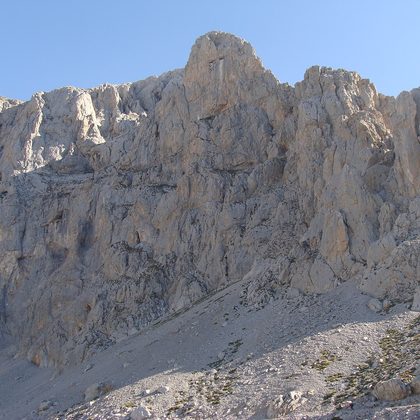
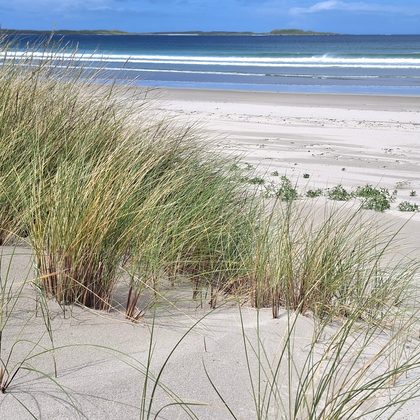
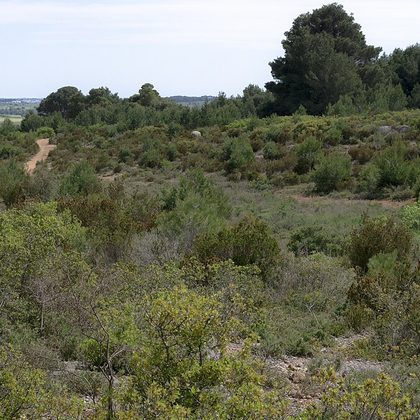
Sand and stone desert with sparse to very sparse vegetation of herbs, grasses and low shrubs, often concentrated in wadis with acacias and other trees; also coastal areas with very sparse, treeless vegetation. On the northern fringe of the Sahara the species occurs in areas with up to 150 mm of rain a year. Rüppell's fox can live in areas without available surface water.
Where the animal is most at home, classified with EUNIS — the European standard for habitats.
Distribution
From Morocco and Mauritania through the Sahara and the Sahel to Egypt, Sudan and the Horn of Africa, and further the Arabian Peninsula, the Middle East, Iran, Afghanistan and Pakistan. Six subspecies are recognised. Within the area of this guide only the northern edge of the range north of 29°N is included: the Negev and the Arava in Israel, the northern deserts of Egypt and the northern edge of the Sahara in Libya, Tunisia, Algeria and Morocco. Almost all records within the window come from Israel; there are a few from Egypt, Morocco and Algeria.
- Native
- dark = core range, pale = thinly spread
Way of life
Mainly crepuscular and nocturnal. The animals stay in the den during the day, although animals active by day have been seen in winter. They leave the den in the hour after sunset, alternate periods of activity and rest through the night, and are usually inactive in the early hours of the morning. Rüppell's fox is active throughout the year. The diet consists largely of invertebrates, and further rodents, lizards, snakes, birds and wild fruit; its composition follows availability. Adults usually live in pairs; groups of 3 to 15 animals have been seen, but these may be family groups or an aggregation of dens where suitable sites are few. In Oman home ranges covered up to 69 km², in Saudi Arabia about 16 km² on average; males have larger home ranges than females. In Saudi Arabia mating takes place from December to February, usually coinciding with the first rains after the summer. After a gestation of 7 to 8 weeks 2 to 3 young are born. Both sexes reach sexual maturity at 9 to 10 months.
Where and when to look
In the Negev and the Arava in Israel, at night, with a lamp over open gravel and sand plains and along wadis, preferably far from settlements, where the red fox dominates. With an eye-shine, the ratio of ear to head, the length of the legs, the black patch at the tail base and the white tail tip decide. In the early morning fresh trails in the sand can be followed to a den under a rock slab or at the foot of a bush. The species is legally protected in Israel; a den is often abandoned after disturbance.
Conservation status
Least Concern (LC, 2015). Little is known about total numbers; density is usually low and appears higher where food is more easily available, for example near settlements. In a fenced reserve in Saudi Arabia a density of 0.7 per km² was measured; lower estimates outside it point to vulnerability in the overgrazed landscape of central Arabia. The main threats given are habitat loss and fragmentation, hunting and persecution, and the indiscriminate use of poison. In Israel the species was close to disappearing as of 2009 through competition with the red fox, which has expanded in the Negev with human settlement; competition with the red fox may also play a role in the United Arab Emirates. In Israel Rüppell's fox is fully protected; in Morocco, where it is listed nationally as near threatened, it may be hunted as a pest.
Scientific name
Vulpes rueppellii | (H. R. Schinz, 1825)
H. R. Schinz described the species in 1825 as Canis Rüppelii; because it was later moved to another genus, the author and year stand in brackets. Vulpes is the Latin word for 'fox'. rueppellii honours the Frankfurt naturalist Eduard Rüppell (1794–1884), whose collections from Nubia and Abyssinia lay behind Schinz's description. The specimen the first description was based on came from Sudan.