All species › Rodents › Birch mice › Northern Birch Mouse
Northern Birch Mouse | Sicista betulina
Berkenmuis | Ratón Listado Nórdico
The Northern Birch Mouse is not a true mouse, but the only northern European member of a family of its own that is most closely related to the jerboas. It weighs five to fifteen grams, climbs through the herb layer with a semi-prehensile tail and has a single black stripe down the back. It spends six to eight months a year hibernating underground.
Tracks
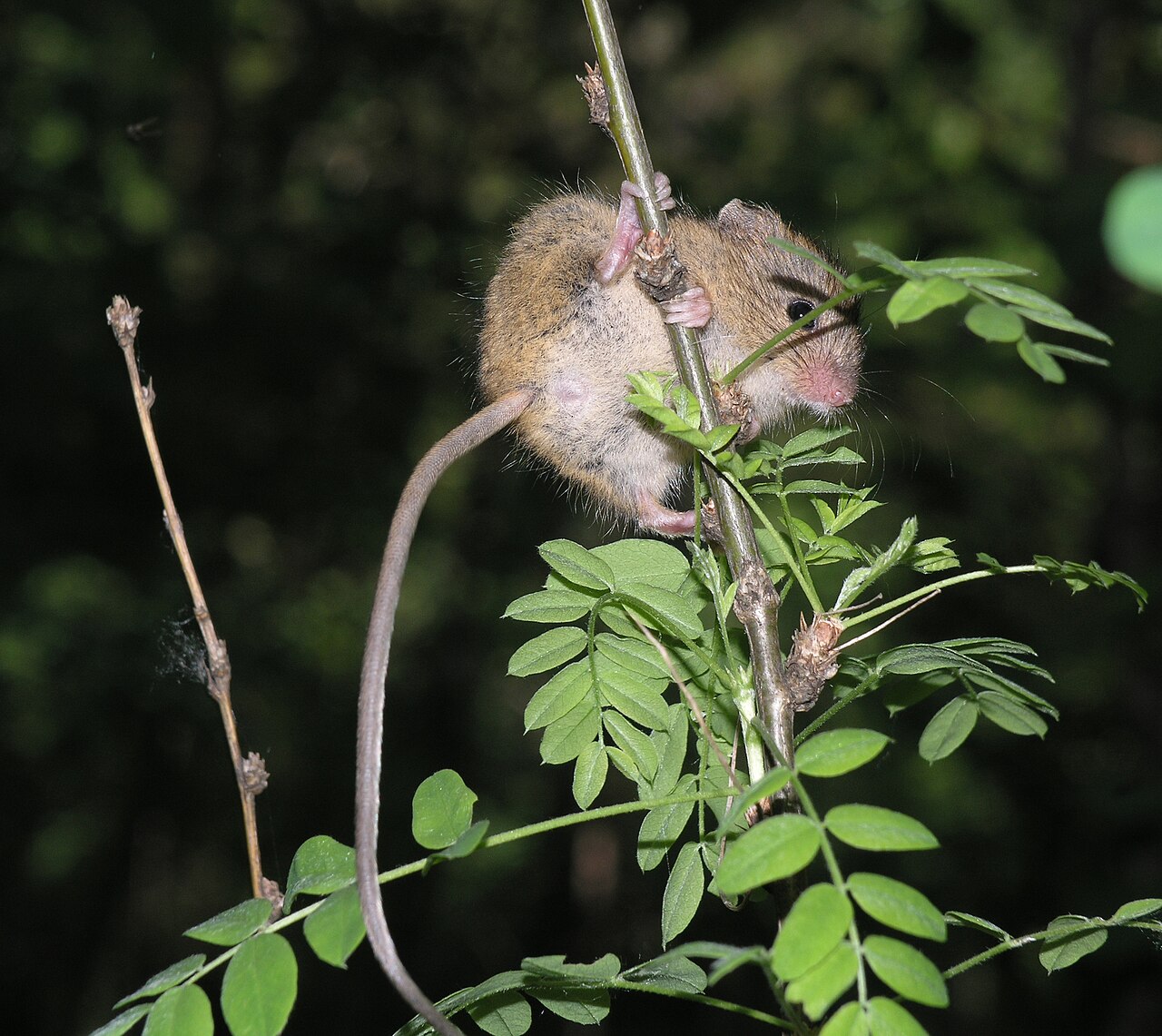
The Northern Birch Mouse leaves hardly any recognisable signs. It is too light to leave prints in mud or sand, digs no visible tunnels, builds no conspicuous nest, gnaws no nuts and makes no sound that can be identified to species. Its presence is therefore established by other means. The standard method is live-trapping with small traps in the herb layer of a woodland edge or mire margin, during the short active period from May to September. In addition, pellets of Barn Owl, Tawny Owl and Long-eared Owl provide usable evidence: the very long tail vertebrae and the structure of the teeth are readily recognisable in pellets. More recently hair tubes and camera tubes have also been used, in which a small camera photographs the animal as it runs through a plastic pipe. This is how the most recent German localities were established: five animals on the Fellhorn near Oberstdorf in 2021 and seven in the rear part of the Bavarian Forest in 2020. The only field view is the animal itself, climbing in the herb layer with its tail wrapped around a stem.
Identification
A very small, slender rodent with a tail about one and a half times the head-body length (7.6 to 10.8 centimetres against 5.0 to 7.5), which is thin, sparsely haired and semi-prehensile: when climbing it is wrapped around a stem. The coat is yellowish to reddish brown, the belly greyish, and from the nape to the base of the tail runs a single sharp black stripe two to three millimetres wide. This stripe is the main character. The head is pointed, with large dark eyes and small, rounded ears standing clear of the fur; the upper lip is not cleft, unlike in true mice. The hind foot is 14 to 18 millimetres long and five-toed; the species does not hop like its desert relatives but walks and climbs. Weight ranges from five to fifteen grams, with the highest values just before hibernation.
Similar species
The dorsal stripe separates the species from all similar species. A Harvest Mouse is equally small and also has a prehensile tail, but lacks the stripe, is orange-buff with a sharp white belly boundary and has a thicker, barer tail. Wood Mouse and House Mouse are heavier, have large ears and no stripe. Shrews have a pointed snout and velvety fur; in the red-toothed shrews the tooth tips are brown. The difficulty lies within the genus. In the steppe and forest-steppe of eastern Europe live three species of the Sicista subtilis group (S. loriger, S. severtzovi and S. subtilis), and in addition the Hungarian S. trizona, which cannot be distinguished from one another in the field. They can, however, be distinguished from the Northern Birch Mouse: the Northern Birch Mouse has one dark dorsal stripe and otherwise a plain flank, whereas the species of the subtilis group have two additional dark side stripes beside the dorsal stripe, with pale bands between them. Habitat also differs: the Northern Birch Mouse lives in damp woodland, mire and mountain meadow, the other species on dry steppe. Where both occur, in the Ukrainian forest-steppe, the stripe pattern is the first character to check.
Habitat
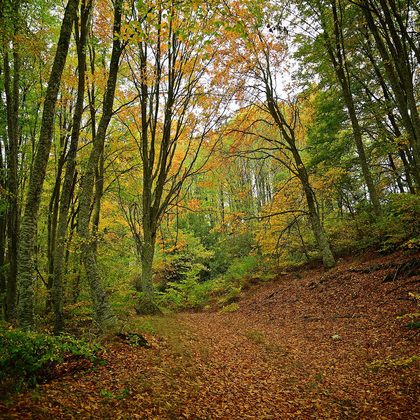
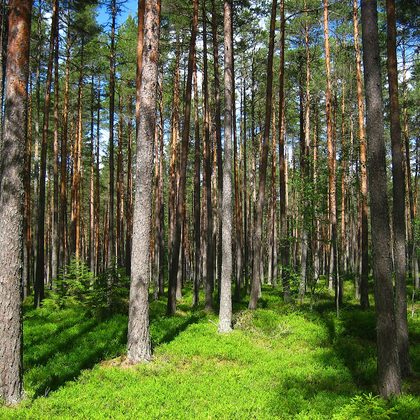
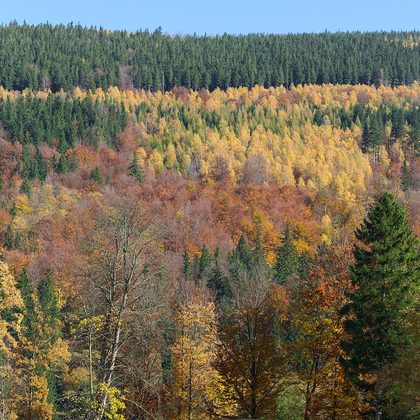
Damp, herb-rich and half-open terrain. Broadleaved, coniferous and mixed woodland with clearings, windthrow and regeneration; above all woodland edges, clear-fells and stream banks with a dense layer of herbs and dwarf shrubs. Also transition mire and mire edges, wet hay meadows and sedge vegetation, bramble and bilberry scrub, and in the mountains the subalpine scrub zone and mountain meadows to well over two thousand metres. The species depends everywhere on a dense, upright herb layer for climbing and cover; closely mown or grazed vegetation is unsuitable. In the Bavarian Forest the species occurs mainly in mires and waterlogged meadows.
Where the animal is most at home, classified with EUNIS — the European standard for habitats.
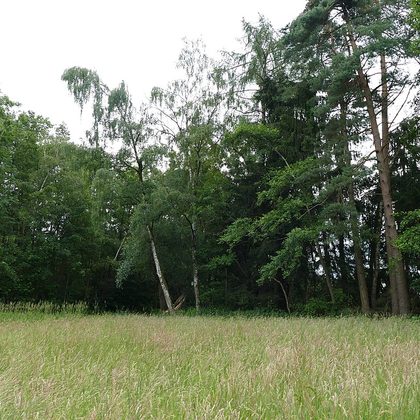
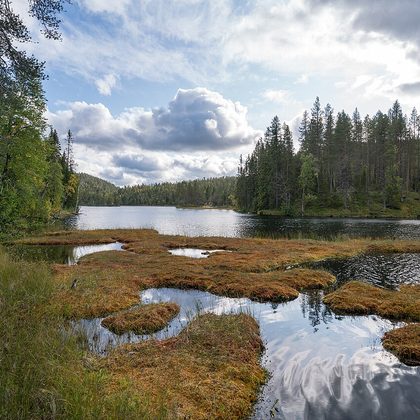
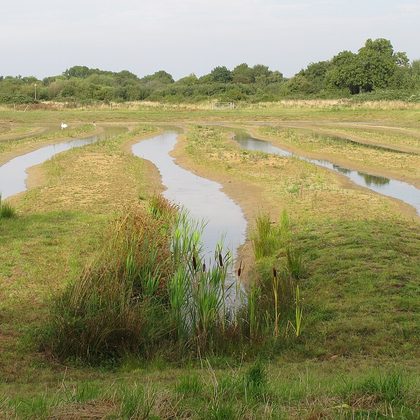
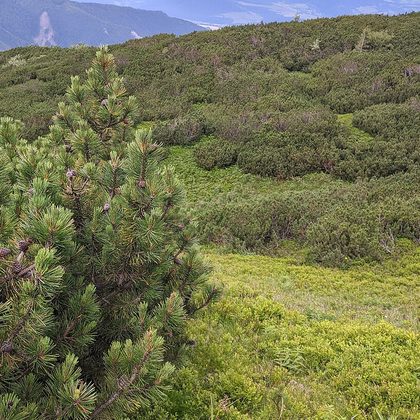
Distribution
A large but strongly fragmented range from northern and eastern Europe into Siberia: from Norway, Sweden, Denmark and the Baltic states east to Lake Baikal, and from the Arctic Circle south to the Carpathians. In central Europe the distribution has the character of a glacial relict: small, isolated populations in Denmark, northern Germany, the Bavarian Forest, the Bavarian, Austrian and Swiss Alps, the Bohemian Forest, the Polish and Slovak mountains and the Carpathians, with hundreds of kilometres without records between them. The species does not occur in the Low Countries, and there is no evidence that it ever did; the nearest localities are in central and eastern Germany and in Denmark. In the north and east of the range the species is common, in the west and south rare and local.
- Native
- dark = core range, pale = thinly spread
Way of life
Nocturnal and crepuscular and a good climber: it runs along stems and thin twigs and wraps its tail around stems for additional grip; it is the only European member of the family to do so. The diet is mixed: insects and other invertebrates, earthworms and snails, and also buds, shoots, grass seed and berries, with a marked shift towards food rich in fat and sugar in late summer. From early October to mid-April it has a true hibernation of six to eight months, curled up in a cavity in the ground, under a tree root or under moss, with the tail coiled around the body; it loses about half its body weight in the process. In Europe only the Alpine Marmot and the Edible Dormouse hibernate longer. The active period therefore lasts only four to six months. This limits reproduction: the animals become sexually mature only after their first hibernation and have a single litter a year of two to seven young, after a gestation of three to four weeks. If that litter fails, there is no reproduction that year. The species is therefore much more sensitive to a bad year than voles, which have three or four litters a year.
Where and when to look
There is no place in Europe where the Northern Birch Mouse is easy to see. The best chance lies in the north and east: the forest mires and clear-fells of Finland, Sweden and the Baltic states, or Białowieża, where the species is commoner and field research takes place. In central Europe taking part in research is the most effective method: the Bavarian and Austrian conservation services have for some years carried out targeted small-mammal surveys in mires and on mountain slopes. To search yourself, go out in June or July after dark with a lamp along a damp, tall woodland or mire edge and watch for movement in the herb layer, at about half a metre above the ground, not on the ground; the climbing behaviour is the main field character. Also examine owl pellets: for this species the loft of a church often yields more records than the woodland.
Conservation status
Least Concern (LC, 2016) globally, since the species is widespread in the Russian and Fennoscandian taiga. For central Europe this assessment does not reflect the situation. The species is listed in Annex IV of the European Habitats Directive and in Appendix II of the Bern Convention; the animal and its habitat are therefore strictly protected throughout the Union. In Germany the species is red-listed as threatened with extinction and in Austria as endangered; in both countries it concerns a few isolated populations with few animals per site. Causes are drainage of mires and wet woodland, clearing of clear-fells and windthrow, mowing and grazing of the herb layer, and fragmentation of the last damp sites. With one litter a year the species also recovers slowly. An important problem is that the species is poorly recorded: in many places it is unknown whether it is still present, so that declines may go unnoticed.
Scientific name
Sicista betulina | (Pallas, 1779)
Pallas described the species in 1779 as Mus betulinus; because it was later moved to another genus, the author and year stand in brackets. Sicista is neither Latin nor Greek. Gray took the word over in 1827 without saying where from; it is generally referred to a vernacular name for the mouse in the Russian and Tatar language area, but which one is not settled. betulina is Latin for 'of the birch', from betula, 'birch', after the birch woods in which Pallas met with the animal. The specimen the first description was based on came from Russia, Siberia.