All species › Even-toed ungulates › Bovids › Muskox
Muskox | Ovibos moschatus
Muskusos | Buey almizclero
The muskox (Ovibos moschatus) is a bovid of the Arctic tundra of North America and Greenland. In the guide area it is an introduced species: since 1932, and after extermination again since 1947, a population has lived on the Dovrefjell in Norway, from which a small group crossed into Sweden in 1971. On Svalbard a 1929 introduction died out in the 1970s.
Tracks
The track is round and broad and resembles that of cattle. In summer the best sign is the shed underwool, lying in pale grey tufts on willow shrubs and on the ground. The dung consists of pellets in winter and pats in summer. In the rut a strong, rank smell of the bulls can be noticed.
Identification
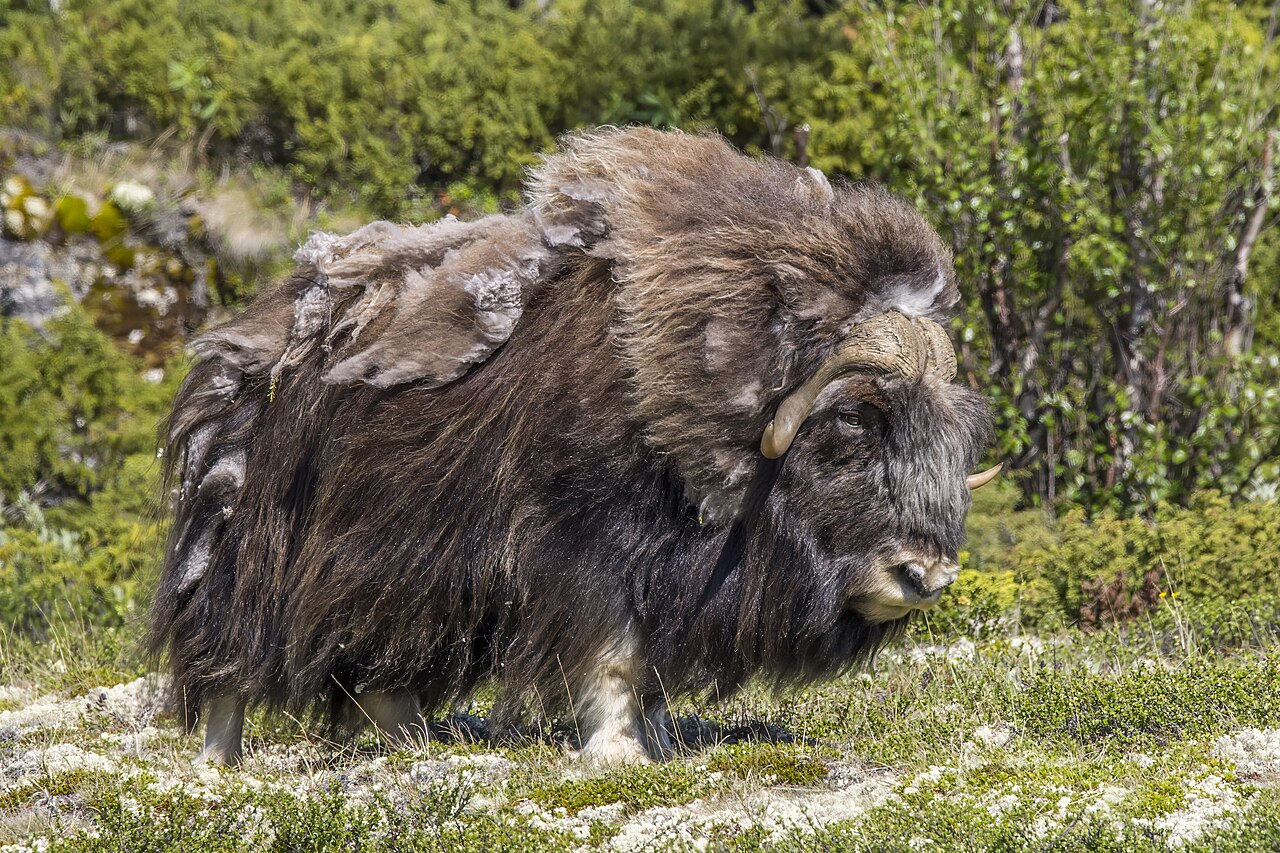
A massive, low-built animal with a head-body length of 200 to 245 cm, a shoulder height of 125 to 135 cm and a weight of 180 to 380 kg. The body is covered with dark brown guard hairs up to almost 60 cm long that hang almost to the ground, over a dense, pale grey underwool. The saddle and lower legs are pale. A hump stands on the shoulders, the neck is barely visible and the short tail is hidden in the coat. Both sexes carry horns: in the bull the broad bases form a boss across the forehead, from which the horns curve down along the side of the head and turn up and out again to sharp, pale yellow tips. In the cow the horns are smaller and there is hair between the bases.
Similar species
In the guide area the muskox cannot be confused with any other wild animal. At a great distance a lying muskox can look like a dark boulder, and a standing one like domestic cattle grazing on the fjell in summer. The reindeer, which lives in the same area, is slimmer and greyer, with antlers instead of horns. The wisent does not share its range.
Habitat
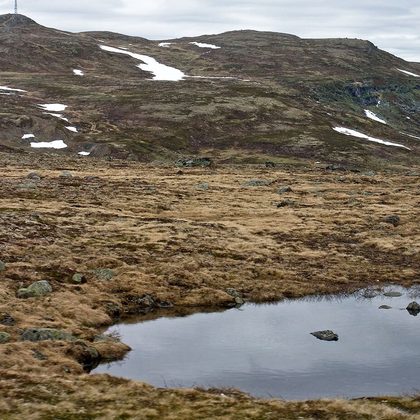
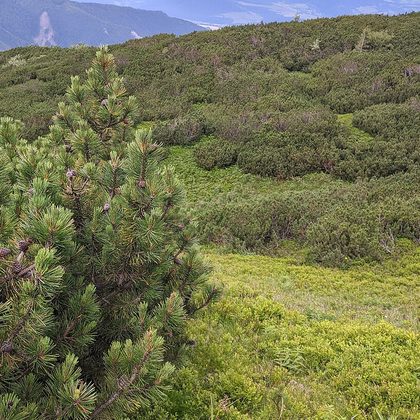
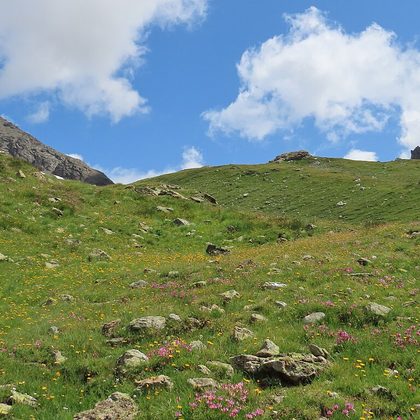
Arctic and alpine tundra: open, treeless plateaus with grass, sedges, dwarf shrubs and willow scrub, and wet hollows and riverbanks with richer vegetation. On the Dovrefjell the muskox lives in the high mountains above the treeline.
Where the animal is most at home, classified with EUNIS — the European standard for habitats.
Distribution
The natural range covers Arctic Canada and Greenland; in Alaska the species was reintroduced after extermination. In Norway the polar researcher Adolf Hoel brought ten animals from Greenland to the Dovrefjell in 1932; this population was exterminated during the Second World War, after which new animals were released from 1947. In summer 2012 the population numbered about 300 animals. In 1971 a small group moved to Härjedalen in Sweden. On Svalbard seventeen animals were released in 1929; that population disappeared in the 1970s. Outside the guide area the muskox has been introduced in Russia on the Taymyr Peninsula and on Wrangel Island.
- Established introduction
- dark = core range, pale = thinly spread
Way of life
The muskox lives in herds of 12 to 24 animals in winter and 8 to 20 in summer, with separate hierarchies for bulls and cows. It eats grasses, sedges, herbs and the leaves of willows and dwarf shrubs, in winter mainly willows, lichens and mosses. The rut begins in late June or early July; dominant bulls then hold harems of six or seven cows. After a gestation of eight to nine months a single calf is born between April and June and follows the herd within a few hours. When threatened, the adults form a ring or half ring with heads outwards and the calves in the centre. The musk odour of rutting bulls comes from the preputial gland.
Where and when to look
Dovrefjell–Sunndalsfjella National Park is the area for this species; excursions are organised from Kongsvoll and Hjerkinn. Scan the open slopes and the valleys along the streams with a telescope. Keep a wide distance, at least 200 metres is advised in Norway: a muskox that feels threatened may charge, and a fatal incident was recorded in Norway in 1964. An animal that lowers its head or rubs its horns against its legs is about to charge.
Conservation status
Least Concern (LC, 2023). The world population is estimated at 80,000 to 125,000 animals. The species declined strongly in the past through overhunting and recovered after hunting rules were enforced. In Greenland populations are small and scattered and therefore sensitive to fluctuations in climate. The Norwegian population is small and isolated. In 2006 many animals died of pneumonia, for which the bacterium Mycoplasma ovipneumoniae, a pathogen of sheep, has been identified as the primary cause; the outbreak coincided with exceptional weather conditions.
Scientific name
Ovibos moschatus | (E. A. W. von Zimmermann, 1780)
E. A. W. von Zimmermann described the species in 1780 as Bos moschatus; because it was later moved to another genus, the author and year stand in brackets. Ovibos is Latin, from ovis, 'sheep', and bos, 'ox': the sheep-ox. moschatus means 'musk-scented', from late Latin moschus, 'musk', from Persian mušk; the animal has no musk gland, and the name comes from the smell of the rutting bulls. The specimen the first description was based on came from Canada.