All species › Rodents › Blind mole-rats › Mehely's Blind Mole-rat
Mehely's Blind Mole-rat | Spalax antiquus
Spalax antiquus | Spalax antiquus
Spalax antiquus, Méhely's Blind Mole-rat, is a large blind mole-rat endemic to the Transylvanian Plain in central Romania. Méhelÿ described the taxon in 1909 not from living animals but from bone material from archaeological excavations. He designated twelve syntypes from five Romanian localities without choosing a lectotype, so that the type locality still comprises all five places. For a century the taxon was treated as a subspecies or synonym of Spalax graecus; in 2013 Németh and colleagues showed with mitochondrial DNA and skull measurements that graecus, antiquus and istricus are three well-defined species. In Romanian the animal is called orbete.
No photograph of a living wild animal of this species with a suitable Creative Commons licence exists. Do you have one that meets the rules? Send it in.
Tracks
The animal itself is almost never seen; its large mounds are. A mole-rat mound is broad and low rather than conical, made of coarse clods rather than fine crumbs, and never has an open tunnel mouth, because the tunnel is plugged from inside. In Spalax the mounds lie close together, so that the ground looks churned rather than showing a single row; an occupied system is therefore recognisable from twenty metres. A molehill is smaller, higher, finer-grained and comes from a vertical shaft. Below ground lies a shallow network of feeding tunnels at twenty to thirty-five centimetres, and beneath it, reached by vertical shafts, the deep chambers: a grass-lined nest, separate store chambers and latrines. There are also gnawed roots, tubers and rhizomes in the tunnel, and patches at the surface where a plant has been pulled down from below. Three predators have been confirmed: Rough-legged Buzzard, Hooded Crow and domestic dog; remains in pellets and at village edges provide part of the Transylvanian distribution data.
Identification
A large blind mole-rat: neckless and cylindrical, with a broad, flat, wedge-shaped head, a heavy forequarter and soft, moderately long fur, buff on the back and greyer on belly and head, locally with a reddish tinge. Ear pinnae are absent, the eyes are small lenses beneath a closed fold of skin, and there is no external tail. From the bare nose pad a fringe of pale, stiff hairs runs back towards the ear region, and the incisors protrude in front of the lips. No measurements of this species have been published, as the Handbook of the Mammals of the World notes; those of S. graecus are not adopted. The chromosome number is 2n = 62; within Spalax 2n = 60 and 62 occur. The differences from the related species lie in the skull and the DNA, not in external characters.
Similar species
The species cannot be determined from a living blind mole-rat. Within Spalax the chromosome number does not help either: all Spalax species have 2n = 60 or 62, and separation rests on nasal bones, jaw details and mitochondrial DNA. In the field only range is usable, and here it is sharply defined: on the Transylvanian Plain this is the only blind mole-rat. East of the Carpathians the range of S. graecus begins, to the south, on the Wallachian Plain, S. istricus lived, and in Dobruja and the Banat live the much smaller Nannospalax species. The distinction between the two genera can be made by eye and is the only field character in this group: a Spalax is twenty to over thirty centimetres long and weighs four to seven hundred grams; a Nannospalax weighs about as much as a large rat and seldom reaches half a kilo. This difference has also been confirmed by DNA (Németh and colleagues, 2013). The mounds show the difference more clearly still: a Spalax makes a dense field of mounds one to two metres apart, while the mounds of a Nannospalax lie in a thin line twenty to thirty metres apart. Also to be excluded are the mole, smaller, with shovel-shaped forefeet and a short tail, and the Water Vole, with normal ears, eyes and tail.
Habitat
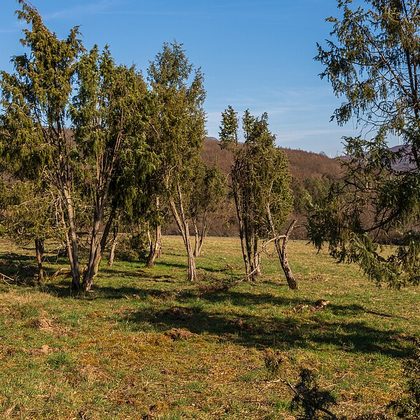
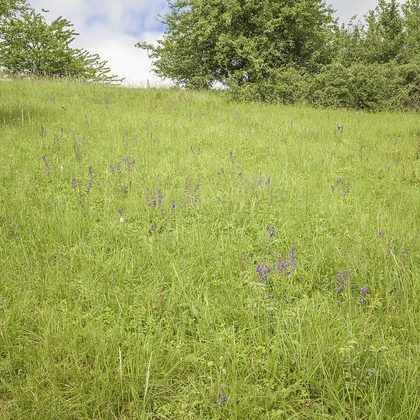
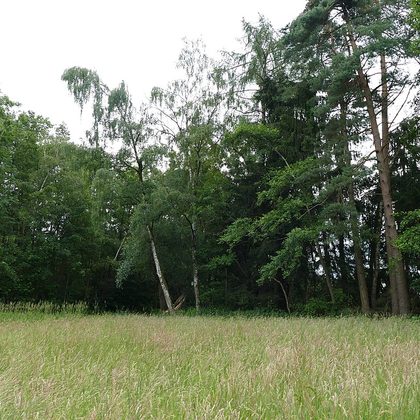
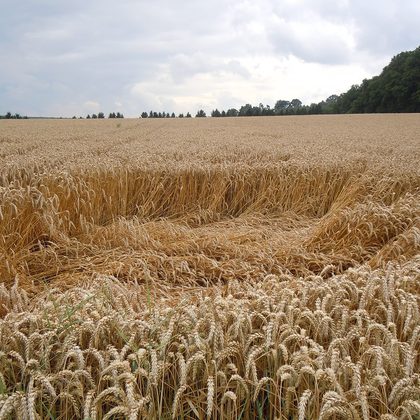
The grassy plains of the Transylvanian Basin: steppe and forest-steppe grassland on deep, loose loess, nowadays almost entirely used as pasture. The species avoids heavily grazed land: it depends on the underground supply of bulbs, tubers and thick roots, which disappears when the vegetation is grazed to the ground. Otherwise it requires what all related species require: deep, free-draining soil, without waterlogging, rock or closed woodland. Intensively worked arable land is unsuitable: deep ploughing destroys the burrow system and kills the animals living in it.
Where the animal is most at home, classified with EUNIS — the European standard for habitats.
Distribution
Central Romania only. The species is endemic to the Transylvanian Plain, with known cores in the counties of Cluj, Mureș, Bistrița-Năsăud and Alba. The type locality comprises five places, Apahida, Nădășelu, Lechința de Mureș near Târgu Mureș, Gherla and Someșeni, all in Cluj and Mureș, because Méhelÿ designated no lectotype. According to the most recent estimate the range has an extent of occurrence of about 2,100 square kilometres and an area of occupancy of 366 square kilometres, divided among at least four separated cores; the species has probably disappeared from the south and south-east of the Transylvanian Plain. No blind mole-rats occur in the British Isles, the Low Countries or the Iberian Peninsula.
- Native
- dark = core range, pale = thinly spread
Way of life
Entirely subterranean, active round the clock, with most digging at the beginning and end of the day; the animals come above ground almost only when young disperse. The species neither hibernates nor keeps a winter rest and lives through the winter on its store chambers. The diet consists of bulbs, tubers, rhizomes and thick roots; nothing has been published on the diet of this species separately, and the data are taken from related species. The animals are solitary and tolerate no conspecifics in their burrow system. Densities of 2.7 to 3.7 animals per hectare have been measured in Transylvania, and the world population is estimated at 3,550 to 3,800 mature individuals. With one litter a year and females that first breed in their second year, a lost colony does not recover by itself.
Where and when to look
Go in March or April to the Câmpia Transilvaniei, the hilly pasture country between Cluj-Napoca, Gherla and Târgu Mureș, early in the morning, when the grass is still short and fresh soil shows dark, and scan across the terrain rather than just ahead of you. An occupied system is recognisable as a group of broad, low, coarsely clodded mounds close together in the grass; fresh, damp soil means that the animal is living there now, grassed-over mounds that the system is abandoned. Search preferably on parcels that have not been grazed bare, because that is where the species occurs. Digging is pointless and disturbs an endangered species. Report finds: knowledge of the Romanian distribution rests largely on reports of new mounds, and unknown colonies cannot be protected.
Conservation status
Endangered (2024). The assessment concerns the species in its current delimitation and not a collective species. The criteria are those of a small and shrinking range: an extent of occurrence of about 2,100 square kilometres, an area of occupancy of 366 square kilometres, a few separated cores, and habitat continuing to decline in extent, area and quality. The causes are the conversion of grassland and deep ploughing of the fertile loess soils, conversion to uniform arable, overgrazing, building and road construction. In addition there are the risks of small, isolated populations, namely inbreeding and the absence of recolonisation after a local loss, and, near villages, the deliberate killing of animals regarded as pests. Climate change has also been identified as a risk for these isolated cores. Because the animal is rarely seen, colonies usually disappear unnoticed.
Scientific name
Spalax antiquus | Méhelÿ, 1909
Méhelÿ described the species in 1909 and placed it straight away in the genus where it still stands. Spalax is Greek spalax, also aspalax, 'mole'. antiquus is Latin for 'ancient, of former times'; Méhely described the animal as an old-fashioned form beside Spalax graecus, but does not say why. The specimen the first description was based on came from Romania, Cluj.