All species › Bats › Bent-winged bats › Maghrebian Long-fingered Bat
Maghrebian Long-fingered Bat | Miniopterus maghrebensis
Miniopterus maghrebensis | Miniopterus maghrebensis
The Maghrebian long-fingered bat was described in 2014 as a separate species within the Miniopterus schreibersii complex, on the basis of genetic differences and skull measurements. It is known from Morocco and northern Tunisia, where it occurs alongside Schreibers's long-fingered bat, from which it cannot be distinguished externally. Little has been published on its behaviour, breeding or echolocation that can be attributed to this species with certainty.
No photograph of a living wild animal of this species with a suitable Creative Commons licence exists. Do you have one that meets the rules? Send it in.
Tracks
As in Schreibers's long-fingered bat, signs are found in caves and other underground sites: droppings beneath roosting spots, fine and crumbling into insect fragments, and dark staining of the ceiling above roosts used for many years. The bats hang in dense clusters against the ceiling. Colonies number up to about 400 individuals. Because both Miniopterus species in the Maghreb use the same type of roost, signs alone do not show which species is present; mixed colonies are also possible.
Identification
Built like Schreibers's long-fingered bat: a short, domed head with a short muzzle, small, triangular ears and a long, narrow wing in which the second phalanx of the third finger is folded back at rest. The dorsal fur is chestnut brown to dark greyish brown, the underparts pale brown; the wing membranes are dark brown to dark greyish brown. Measurements of the holotype: head-body 60 mm, tail 63 mm, ear 13.4 mm, tragus 6.3 mm; the forearm measures 45 to 48 mm. Body mass is not given in the species description. The diagnostic differences from M. schreibersii lie in the skull: a broader rostrum (infraorbital width 4.0 to 4.4 mm, 0.27 to 0.28 of skull length against 0.24 to 0.27), a higher braincase (7.7 to 8.4 mm), a distinct tubercle on the lower jaw and more robust small premolars. These characters can only be assessed on a skull or with X-ray images. Echolocation data are not given in the species description.
Similar species
Schreibers's long-fingered bat (M. schreibersii) occurs in the same area of the Maghreb and cannot be separated from the Maghrebian long-fingered bat in the field; the browner fur of M. maghrebensis overlaps with the variation of M. schreibersii. Separation rests on mitochondrial and nuclear DNA and on the skull characters under Identification. The mitochondrial distance between the two species is small (1.2% on average), but microsatellite data point to two strongly isolated gene pools. According to the describers, all earlier North African records of M. schreibersii need to be re-evaluated. Other cave bats in the same area, such as Myotis punicus, the long-fingered bat (Myotis capaccinii) and horseshoe bats, have longer ears with a straight tragus or a noseleaf and a shorter third finger.
Habitat
Mediterranean scrub and dry woodland, steppes and other semi-desert landscapes at 300 to 1200 m. In Morocco the species is known mainly from the drier southern regions, including south of the High Atlas; the type locality is a cave in Er Rachidia Province, on the edge of the Sahara. Caves and other underground sites serve as roosts. On the basis of wing shape the species is assumed to forage in open space: over clearings, above trees and over water.
Where the animal is most at home, classified with EUNIS — the European standard for habitats.
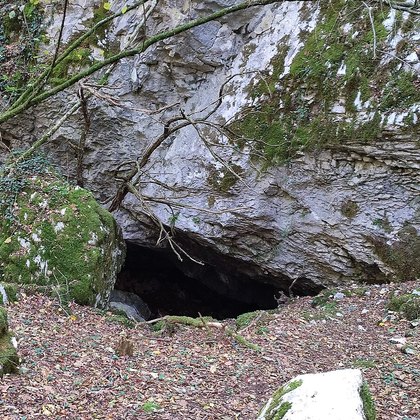
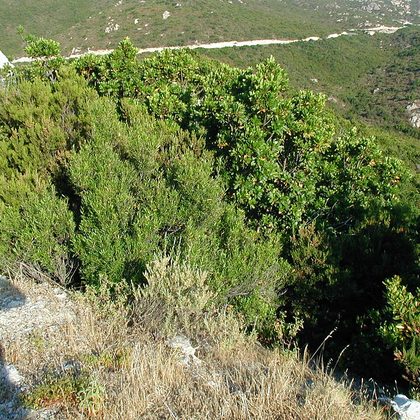

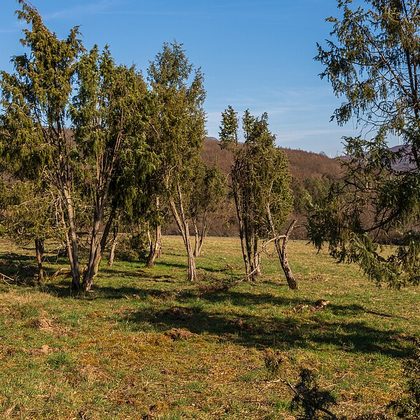
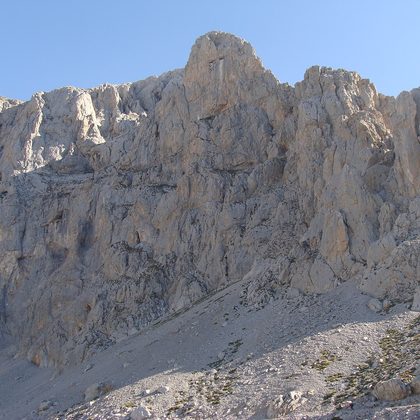

Distribution
Known from central and south-western Morocco (Middle and High Atlas, from the north of the country to south of the High Atlas) and from northern Tunisia. The species may occur continuously across most of Mediterranean North Africa, including Algeria, but has not been genetically confirmed there. The whole known range lies within the guide area. Because earlier data were published under M. schreibersii, the distribution of the two species in the Maghreb has not yet been mapped.
- Native
- dark = core range, pale = thinly spread
Way of life
Presumably nocturnal. The species enters torpor in autumn, builds up fat reserves in autumn and hibernates in caves. From its wing structure it is assumed to catch flying insects in moderately fast flight; no diet study of genetically identified individuals has been published. A wide spread of birth dates, from mid-April to the end of June, has been reported from Algeria, but it has not been established whether these data refer to M. maghrebensis, M. schreibersii or both. Colonies number up to about 400 individuals.
Where and when to look
A Miniopterus in the Maghreb cannot be identified to species in the field and is recorded as Miniopterus sp. unless DNA has been examined. Watching emergence at a cave entrance in summer is the way to see the bats without disturbing them; a bat detector records the calls, but these do not allow separation from Schreibers's long-fingered bat. Caves with colonies are not entered during the maternity period or in winter. New sites, especially in Algeria, contribute to defining the range; a licensed researcher can take a skin biopsy for DNA analysis without killing the bat.
Conservation status
Near Threatened (NT, 2017). The assessment assumes that current levels of disturbance will lead to a decline in habitat of at least 30% within fifteen years, and that the known roosts are threatened by human activities. Because the species was described only in 2014 and its range is not settled, the assessment rests on a limited number of known sites.
Scientific name
Miniopterus maghrebensis | Puechmaille, Allegrini, Benda, Bilgin, Ibáñez, & Juste in Puechmaille, Allegrini, Benda, Gürün, Šrámek, Ibáñez, Juste, & Bilgin, 2014
Puechmaille, Allegrini, Benda, Bilgin, Ibáñez, & Juste in Puechmaille, Allegrini, Benda, Gürün, Šrámek, Ibáñez, Juste, & Bilgin described the species in 2014 and placed it straight away in the genus where it still stands. Miniopterus is Greek, from minyos, 'small' (compare minythein, 'to lessen'), and pteron, 'wing'; Bonaparte gave no explanation, but he presumably meant the very short first phalanx of the third finger, which lets the long wing-tip fold back. maghrebensis means 'of the Maghreb', Arabic al-Maghrib, 'the west, where the sun sets', the name for north-west Africa. The specimen the first description was based on came from Morocco, Er-Rachidia.