All species › Rodents › Jerboas › Lesser Egyptian jerboa
Lesser Egyptian jerboa | Jaculus jaculus
Kleine woestijnspringmuis | Jaculus jaculus
The Lesser Egyptian Jerboa (Jaculus jaculus) is the commonest jerboa of the Sahara. It weighs 43 to 73 grams, does not drink, covers up to about ten kilometres in a night and spends the day in a burrow whose entrance is closed with a plug of sand. The species moves on its hind legs only, so its trail in sand consists of pairs of hind-foot prints without fore feet.
Tracks
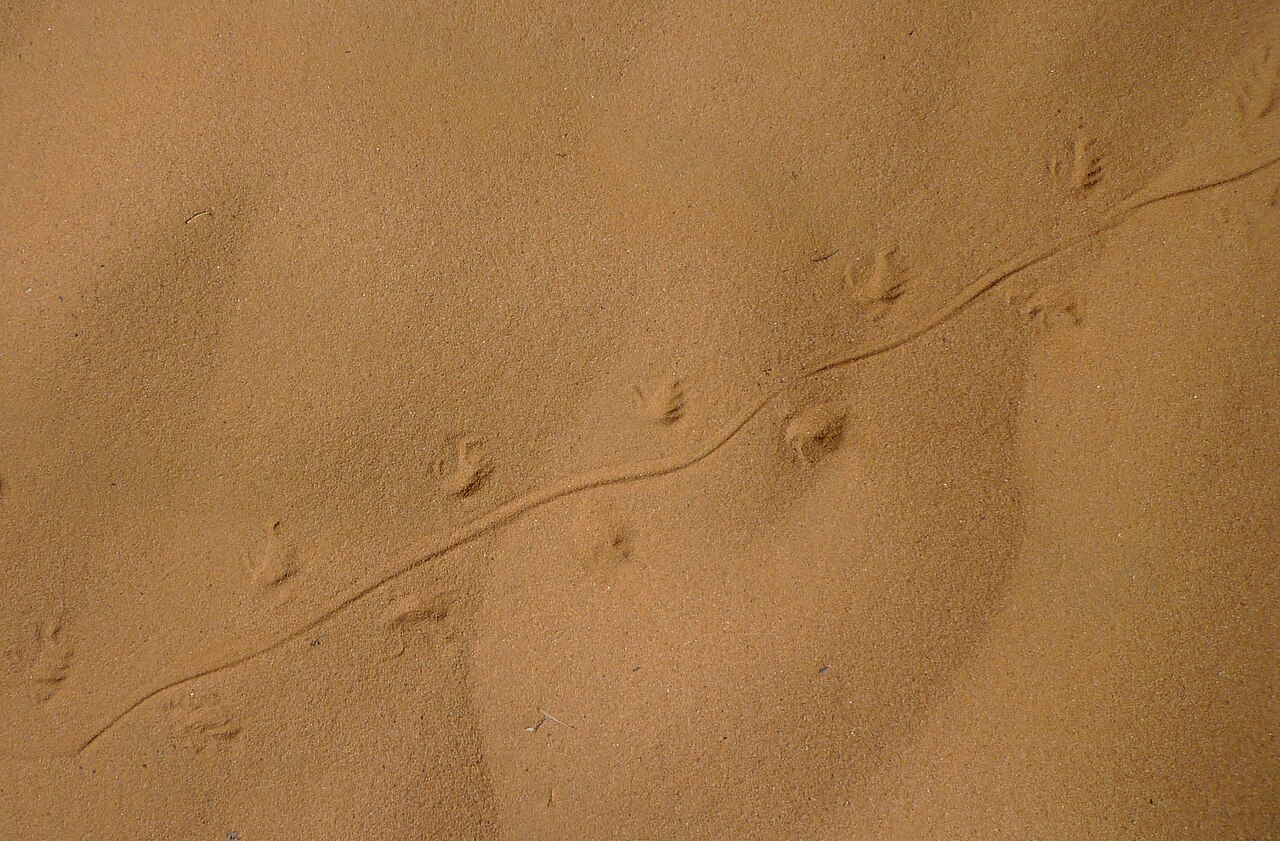
The trail is best seen early in the morning. A jerboa sets down only its hind feet: the trail consists of pairs of prints with undisturbed sand between them, without fore feet and without a body drag. Each print is a three-toed print two to three centimetres long, with the three toes with pointed claws in front and behind them the sweep of the hair brush beneath the foot. The foot itself is five to over seven centimetres long, but only the toes bear the weight; the hair brush keeps the print recognisable even in soft sand. Leap length is the second character: ten to thirteen centimetres when moving calmly, up to three metres per leap in flight, so that the pairs then lie far apart. In fine, dry sand the tail sometimes draws a thin, continuous wavy line between the prints. Where the animal has dug or fed, the two small fore-foot prints lie side by side, with a small scrape and seed husks. The burrow entrance is closed by day: a round hole with a plug of sand slightly looser and darker than the surrounding sand, usually at the foot of a tussock or under a shrub. Below ground the tunnel spirals down to about 1.2 metres, with one or more escape shafts ending just below the surface; if the main entrance is disturbed, the animal escapes through such a shaft. After about nine in the morning the wind has usually erased the tracks.
Identification
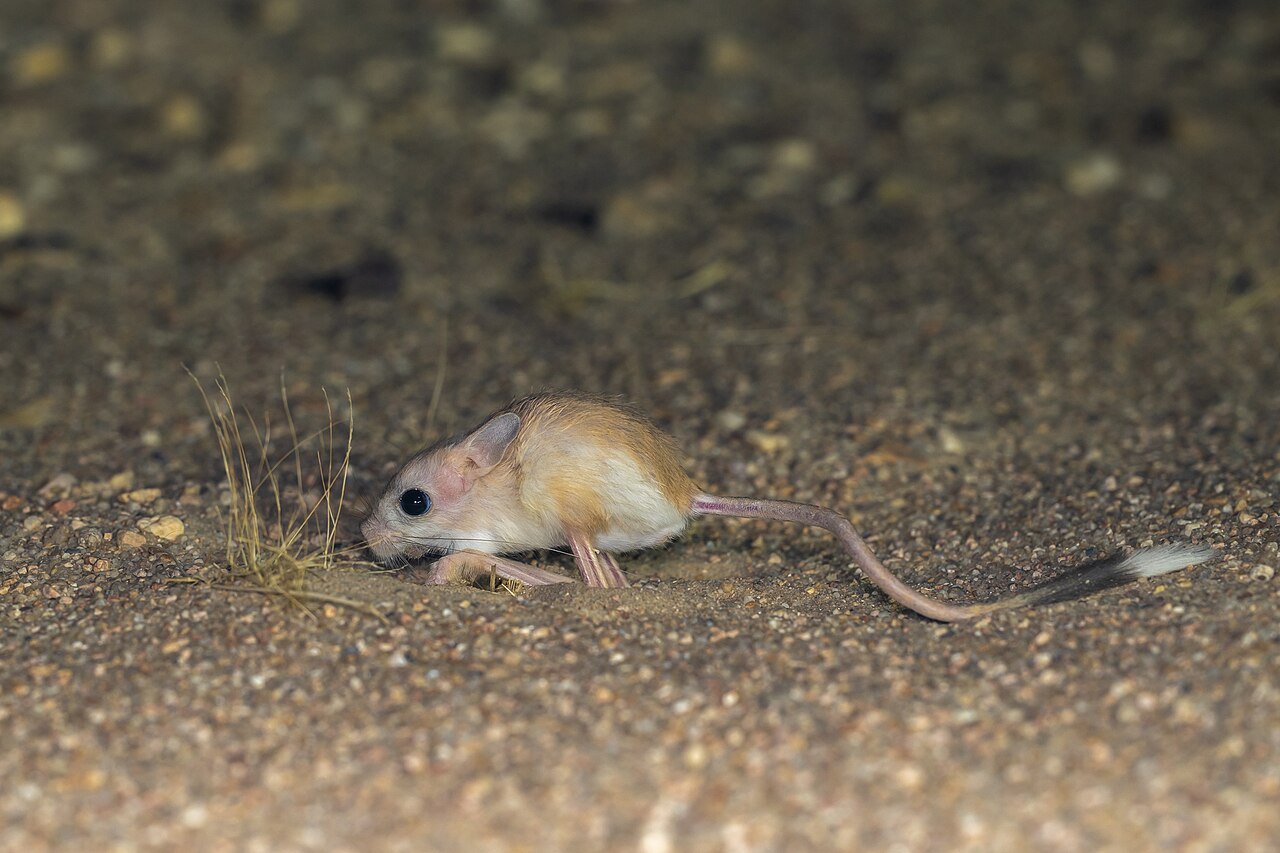
A small, sand-coloured rodent that sits upright and hops on its hind legs. Head-body nine to eleven centimetres, with very large eyes, moderately large, rounded ears clearly shorter than in the five-toed jerboas, and a short, broad muzzle with long whiskers. The upperparts are ochre to sandy, the belly and inner limbs pure white, and a white hip stripe crosses the thigh, clearly visible in a sitting animal. The hind foot has three toes, with brushes of stiff hairs beneath that reduce sinking into loose sand. At thirteen to twenty-five centimetres the tail is much longer than the body, thin, and ends in a flat black-and-white tuft: a black band with a white tip. The forelimbs are very small, held against the chest and used only for digging and feeding.
Similar species
North Africa also holds the Greater Egyptian Jerboa, of the same build but two to three times the weight (134–139 against 43–73 grams), coarser and greyer, and preferring the firmer, better-vegetated steppe soils on the northern edge of the Sahara to open sand. At a distance, in a headlight beam, that difference cannot always be established, and a lone jerboa at night often cannot be identified with certainty; size and ground type together give the best indication. Confusion is also possible with gerbils and jirds (Gerbillus, Meriones, Pachyuromys), which are likewise sandy with a long tail, but move on four legs, have much shorter hind legs and a haired tail without a black-and-white tuft. In the trail the difference is unambiguous: a gerbil leaves fore and hind prints in a bounding pattern, the jerboa hind feet only. The North African Elephant Shrew has a mobile snout and runs rather than hops.
Habitat
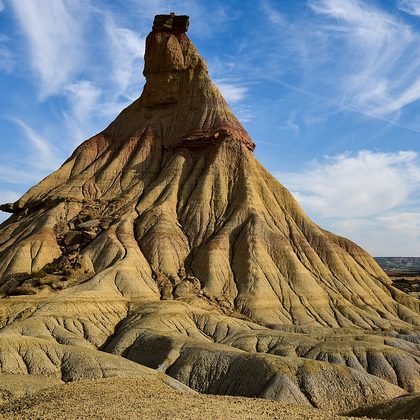
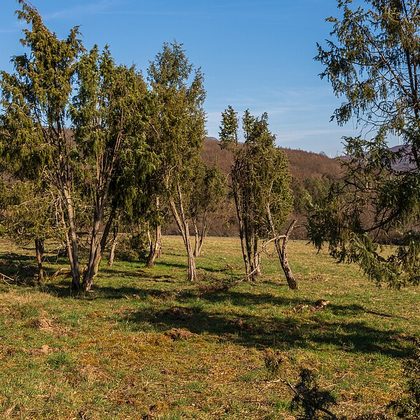
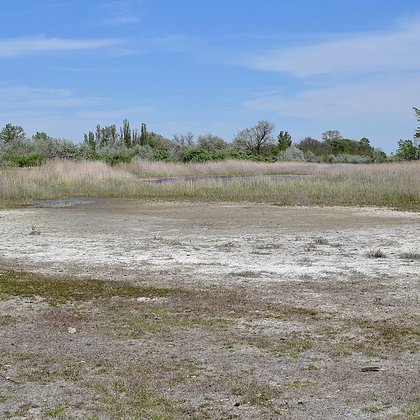
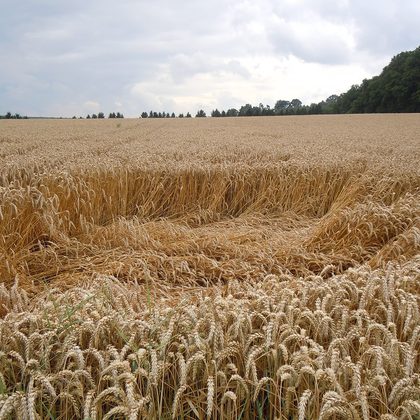
Desert and semi-desert, both sandy and stony. The species is most numerous on transitions: the foot of a dune, the edge of a wadi, flat hamada with scattered shrubs, salt flats with sebkha margins and the cultivated strips around oases. Bare, hard gravel offers too little food and high dunes are too loose; it needs loose sand to dig in and scattered vegetation for food. The species also occurs in farmland, on fallow fields and along desert tracks.
Where the animal is most at home, classified with EUNIS — the European standard for habitats.
Distribution
The whole Sahara, from Morocco and Mauritania to Egypt and Sudan, and beyond into the Sahel, the Arabian Peninsula and the Levant. The northern part of the range comprises the Maghreb and north-east Africa: Morocco, Algeria, Tunisia, Libya and Egypt north of 29°N, Sinai, the Negev and southern Jordan. There it is the commonest jerboa and one of the most numerous desert mammals; GBIF holds more than thirteen hundred records for that area, far more than for any other jerboa. The species does not occur on the European mainland.
- Native
- dark = core range, pale = thinly spread
Way of life
Strictly nocturnal and solitary. After dark the animal comes above ground and covers a long distance while hopping and foraging, up to about ten kilometres from the burrow. The diet consists of seeds, grain, roots, succulent parts of desert grasses, insects and desert truffles (Terfezia), which are dug up after the winter rains. The species does not drink: moisture from green plant parts and insects suffices, and the kidneys are adapted to this. In great heat or drought the animal withdraws into the burrow and aestivates; in the north of the range it is thought also to have a winter dormancy in the coldest weeks, in a separate chamber of the burrow system. The burrow has several entrances and exits, storage chambers and a nest chamber at the bottom. It breeds at least twice a year, in June and July and again from October to December, with a gestation of 25 to 45 days and one to six, on average three young. These are weaned at six weeks, independent at eight to ten weeks and sexually mature at eight to twelve months. Lifespan in the wild is two to four years, in captivity more than six.
Where and when to look
There are two methods. At night: drive at walking pace with headlights along a desert track in southern Morocco, Tunisia or Egypt's Western Desert, preferably in the first two hours after sunset, and watch for red eyeshine and sideways leaps in the beam. By day: walk along the foot of a dune or a sandy wadi floor at first light, before about nine, and follow the previous night's tracks. A run of pairs leads to the closed burrow entrance; mark it with a stone and wait there after sunset the following evening. Do not dig the burrow open.
Conservation status
Least Concern (LC, 2021). The range is very large, numbers are high and the species lives in landscapes that people change little. Where desert is reclaimed or overgrazed, numbers decline locally, and along desert tracks there are road casualties; neither has consequences for the species as a whole. The species is used as a laboratory animal and traded in the pet trade, without demonstrable effect on populations.
Scientific name
Jaculus jaculus | (Linnaeus, 1758)
Linnaeus described the species in 1758 as Mus Jaculus; because it was later moved to another genus, the author and year stand in brackets. Jaculus is Latin for 'thrown, darting', from iacere, 'to throw'; the Romans also used it of a snake that shot out like a javelin. The specific name repeats the genus name. The specimen the first description was based on came from Egypt, Giza Pyramids.