All species › Even-toed ungulates › Oceanic dolphins › Killer whale
Killer whale | Orcinus orca
Orka | Orca
The Killer Whale is the largest member of the dolphin family: a black-and-white toothed whale whose males grow to eight metres and carry an upright dorsal fin of almost two metres. The species occurs in all oceans and lives in close family groups that specialise on particular prey. In Europe the best known are the Killer Whales of Norway and Iceland, which follow the herring; there are also Killer Whales that hunt seals around Shetland, a small group off the west coast of Scotland and Ireland, and a group of about forty animals in the Strait of Gibraltar and along the Iberian coast that hunts Atlantic bluefin tuna.
Tracks
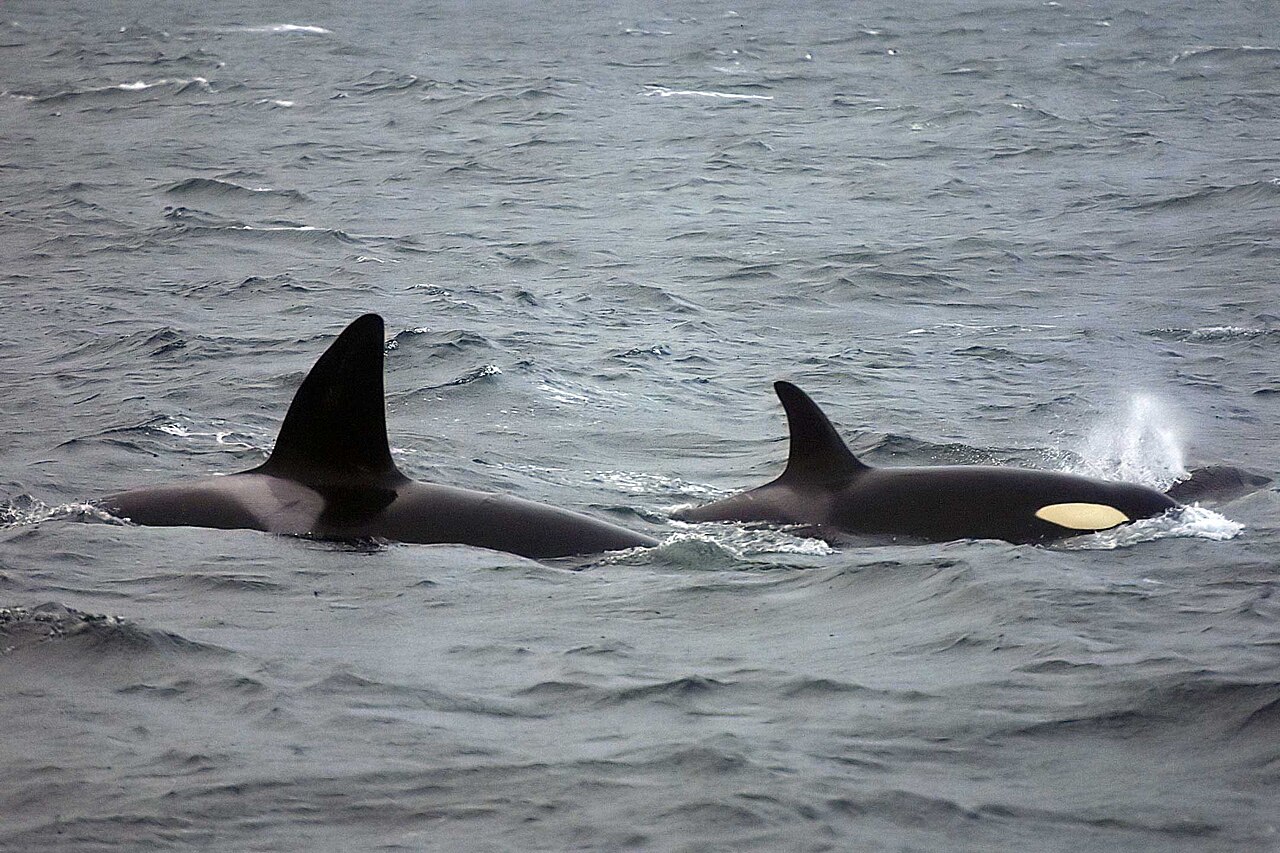
At sea the dorsal fin is the first and clearest feature: the tall straight fin of a male can be seen from kilometres away and stands above the fins of the rest of the group. The blow is low and bushy and clearly visible in cold, still weather; when resting the group dives together after a series of short breaths and resurfaces after a few minutes. Killer Whales often travel in a loose line or a tight group, and a hunting group suddenly changes direction and speed. They leap, slap tail and flippers on the water and raise the head vertically out of the water. Groups around the British Isles usually number fewer than ten animals, rarely more than fifteen; in the northern North Sea and off Norway groups of one to three hundred are seen around the herring fishery. Where Killer Whales hunt seals, along the Shetland coast, you often see them patrolling close under the rocks.
Head close-up
Identification
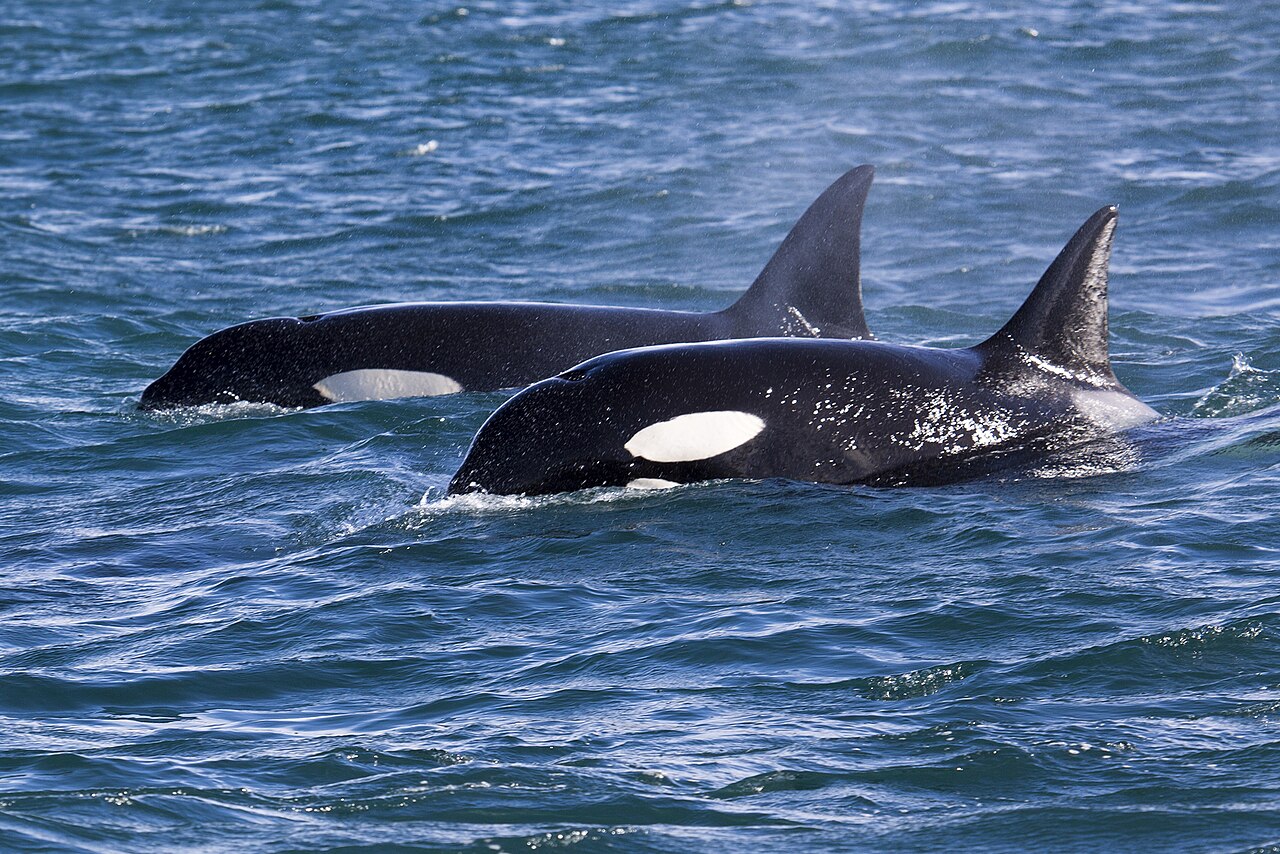
Recognised by the sharply bordered black-and-white pattern: a black back and flanks, a white throat and belly that extends up the flank in a white lobe, a white oval patch above and behind the eye and a grey saddle behind the dorsal fin. The head is conical, without a distinct beak. The dorsal fin is set mid-back and differs between the sexes: in an adult male it is triangular and straight, up to almost two metres tall, sometimes leaning slightly forward; in females and young animals it is about ninety centimetres tall and curved back like a sickle. The flippers are large and rounded, like paddles. Females are five to seven metres long, males six to eight.
Similar species
An adult male, with its tall straight fin, cannot be confused with any other European cetacean. Females and young animals have a curved fin like the Bottlenose Dolphin and Risso's Dolphin, but are larger and black, and as soon as the eye patch or saddle is seen the identification is certain. The Long-finned Pilot Whale is also black, but has a low, broad fin far forward on the back and a round, bulbous head without a white eye patch. The Minke Whale has a small curved fin far back on a long grey back and usually surfaces alone. At long range an upright Killer Whale fin can briefly resemble a wave crest; keep watching the same spot.
Habitat
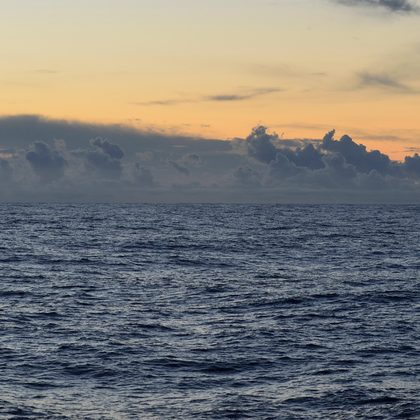
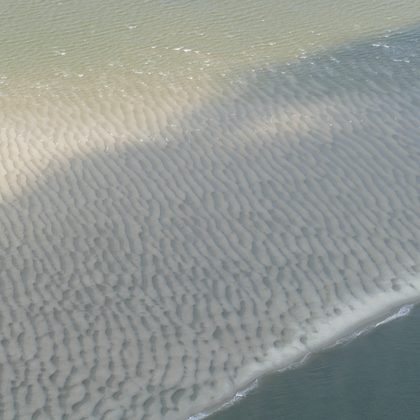
From the open ocean to close inshore, in fjords, straits and around rocky islands; the species occurs in cold and warm water, but is most numerous in cooler seas rich in food. What a group eats decides where it stays: the herring-eating Killer Whales of Norway and Iceland follow the herring into the fjords and the open sea, the seal hunters of Shetland patrol rocky coasts, and the Iberian Killer Whales follow the migration of bluefin tuna. The diet includes fish such as herring, mackerel, salmon, cod, halibut and tuna, as well as squid, rays, marine mammals and occasionally seabirds.
Where the animal is most at home, classified with EUNIS — the European standard for habitats.

Distribution
In Europe mainly from Norway and Iceland via the Faroes to the north and west of the British Isles. The North Atlantic population was estimated at about 30,000 animals in 2005; Norwegian surveys between 2014 and 2018 estimated about 14,000 in southern Norway, the northern North Sea and the Barents Sea. Around the British Isles the species is seen most in northern and western Scotland and western Ireland; in the Irish Sea, the central and southern North Sea and the Channel it is rare. The small West Coast Community of Scotland and Ireland numbered eight animals, of which only two old males have been seen in recent years. In the south lives the group of the Strait of Gibraltar and the Gulf of Cádiz, about forty animals, which is in the Strait in spring and summer and then moves north along Portugal to Galicia. In the Mediterranean outside the Alboran Sea the Killer Whale is a vagrant.
- Native
- dark = core range, pale = thinly spread
Way of life
Active by day and night. Killer Whales live in family groups around an older mother, in which sons and daughters often stay for life; groups hunt together and pass their hunting technique on to the young. Mating takes place mainly in October and November; gestation is fifteen to eighteen months, and the calf is just over two metres long at birth. Mortality in the first six months is high. Females live fifty years on average and up to about ninety, males thirty on average and up to about sixty.
Where and when to look
In northern Norway large shoals of herring overwinter in the fjords of Troms, and between November and January boats leave Tromsø and Skjervøy for the Killer Whales that follow them; sometimes the animals can also be seen from the fjord shore. In Iceland Killer Whales can be seen in winter around the Snæfellsnes peninsula. In Shetland they are mainly to be expected along the coast from May to August; the animals come close under the rocks, and sightings spread quickly through local reporting groups. In the Strait of Gibraltar the chances are best in spring and summer, from boats out of Tarifa. Keep your distance and do not follow a group in a fast boat.
Conservation status
Data Deficient (DD, 2017). The species is worldwide too diverse and too incompletely studied for a single verdict. The Strait of Gibraltar subpopulation has been listed as Critically Endangered (CR) since 2019; it depends on bluefin tuna, and since catches in the drop-line fishery declined few calves have survived. Since 2020 animals from this group have attacked sailing yachts and small vessels hundreds of times, often damaging the rudder; by November 2023 more than five hundred incidents had been reported and three yachts had sunk. The West Coast Community of Scotland and Ireland has produced no calves since observations began in the 1990s. Threats are depletion of prey such as herring and mackerel and high loads of PCBs, PBDEs and DDT, which impair reproduction. The species is protected under the Habitats Directive and is covered by ASCOBANS and ACCOBAMS.
Scientific name
Orcinus orca | (Linnaeus, 1758)
Linnaeus described the species in 1758 as Delphinus Orca; because it was later moved to another genus, the author and year stand in brackets. Orcinus is derived from Latin orca, in Pliny the name of a large sea animal, with the suffix -inus, 'belonging to'. orca is the Latin word from which the genus name is also derived.