All species › Rodents › Mice and rats › Flower's Gerbil
Flower's Gerbil | Gerbillus floweri
Flowers renmuis | Gerbillo de Flower
Flower's Gerbil (Gerbillus floweri) is the largest gerbil of the Sinai dunes. Characteristic is the large hind foot, up to nearly 4 cm, in an animal weighing less than 70 g. The species is named after Stanley Smyth Flower, the British director of the Giza zoo, and was described from a wadi near El Arish. It lives on the sand belt between the Nile Delta and the Negev.
No photograph of a living wild animal of this species with a suitable Creative Commons licence exists. Do you have one that meets the rules? Send it in.
Tracks
On sand the tracks of this species are easy to recognise because of the large foot. In damp morning sand in a dune slack the bounding tracks form pairs of elongated prints of 3 to nearly 4 cm, clearly larger than those of the other gerbils on the same dune; in practice this is the most usable distinction. Because the soles are haired, the print is filled and blurred rather than a sharp toe pattern, and in a fast bound the fore feet are absent. Between the pairs there is often a fine drag mark of the tail. The burrow lies in loose or semi-stabilised sand, usually in the lee of a shrub or at the foot of a dune slope, with a few entrances and a fresh spoil fan; by day the entrance is plugged, so that no open burrows are visible; after sunset the entrances are opened. Around the entrance lie empty seed coats and gnawed-out colocynth seeds, the wild desert gourd whose seeds it eats; the hard yellow fruits lie on the dune, and gnawed fruits indicate an occupied site. Droppings are small, dark and dry, 2 to 3 mm, scattered and not in a latrine. In the sand around shrubs there are sifting pits where seed has been extracted from the sand.
Identification
A large, long-bodied gerbil of 9.5 to 13 cm head-body length, with a tail of 13 to nearly 16 cm (120 to 130 per cent of head-body length), two-toned and ending in a small grey tuft. The back is cinnamon to dull tawny, with a faint paler dorsal stripe visible only in raking light; the belly is pure white. The ears are large, thin and unpigmented (14 to 18 mm). The decisive character is the hind foot of 31 to 38 mm, with densely haired soles; this is the largest hind foot of the gerbils of Sinai and the Negev. Weight 26 to 63 g, clearly more than in related species of the same area. The skull has greatly inflated auditory bullae, which give acute hearing, including for approaching owls.
Similar species
Two other gerbils live on the same dunes. Gerbillus andersoni is smaller and lighter (16 to 38 g), more orange-brown, and has a smaller hind foot of 25 to 32 mm. The Lesser Egyptian Gerbil (Gerbillus gerbillus) is smaller and paler still, weighs 14 to 35 g and likewise has a hind foot of 25 to 32 mm. This species is therefore roughly the heavy, large-footed gerbil of the group, but measurements overlap at the extremes, and a young animal of this species cannot be separated from an adult andersoni. Gerbillus dasyurus differs clearly: smaller, greyer yellow, with a dark eyebrow stripe, a short hind foot of 20 to 27 mm, and it lives on rock and gravel rather than sand. The Fat-tailed Gerbil and the spiny mice are distinguished by their short or almost naked tails. In the field these gerbils often cannot be identified to species; without a hind-foot measurement the genus is the correct identification.
Habitat
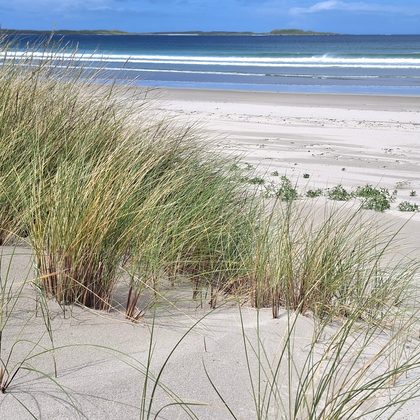
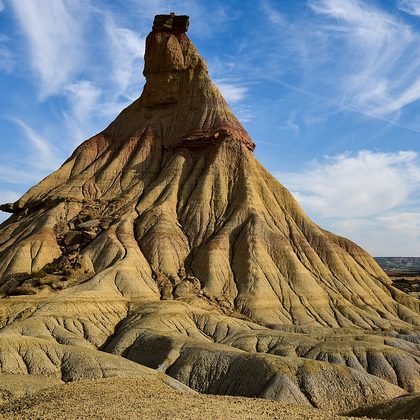
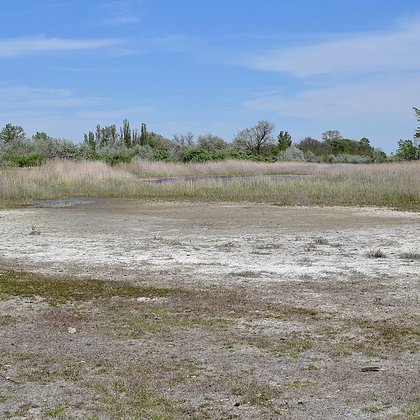
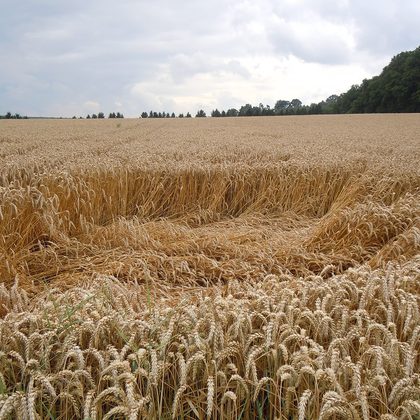
Sand with some cover: dunes and dune slacks, coastal sand plains, sand belts along wadis, date plantations and acacia groves, and the sandy margins of salt lakes and salt pans with low scrub. The species also occurs in built-up and cultivated land, such as field margins and gardens on sandy soil in the Nile Delta and along the coast, and locally reaches high densities in the dunes of northern Sinai. It is absent from rocky ground; there Gerbillus dasyurus lives.
Where the animal is most at home, classified with EUNIS — the European standard for habitats.
Distribution
A narrow area: the sand belt on both sides of the Nile Delta and in northern Egypt, the whole of northern Sinai (the type locality is Wadi Hareidin, a few miles south of El Arish), and further the Negev and the coastal plain of southern Israel and Palestine. Since version 2.5 the Mammal Diversity Database also includes perpallidus, the pale gerbil of the western desert margin of Egypt, in this species; on newer maps the range therefore extends further west than on older ones.
- Native
- dark = core range, pale = thinly spread
Way of life
Nocturnal and entirely ground-living; by day it rests in a self-dug, plugged burrow in the sand. It eats seeds and plant parts, seeds of colocynth in particular having been recorded, and also insects. Almost nothing has been published about breeding in the wild: the Handbook of the Mammals of the World gives no information, and other data in circulation (a breeding season from May to December, a litter of about four young, a gestation of 20 to 22 days, sexual maturity within three months) come from secondary sources and have not been verified. There is no hibernation; in Sinai the species is active at night throughout the year. The large, haired hind foot and the inflated bullae are adaptations for rapid escape over loose sand from approaching owls.
Where and when to look
Search the dunes of northern Sinai or the sand belts of the north-western Negev after dark with a lamp. The first two hours after sunset on a moonless night produce the most sightings; drive at walking pace along a sand track or walk along the foot of a dune and watch for eyeshine. The most reliable way to establish this species, however, is by its print: walk through a dune slack at first light, before the wind has erased the tracks, and measure the hind-foot prints. Prints of 3 to 4 cm indicate this species, 2 to 3 cm one of the smaller related species. Also look for gnawed colocynth fruits and plugged burrow entrances. When in doubt, record only the genus.
Conservation status
Least Concern (LC, 2008). The assessment predates the taxonomic revision by which perpallidus was added to the species; a new assessment covering the broader species concept is lacking. The range is small and lies on the sand belts under greatest pressure in Egypt and Israel: coastal development, farming on dune sand and the stabilisation of drifting sand reduce the species' habitat. On the other hand it still occurs at high densities in the dunes of northern Sinai and also uses field margins and palm plantations.
Scientific name
Gerbillus floweri | O. Thomas, 1919
O. Thomas described the species in 1919 and placed it straight away in the genus where it still stands. Gerbillus is a diminutive of gerbo, the old name of the jerboa, from Arabic yarbūʿ: the jerboa's little cousin. floweri honours Stanley Smyth Flower (1871–1946), the British director of the Giza zoological gardens, who supplied Thomas with Egyptian mammals. The specimen the first description was based on came from Egypt.