All species › Even-toed ungulates › Bovids › Chamois
Chamois | Rupicapra rupicapra
Gems | Rebeco alpino
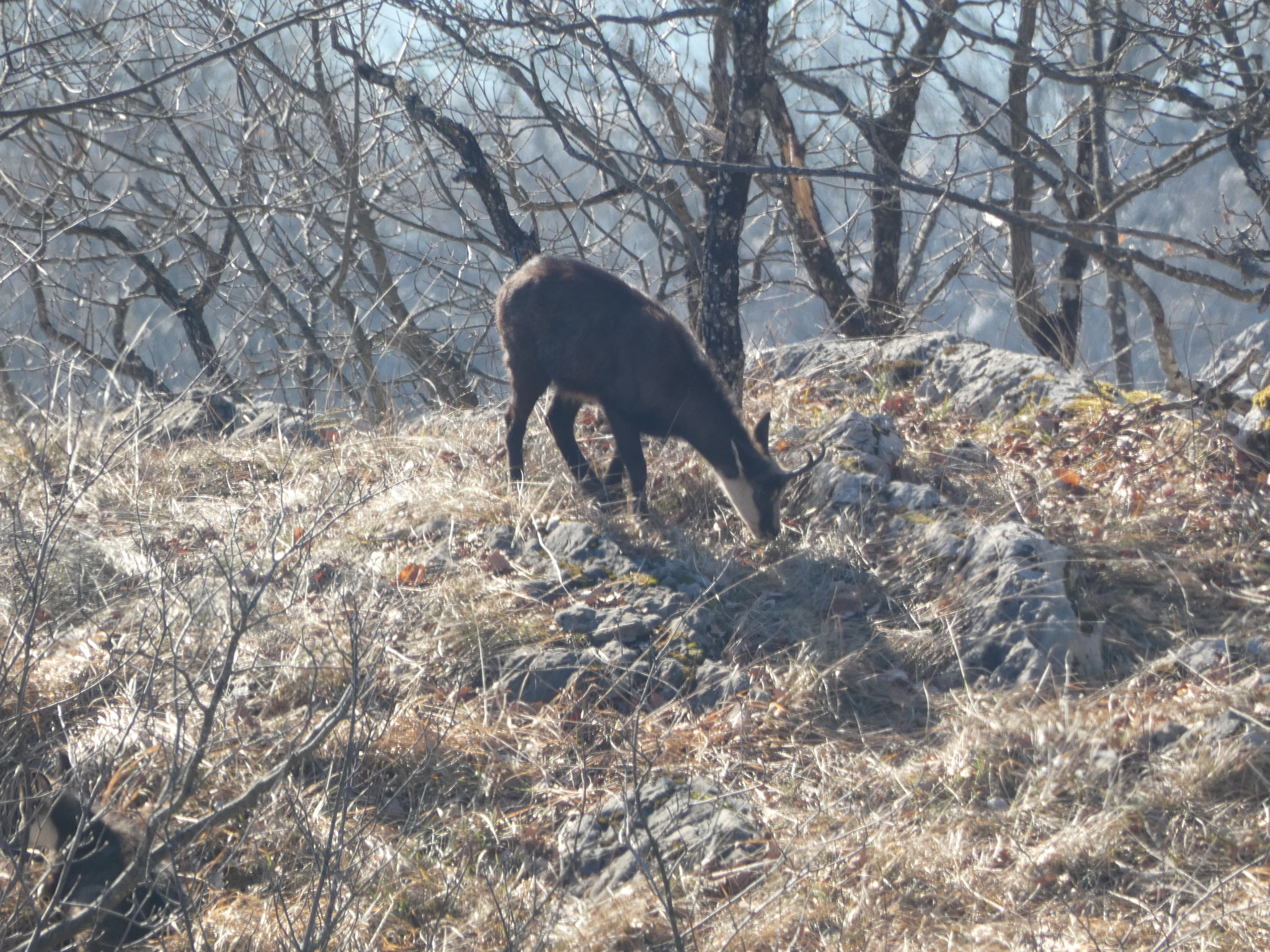
The chamois (Rupicapra rupicapra) is a diurnal goat-antelope of the Alps, the Carpathians and other mountain ranges of central and south-eastern Europe. It often stands in the open on slopes, but usually at a great distance, so that a telescope is needed to see it well. In the Alps and the Carpathians it is almost always found by scanning the grass strips between the rock bands. In the Pyrenees, the Cantabrian Mountains and the Apennines a different species lives, the Pyrenean chamois.
Tracks
The slot is 5 to 6.5 cm long and 3 to 4 cm wide, cloven, with the halves clearly apart and rounded rather than pointed at the tip; the chamois spreads its toes for grip, which shows in the print. The dew claws register in snow and on soft ground. In snow the trail is the most useful sign: long, straight tracks crossing a snowfield or couloir diagonally from rock band to rock band, often through terrain impassable for people. In deep snow the chamois digs craters down to the grass; a slope with many such pits indicates a herd. Droppings are black, glossy pellets of 8 to 12 mm in loose heaps on ledges and at resting sites; in the field they cannot be reliably distinguished from those of ibex, mouflon and free-ranging goat; the site and accompanying signs are decisive. Resting sites are clearer: scraped oval hollows under an overhang or on a ledge, with droppings and shed hairs, used for years. In June the moulted winter coat lies in tufts on shrubs and rocks. In winter there are browse marks on mountain pine, young larch and spruce: bitten shoots and locally stripped bark. During the rut, in November, bucks rub the secretion of the glands behind the horns onto branches and rock points, leaving a strong goaty smell detectable in still air. An important sign is the alarm whistle, a sharp, high-pitched blast through the nose that carries over a long distance and indicates that a herd has noticed the observer.
In its habitat
In winter coat
The young
Identification
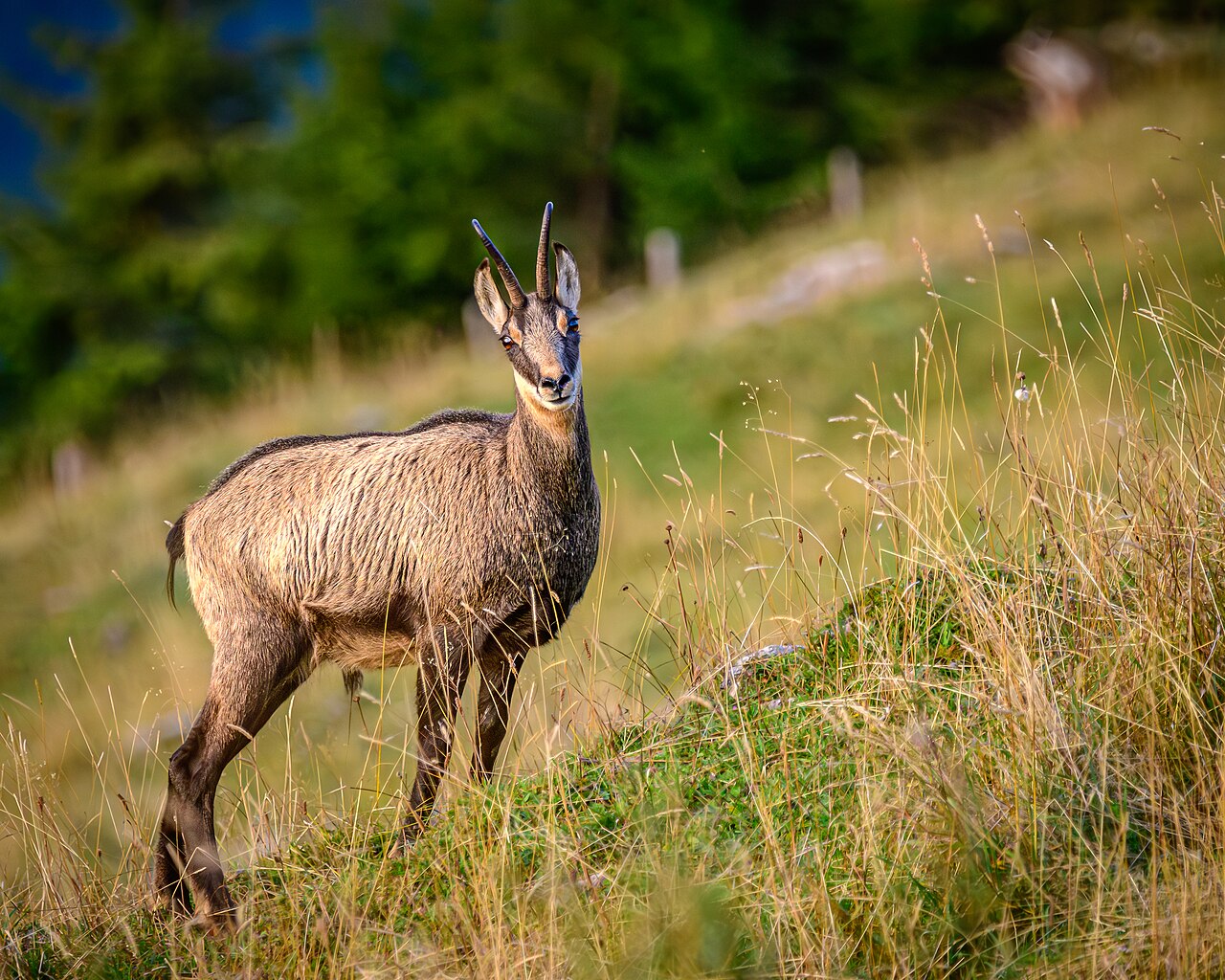
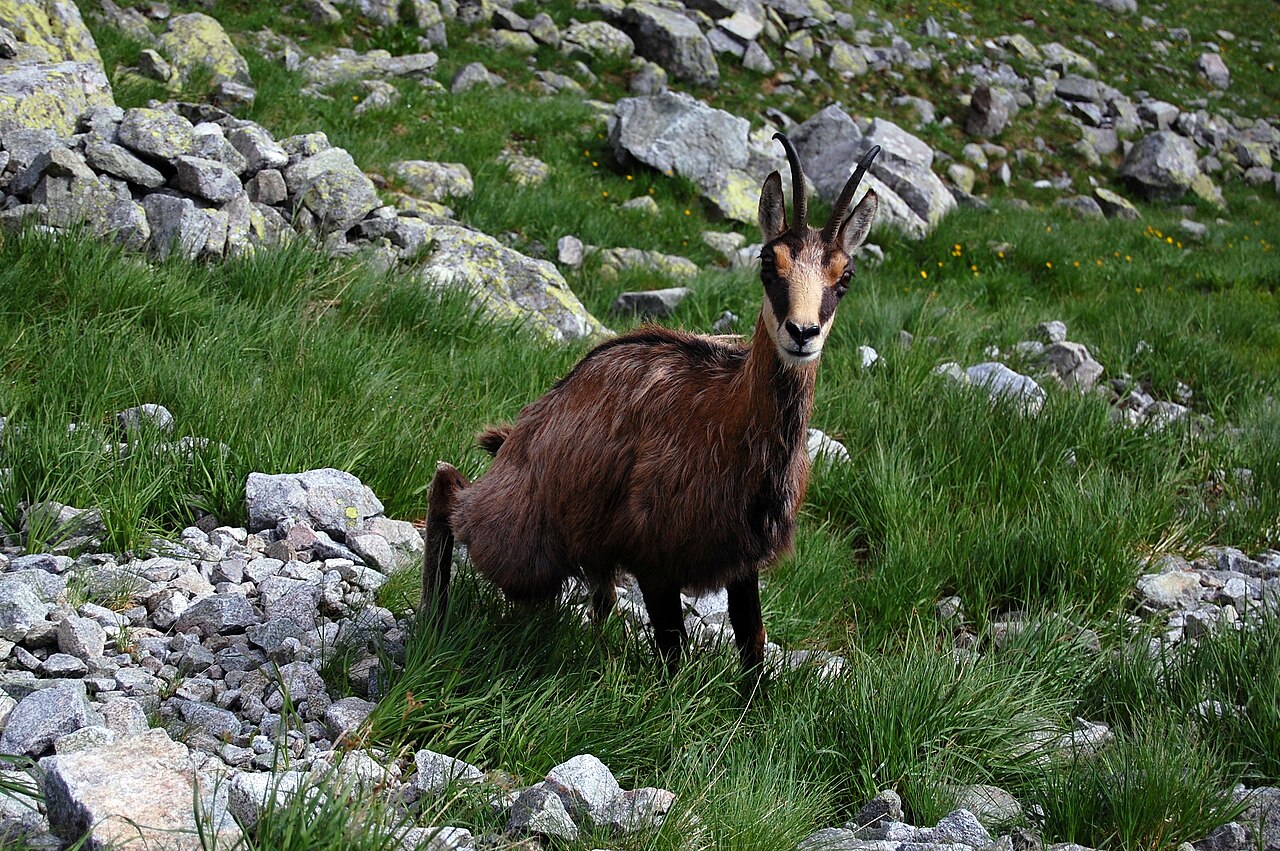
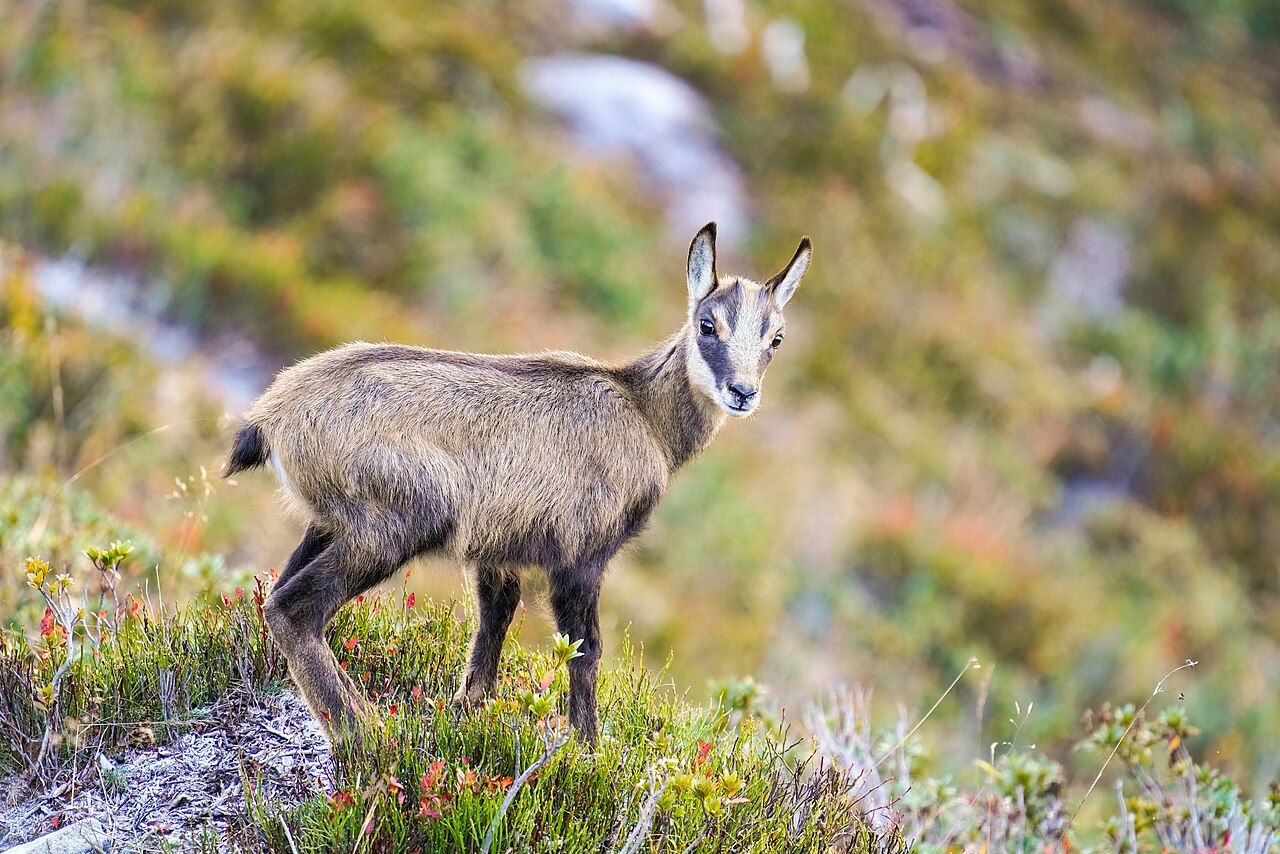
A compact goat-antelope of 110 to 130 cm head-body, 70 to 85 cm shoulder height and 25 to 60 kg, with a short body on long, powerful legs and a short tail of 3 to 8 cm. The summer coat is pale foxy to ochre-brown; the winter coat is nearly black, much longer, with pale hindquarters, long guard hairs over back and flanks and a dirty-white rump patch. A black dorsal stripe runs along the back. The face is the character at a distance: cream-white to pale yellow, with a sharp black stripe from the muzzle through the eye to the ear, and a black chin. Both sexes carry hooked horns: slender, smooth, black horns rising vertically from just above the eyes and bent sharply backwards at the tip; 15 to 30 cm long, thicker at the base and more strongly hooked in the buck, more slender and more openly curved in the female. The hooves have a hard, sharp outer rim that gives grip on rock and ice, with a soft, elastic sole inside; the two toes can spread widely. The kid follows its mother in steep terrain within a few days.
Similar species
In the Pyrenees, the Cantabrian Mountains and the Apennines the animal is not this species but Rupicapra pyrenaica, the Pyrenean chamois (in Spanish rebeco, sarrio or isard), with the forms pyrenaica in the Pyrenees, parva in the Cordillera Cantábrica and ornata in the Abruzzi. The two species nowhere overlap. R. pyrenaica is smaller and lighter, its winter coat is rufous rather than black, the black facial mask is less complete, and it has conspicuous white to reddish-white patches on throat, shoulder and flank that R. rupicapra lacks. A chamois in the Picos de Europa or Ordesa is therefore the other species; this is the most frequent identification error. In the Alps also occur: the Alpine Ibex, much heavier and stockier, with a blunt head lacking the facial mask and, in the male, very large, backward-curving ridged horns; the Mouflon, with curled horns and a pale saddle patch; and free-ranging domestic goats, which in the southern mountains are the most frequent source of confusion at a distance. In the Iberian Peninsula the Iberian Ibex, much more robust and with different horns, is a possible confusion species for the Pyrenean chamois.
Habitat
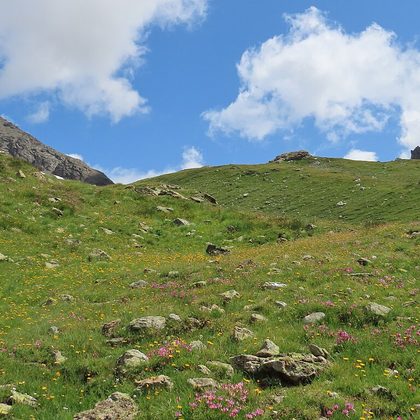
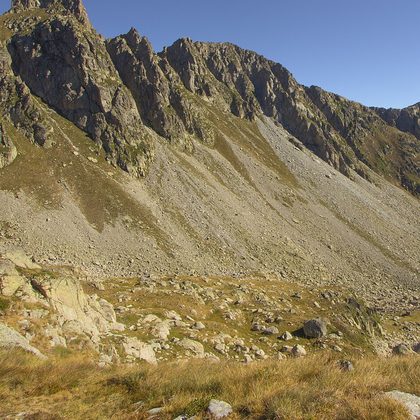
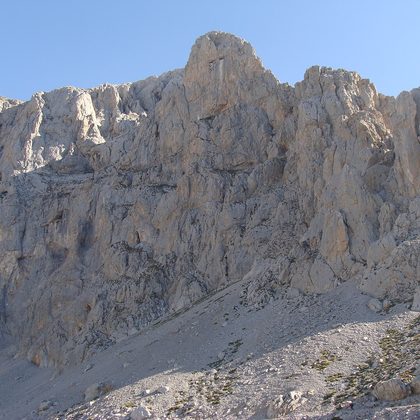
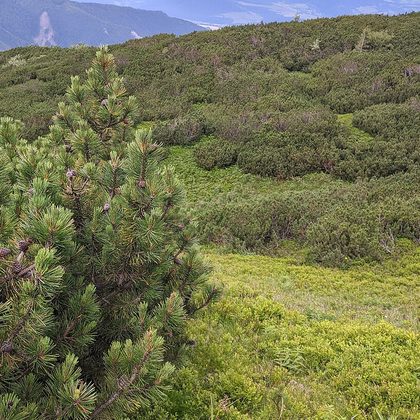
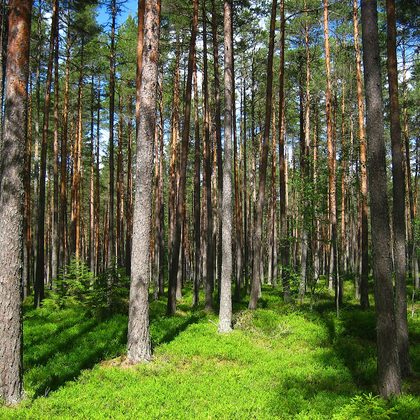
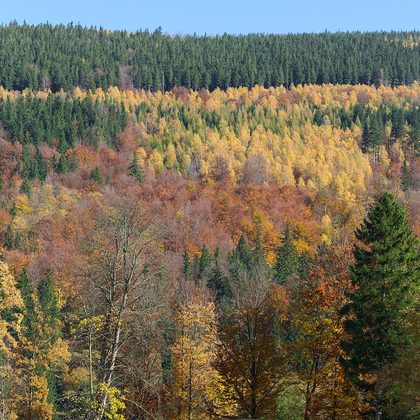
The zone between the treeline and the rocks. Alpine and subalpine grassland, scree, cliffs and grass strips between rock bands form the summer habitat, to above 3000 m. In winter the chamois moves into the upper mountain forest (coniferous and mixed woodland with clearings) and onto steep, sunny south-facing slopes where the snow is blown clear; mountain pine scrub provides cover there. Everywhere the combination of food and steep, impassable terrain close by is characteristic.
Where the animal is most at home, classified with EUNIS — the European standard for habitats.
Distribution
The Alps, with by far the largest population (hundreds of thousands of animals), as well as the Jura, the Vosges (introduced from the 1950s), the Black Forest, the Tatras, the Carpathians, the Dinaric mountains, the Pindos and the Balkans, the Caucasus and north-eastern Anatolia; outside Europe introduced to New Zealand, where it is regarded as a pest. The northern limit in Europe lies in the Tatras and the Alps; the chamois does not occur in Scandinavia, the British Isles or the Low Countries and has not occurred there in historical times. The populations nearest to the Low Countries are in the Vosges, about 400 km from the Ardennes, followed by the Jura and the Swiss and Bavarian Alps. The species does not occur in the Iberian Peninsula. In the Pyrenees (Ordesa, Aigüestortes, Val d'Aran, Alta Ribagorça) and the Cantabrian Mountains (Picos de Europa, Somiedo, Riaño, Fuentes Carrionas) lives Rupicapra pyrenaica, with about 25,000 animals in the Pyrenees and a similar number in the Cantabrian Mountains; both populations recovered strongly in the twentieth century after being reduced to a few nuclei.
- Native
- dark = core range, pale = thinly spread
Way of life
The chamois is diurnal and therefore one of the most easily observed large mammals of the European mountains: it grazes in the early morning and late afternoon and ruminates in between lying on a ledge, often in the open. Females with young and immature animals live in herds of five to thirty, up to a hundred in autumn; old bucks are solitary for most of the year. Food changes greatly with the season: alpine grasses, herbs and flowers in summer; mosses, lichens, buds, needles of mountain pine and spruce, and bark in winter. Vertical migration is the rule: above the treeline in summer, in the forest and on wind-cleared south slopes in winter. The rut runs from mid-November to mid-December: bucks chase one another and the females across snow slopes, which sometimes leads to fatal falls. Gestation is about 170 days; in May or June a single kid is born on a sheltered ledge, rarely twins. The kid stands within an hour and follows its mother after a few days. Chamois live fifteen to twenty years. There is no winter dormancy, but energy expenditure in winter is strongly reduced: less movement, a lower metabolic rate and a weight loss that in old animals can amount to a third of body weight. Disturbance in winter, for example by skiers off-piste or snowshoers on south slopes, therefore has serious consequences.
Where and when to look
Search early in the morning, high in the mountains and with a telescope. After sunrise, systematically scan the grass strips between the rock bands and the ridge line: a grazing chamois is a slowly moving dark shape, and where there is one, the whole herd is usually nearby. By mid-morning the animals move to shaded north slopes and lie on ledges. Well-known areas are Gran Paradiso National Park in Italy, the Berchtesgaden Alps, the Vanoise, the Swiss National Park at Zernez, the Hohe Tauern and the High Tatras; in all these areas the animals are used to walkers and can be approached to about a hundred metres. For R. pyrenaica, Ordesa y Monte Perdido, Aigüestortes, the Picos de Europa and Somiedo are suitable, using the same method. In November the rut can be watched, with chases across snow-covered slopes. Do not walk above a herd: chamois react to danger from above and flee. Listen for the alarm whistle, often the first sign of chamois.
Conservation status
Least Concern (LC, 2021), with more than a million animals and a growing population in the Alps; the chamois is one of the few European ungulates that is both common and hunted under quota throughout its range. Problems are local. Two diseases can reduce a population by eighty per cent within a few years: infectious keratoconjunctivitis or chamois blindness, which blinds the animals temporarily so that they may fall, and sarcoptic mange, which has spread in waves through the eastern Alps and the Carpathians since the nineteenth century and in Spain has also severely affected the Cantabrian populations of the Pyrenean chamois. In addition there is competition with sheep and cattle on summer pastures, the construction of ski areas and lifts in the wintering range, and, in recent years the main disturbance factor, off-piste winter recreation, when every flight costs energy the animals need to survive the winter. Climate warming shifts the alpine zone upwards and reduces the habitat in each mountain range; research in the Alps also points to lower weights of young chamois in warmer summers.
Scientific name
Rupicapra rupicapra | (Linnaeus, 1758)
Linnaeus described the species in 1758 as Capra Rupicapra; because it was later moved to another genus, the author and year stand in brackets. Rupicapra is Latin, from rupes, 'rock', and capra, 'goat': the rock goat. The specific name repeats the genus name. The specimen the first description was based on came from Switzerland.