All species › Rodents › Voles and hamsters › Calabria Pine Vole
Calabria Pine Vole | Microtus brachycercus
Microtus brachycercus | Microtus brachycercus
The Calabria Pine Vole (Microtus brachycercus) is a subterranean vole of southern Italy that cannot be distinguished externally from Savi's Pine Vole. Lehmann described it in 1961 as a subspecies of Savi's Pine Vole, from specimens from Camigliatello Silano in the Sila (Calabria). Chromosome comparisons and breeding experiments in captivity later showed that male hybrids between the two forms are sterile; recognition as a separate species rests on this reproductive isolation.
No photograph of a living wild animal of this species with a suitable Creative Commons licence exists. Do you have one that meets the rules? Send it in.
Tracks
Almost nothing has been published on the signs of this species. The expected pattern is that of the subterranean voles of the subgenus Terricola: a shallow tunnel system under the turf, with small, low heaps of excavated soil with the opening at the side, the soil even and stone-free because the animal digs with its teeth. A molehill has the opening in the centre and a vertical tunnel, contains coarse soil with small stones, and molehills lie in a regular line. The water vole, which also throws up heaps in Italy, does so on a larger scale. There are also swept runways under dense vegetation, gnawed roots and tubers and droppings of four to seven millimetres. To establish which Terricola species occurs in an area, pellet analysis (Barn Owl or Eagle Owl) with examination of the teeth under a lens is the practical method, with laboratory analysis for final identification.
Identification
Small, with a very short tail: head-body 8.7 to 9.8 cm, tail 2.3 to 2.7 cm, about twenty-two per cent of head-body length (the name brachycercus means 'short-tail'), and a weight of 14 to 24 grams. The build is that of a typical subterranean vole: blunt head, very small eyes, ears hidden in the fur and a compact body. The coat is dark brown above and slaty grey below. The skull is small, lightly built and without ridges; the upper incisors are slightly proodont. The first lower molar is long and complex, with six inner salient angles; the second upper molar is short and simplified, with three. Females have six teats: two inguinal pairs and one pectoral pair.
Similar species
This species cannot be distinguished from Savi's Pine Vole, neither in the field nor in the hand, and on the skull only by measurements, and even then with overlap. The Handbook of the Mammals of the World describes it as 'very similar to Savi's Pine Vole'. Its species status rests on three characters that are not externally visible: the karyotype, the mitochondrial DNA and the sterility of male hybrids from controlled crosses. Identification therefore rests on locality: northern Italy and the west of central Italy hold Microtus savii, southern Italy and, according to mtDNA studies, the east of central Italy this species (Bezerra et al. 2016), and on Sicily the third related species, M. nebrodensis. Where the boundaries lie exactly has not been established; central Italy is regarded as a possible contact zone, and there locality is not conclusive either. From the other voles of southern Italy the species can be distinguished: the Common Vole and Microtus lavernedii are larger, have clearly visible ears, larger eyes and a longer tail, and do not dig; the Bank Vole is reddish brown, with large eyes and a tail twice as long; the water vole is many times larger. A very small, dark brown, short-tailed vole throwing up soil in Calabria is, on the basis of locality, this species.
Habitat
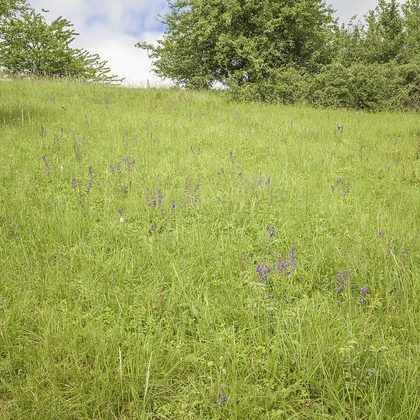
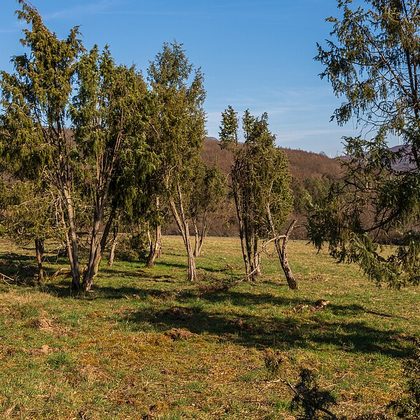
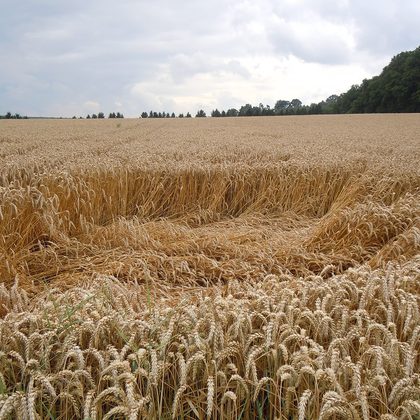
Broad and tolerant of cultivation: hay meadows and pasture, gardens and vegetable plots, arable land, orchards and olive groves, town edges and built-up areas, and open woodland. Lawns in villages are also inhabited. According to the Handbook of the Mammals of the World the species does not occupy high mountains; it does occur at middle altitudes, as the type locality Camigliatello Silano lies at about 1270 metres on the Sila upland.
Where the animal is most at home, classified with EUNIS — the European standard for habitats.



Distribution
Endemic to Italy: southern Italy (Calabria, Basilicata, Apulia including the Gargano, and Campania) and, according to mtDNA studies, north into central Italy, mainly on the eastern side (Bezerra et al. 2016). The type locality is Camigliatello Silano in the Sila. The boundary with the range of Savi's Pine Vole has not been established precisely and is an open question in Italian mammalogy. In areas such as the Cilento, the Salento and Calabria the species is common but rarely noticed.
Way of life
Almost nothing is known about its way of life. The Handbook records 'no information' for diet, activity, home range and social organisation. It has been published that among females collected in March on Monte Gargano in Apulia, several carried two to four embryos, on average three to four. By analogy with the well-studied Savi's Pine Vole it is assumed that the species lives largely underground in a shallow tunnel system, feeds on roots, tubers, bulbs and green plant parts, is active all year without winter dormancy, and in the Mediterranean climate breeds mainly in the cool half of the year. This is an assumption based on analogy, not an observation.
Where and when to look
Look not for the animal but for the soil heaps, which are common in Calabria, Basilicata and the Salento: along verges, in olive groves and at the edges of village lawns. The position of the opening and the absence of small stones in the soil show that the maker is a vole and not a mole. Further identification in the field is not possible. No freely available photograph of a living animal exists, the range boundary has not been established, and habits, diet and daily rhythm have not been described; documented records with place, date and image therefore add to knowledge of the species.
Conservation status
Least Concern (LC, 2024). The species is common in southern Italy and adapts to farmland and village edges; no threats have been identified, but no targeted research has been done either. In orchards and vegetable gardens in southern Italy it is, like Savi's Pine Vole, locally regarded as a pest, because it gnaws roots and tubers and girdles young trees; control is by poison bait, with secondary effects on owls and carnivores. As long as the boundary with the range of Savi's Pine Vole has not been established, the size of the range, and thus the assessment of its status, remains uncertain.
Scientific name
Microtus brachycercus | (E. von Lehmann, 1961)
E. von Lehmann described the species in 1961 as Pitymys savii brachycercus; because it was later moved to another genus, the author and year stand in brackets. Microtus is Greek, from mikros, 'small', and ous, genitive ōtos, 'ear', after the small ears hidden in the fur. brachycercus is Greek for 'short-tailed', from brachys, 'short', and kerkos, 'tail'. The specimen the first description was based on came from Italy, Calabria.