All species › Rodents › Squirrels and marmots › Barbary Ground Squirrel
Barbary Ground Squirrel | Atlantoxerus getulus
Barbarijse grondeekhoorn | Atlantoxerus getulus
The Barbary Ground Squirrel is the only ground squirrel of North Africa and the only species in its genus. It belongs to the African ground squirrels and not to the European sousliks. It is a diurnal species of bare rocky slopes in the Atlas, which often sits upright on a stone and is hard to see against the rock because of its striped back. Since 1965 it has also occurred on Fuerteventura, where a single released pair has grown into nearly a million animals.
Tracks
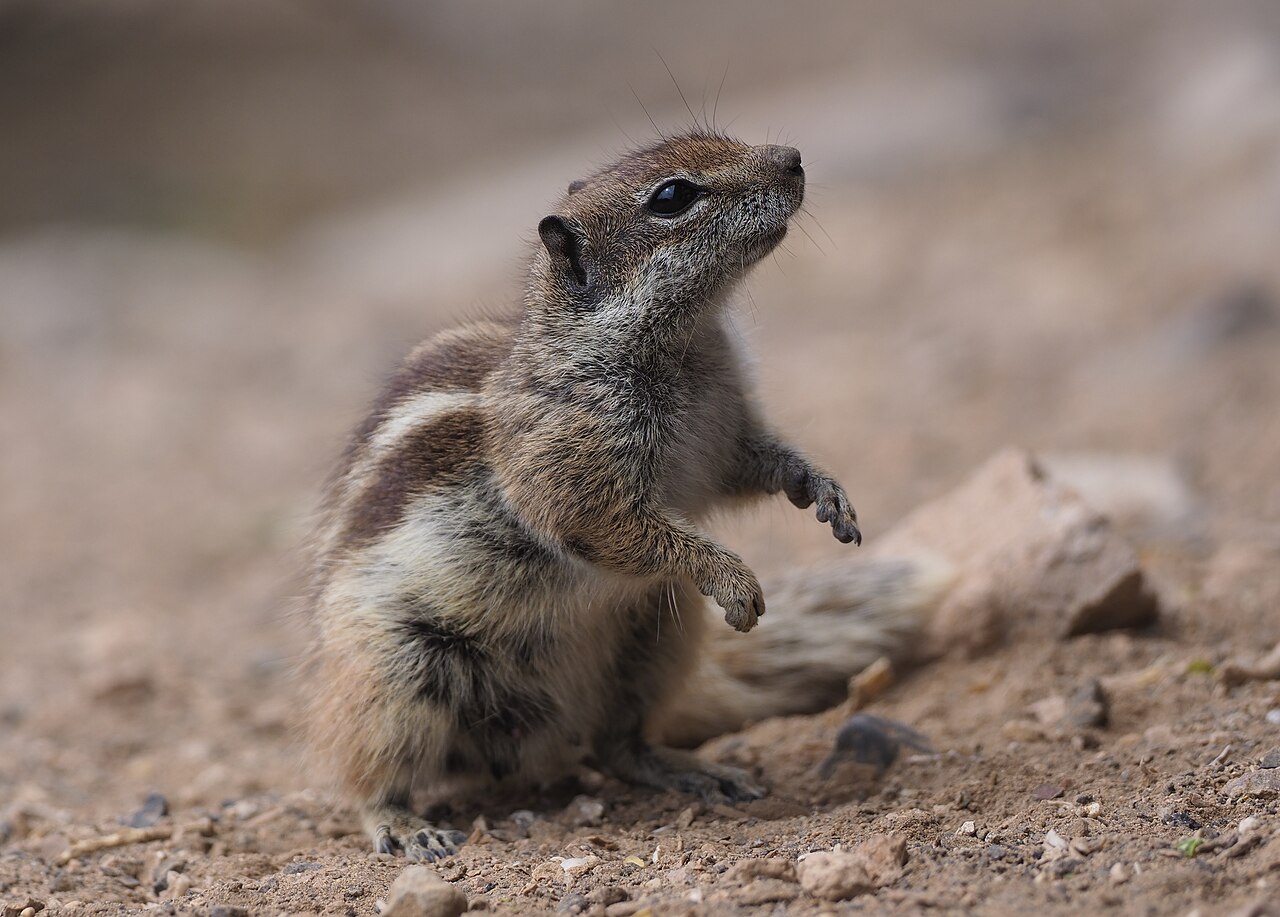
The most useful sign is the burrow site. Burrow entrances are round holes wide enough for an animal of a quarter kilo, always under or among stone: in a scree slope, under a boulder, in the cavities of a dry-stone terrace wall or in a culvert under the road. There is no spoil fan in front, as with the steppe souslik, because the species digs in rubble rather than soil. Around the entrance lie feeding remains: gnawed almond shells, argan nuts whose hard kernel has been broken open with a ragged edge, fig skins and seed husks. The droppings are small, dark and elongated and lie scattered on the lookout stones, not in a separate latrine. The prints are ordinary squirrel prints and only visible in dust or fine sand: four toes on the forefoot, five on the hind foot; when bounding the hind feet land ahead of the forefeet, in groups of four with a leap between. Sound is also useful: in the breeding season the males give a rapid, high, staccato clicking call that can last for minutes and carries far along a rock slope. On Fuerteventura polished wall tops and verge edges at car parks are also found, where the animals approach people.
In its habitat
Head close-up
Identification
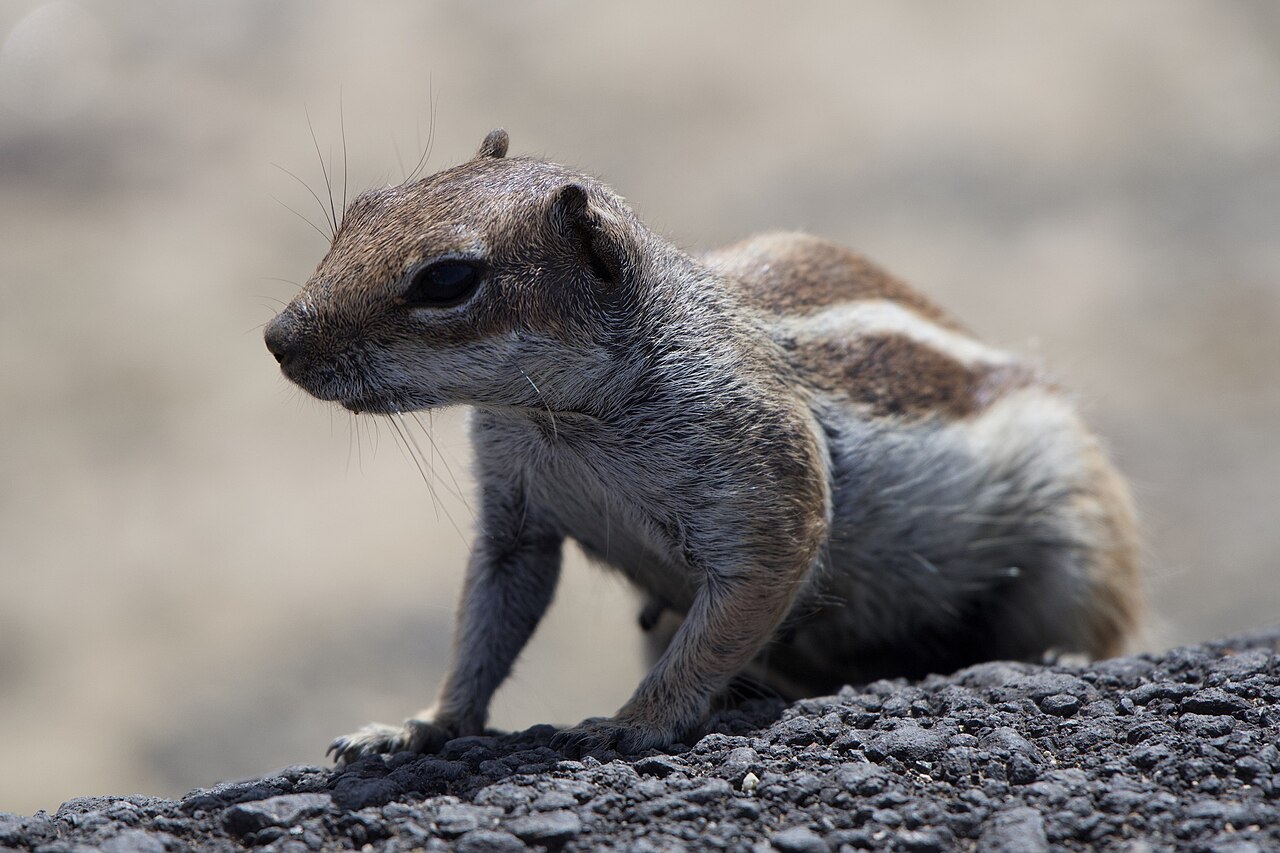
A stocky, ground-living squirrel with a large head relative to its body, very small rounded ears without tufts, and short legs. The coat is grey-brown to rufous and carries four black and two white bands running lengthwise over back and tail; in the field the white flank stripe is most noticeable, a sharp line between the dark back and the dirty-white belly. The tail is about two-thirds of the head-body length, coarse and grey-barred, and is carried low and straight back when running, not curled up. Males are heavier than females (232–280 against 209–250 grams). The animal often sits fully upright with the forepaws against the chest, and when threatened presses itself flat against the stone rather than running away.
Similar species
On Fuerteventura confusion is unlikely: it is the only striped mammal there and, after the rabbit, the commonest. The same applies in Morocco and Algeria, since no second ground squirrel occurs in the Maghreb. When identifying from a photograph, the Barbary Striped Grass Mouse should be considered; it is also striped but much smaller, with a thin, naked tail and eight to twelve narrow stripes instead of four broad bands. The Siberian Chipmunk, introduced in Europe, has five dark stripes on a pale back, is slimmer, has larger ears and lives in woodland, not on rock. The Red Squirrel is twice as heavy, unstriped and climbs trees. A ground-living squirrel that sits upright, with a large head and very small ears, is this species.
Habitat
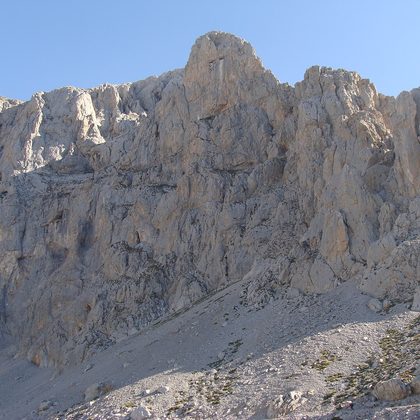
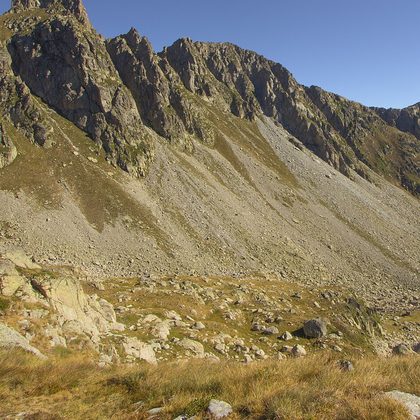
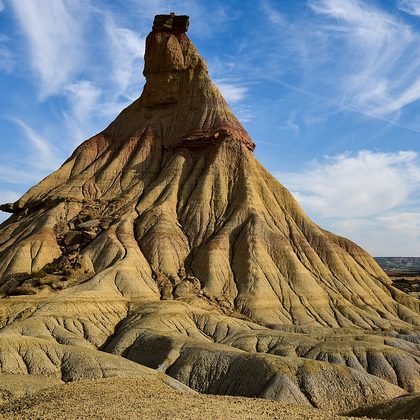
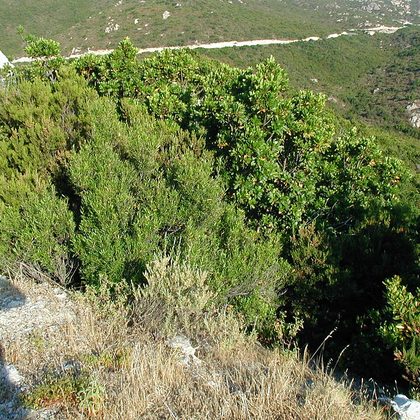
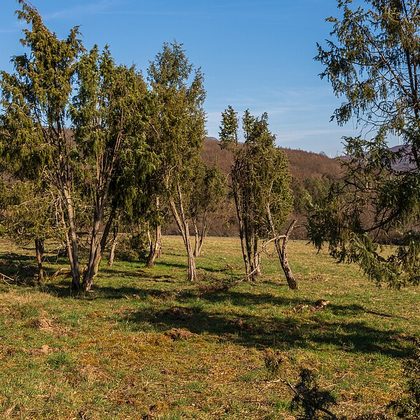
Dry, stony, open terrain with plenty of cover among rocks. In Morocco the rocky slopes and ravines of the Anti-Atlas, the High and the Middle Atlas, from the coast to well above two thousand metres, with a preference for argan woodland, juniper scrub and thorny mountain slopes; also in old terrace walls along fields and in abandoned buildings. On Fuerteventura it occupies every habitat on the island, from sea level to the highest summits around eight hundred metres, and is most numerous where rock shelter lies close to fields and barrancos. Woodland is not required; the species depends on rock crevices for shelter.
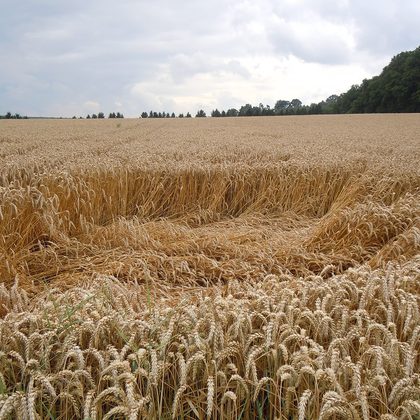
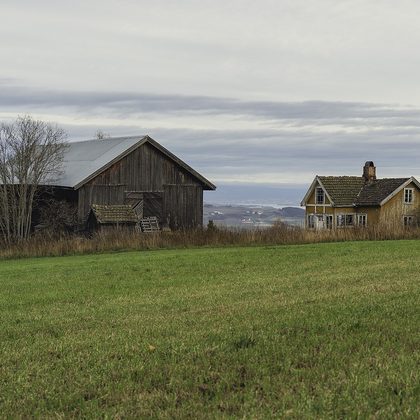
Where the animal is most at home, classified with EUNIS — the European standard for habitats.
Distribution
Natively Morocco and the extreme north-west of Algeria, in the Atlas ranges and the Anti-Atlas; the entire natural range lies within this area. In 1965 a single pair, originating from what was then the Spanish Sahara, was released near Gran Tarajal on Fuerteventura; within three years the species was established, and the current estimate is 900,000 to a million animals, at densities of two to 296 animals per hectare. Fuerteventura is thus the only European territory where the species occurs. It is not established elsewhere in the Canary Islands, but animals that have travelled as stowaways in a car or as pets are intercepted regularly; on Lanzarote establishment has so far been prevented in this way.
- Native
- dark = core range, pale = thinly spread
Way of life
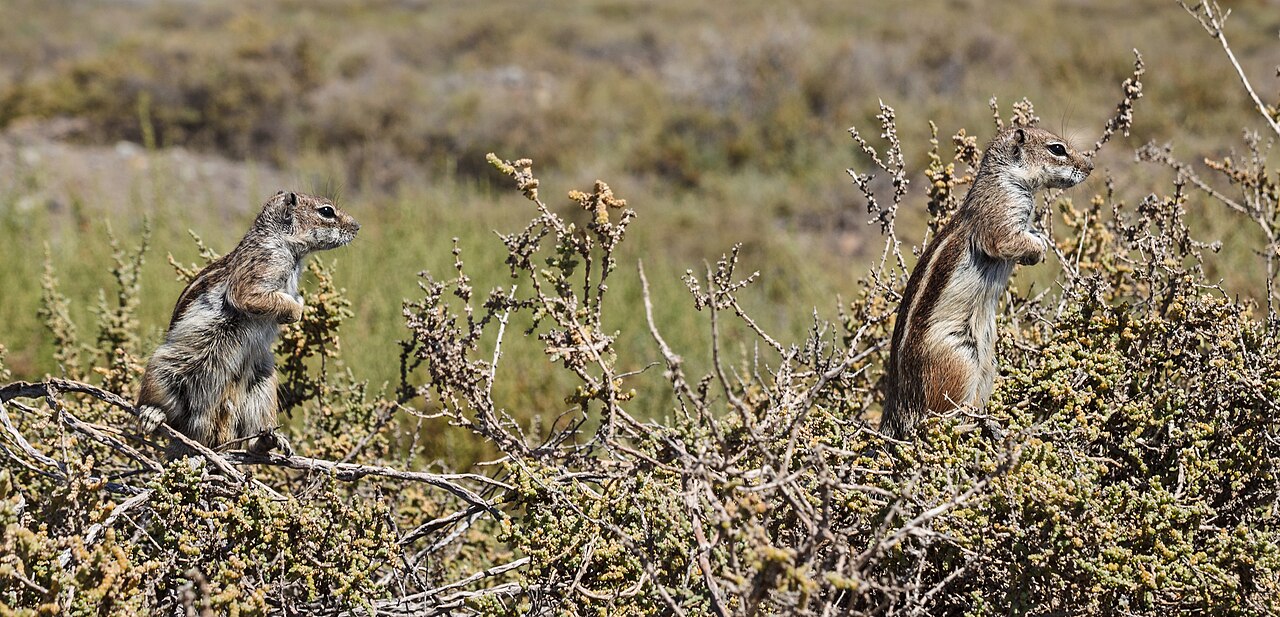
Strictly diurnal, with two peaks: early morning and late afternoon. In the middle of the day it rests in the burrow or flat in the shade of a stone. There is no hibernation or winter rest; the species is above ground all year, but less visible during the coldest and wettest weeks. An omnivore with a strong preference for plant food: more than three-quarters of the diet is vegetable, namely seeds, bulbs, herbs and above all fruit; in Morocco the fruit and kernel of the argan form the main food, on Fuerteventura figs, almonds and tomatoes from the fields. In addition insects, snails and occasionally a bird's nest with eggs or young. The species is social and lives in groups around a rock outcrop; groups of fifteen or more animals are not unusual. Some animals always sit upright on a prominent stone or wall top, as sentinels and to sunbathe. Breeding begins in February; fifteen to thirty per cent of females have a second litter in May or June. A litter numbers four to nine young. The main natural predator on Fuerteventura is the Common Buzzard, in Morocco also the fox, snakes and the raven.
Where and when to look
On Fuerteventura the species is easy to see. Go early in the morning to the salt pans at Salinas del Carmen, the small reservoirs near Betancuria or the roadside walls along the FV-30 through the hills, and watch for movement on stone heaps and on the tops of dry walls. In winter and spring, when the island is green, the animals are most active and sit upright longest. Do not feed them and leave no food scraps: it is an introduced species, and feeding increases the problems. In Morocco the road to Oukaïmeden in the High Atlas, the rock walls of the Todra and Dadès gorges and the argan slopes behind Essaouira and Tafraoute are reliable sites, in each case in the first hour after the sun reaches the slope.
Conservation status
Least Concern (LC, 2016), and common in its natural range: the Moroccan population is large and not threatened. In Spain the species is on the Spanish catalogue of invasive alien species, which prohibits trade, keeping, breeding and transport and obliges the authorities to manage the established population. The damage on Fuerteventura is threefold: feeding on crops and fruit, feeding on the native island flora and on the nests of breeding birds, and the spread of alien plants such as prickly pear, whose seeds it disperses. An attempt in the 1970s to reduce the species with buzzards brought in from Toledo failed. Eradication of a population of nearly a million animals on an island of 1,660 square kilometres is not considered feasible; policy focuses on trapping animals that appear on other islands, and this has so far been effective.
Scientific name
Atlantoxerus getulus | (Linnaeus, 1758)
Linnaeus described the species in 1758 as Sciurus getulus; because it was later moved to another genus, the author and year stand in brackets. Atlantoxerus joins Atlas, genitive Atlantos, the North African mountain range, to the genus name Xerus, from Greek xēros, 'dry'. getulus is Latin Gaetulus, 'of the Gaetuli', the Berber people of the North African interior; Gaetulia was to the Romans the land south of Mauretania. The specimen the first description was based on came from Algeria.