All species › Rodents › Voles and hamsters › Bank Vole
Bank Vole | Clethrionomys glareolus
Rosse woelmuis | Topillo rojo
The Bank Vole is the vole of woodland, wood edges and scrub. Unlike most voles it climbs and is also active by day, so it is seen more often than the other species of the group. In the hand it can be identified reliably by colour and tail length.
Tracks
The Bank Vole does not make the dense runway systems in the grass sward that the Common Vole does, but uses narrow paths through leaf litter and moss, along tree roots, under fallen trunks and through the hollow space beneath a log pile, with burrows about three centimetres across that are shorter and more irregular than in related species. The droppings are 4 to 6 mm, short cylinders with blunt ends, greenish grey to brown-black, deposited in small groups on a raised spot beside such a path. In winter and early spring the species gnaws bark from young trees and shrubs, up to half a metre high and higher under snow, in irregular upward-worked patches with paired incisor grooves about 1 mm wide; because it climbs, ring-barked twigs high in a sapling are more often its work than a hare's. In hazelnuts it leaves a hole with regular parallel grooves on the inner rim but no gnaw marks on the surface of the nut around the hole; a Wood Mouse also leaves rough marks on the surface, and a squirrel splits the nut in two. Other signs are nibbled fungi, opened beech mast and cherry stones, and sometimes a globular nest of grass and moss under a stump, in a hollow trunk, in a nest box or in a compost heap. In pellets of Tawny, Long-eared and Barn Owls the species is often numerous. Vole remains are recognisable there by the flat cheek teeth folded into zigzag prisms: rooted and worn in the Bank Vole, rootless and ever-growing in the Microtus species. For this group pellet analysis is often the only reliable method of establishing which species occur in an area.
In its habitat
Head close-up
The young
Identification
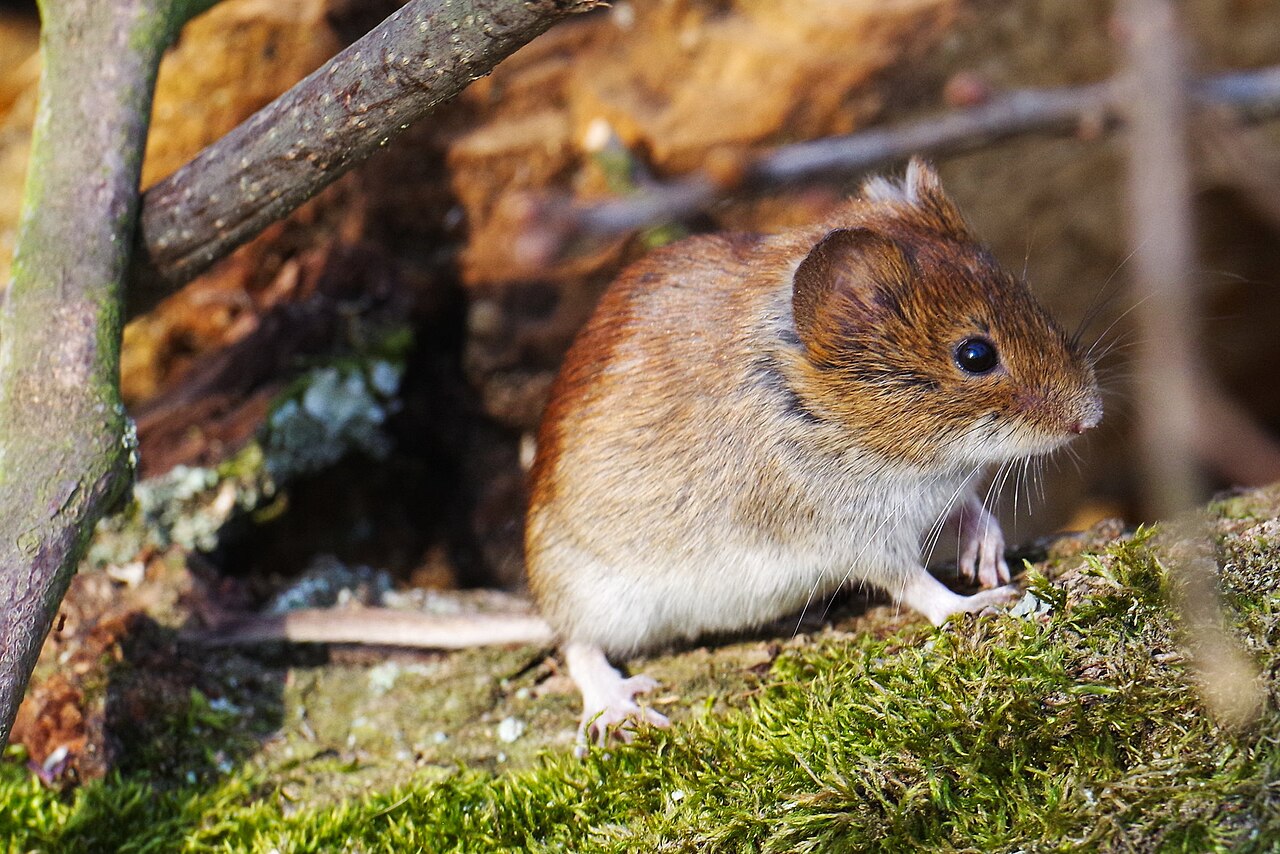
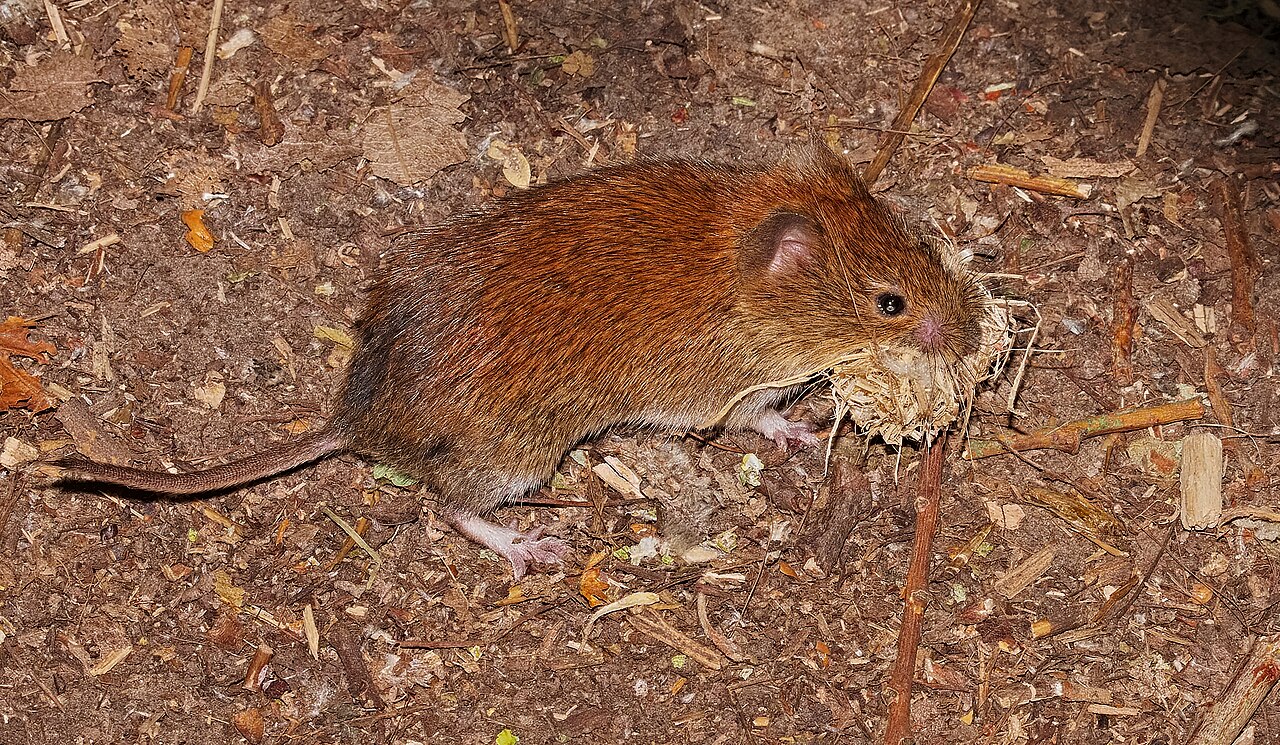
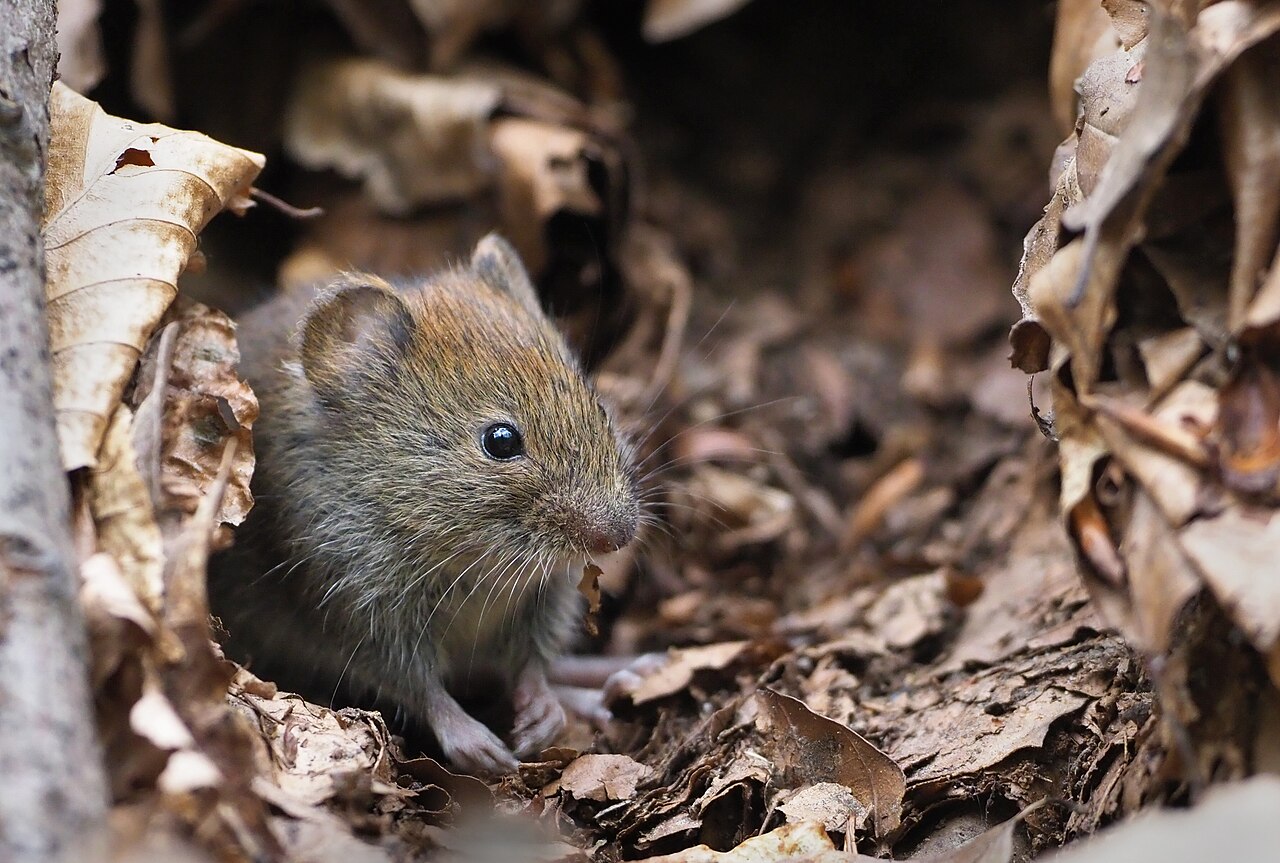
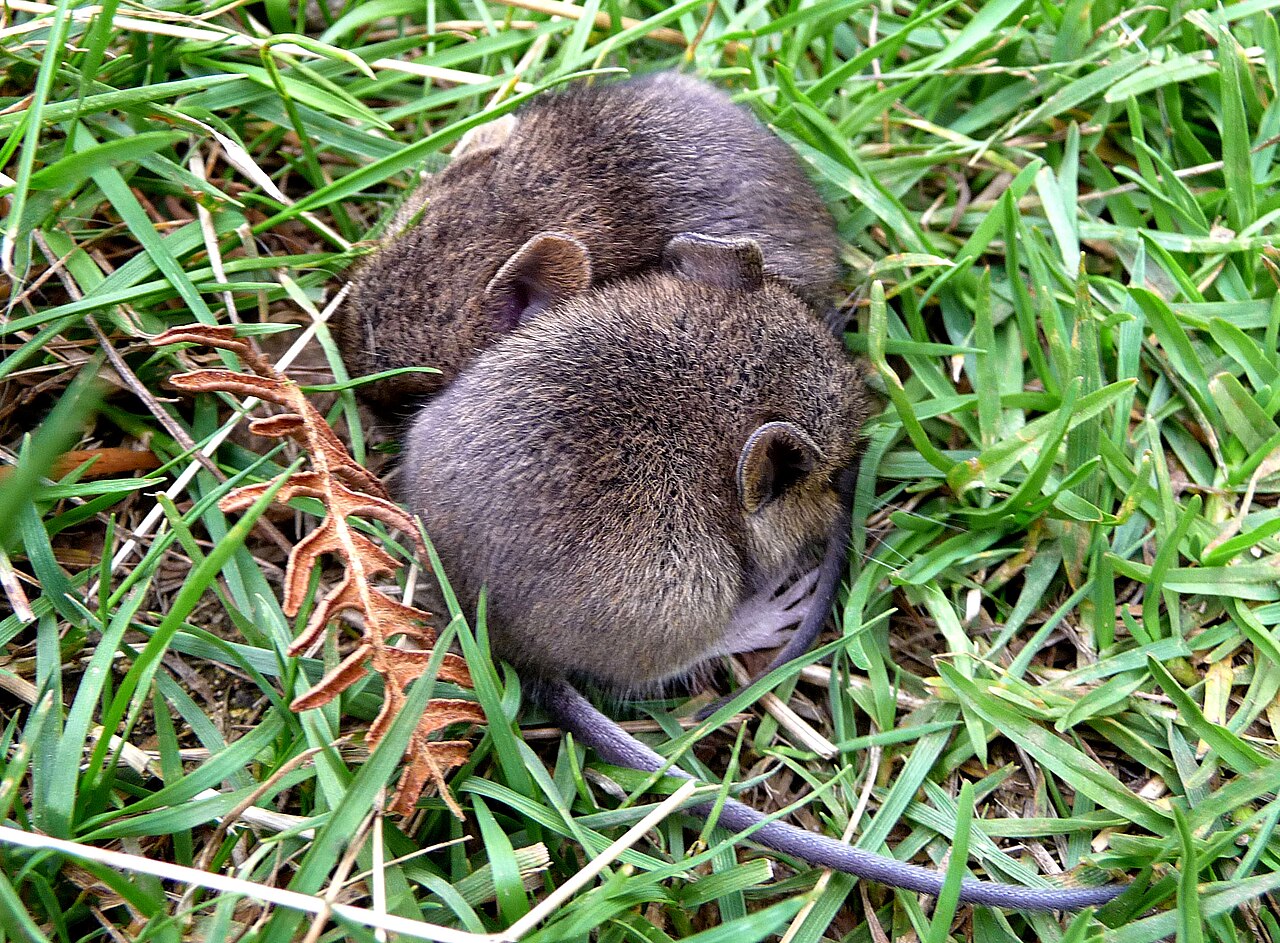
A small, thickset vole with a chestnut to rufous back contrasting sharply with greyish flanks and a yellowish or off-white belly. The muzzle is blunter than a mouse's but less domed than in the Common and Field Voles, the eyes are large and dark and the ears project clearly from the fur. The decisive character is the tail: 3.5 to 7 cm, roughly half the head-body length, lightly haired and distinctly two-coloured, dark above and white below. This separates the species in the hand from the other voles of western and central Europe, whose tails are at most a third of the body length. Young animals are greyer and lack the red; in them tail length and ears are the characters to use. In the hand there is a second, age-dependent character: in Clethrionomys the cheek teeth develop roots with age and wear down, while in Microtus they grow throughout life.
Similar species
The species is one of the few European voles that can be identified reliably in the field. Common Vole and Field Vole are yellowish grey to dull brown without a red back, have smaller ears hidden in the fur, smaller eyes and much shorter tails, and live in grass rather than in the shrub layer. The Root Vole is larger and darker. In the northern third of the Iberian Peninsula the Lusitanian Pine Vole also occurs; it is greyer, with small ears, a short tail and no reddish back. The Wood Mouse shares the habitat but is a true mouse: large ears, bulging eyes, a tail as long as the body, and a bounding rather than running gait. The island forms of Skomer, Jersey, Mull and Raasay are larger and paler; this is variation within the species. Where it occurs together with the northern red-backed voles in Fennoscandia, field identification is not reliable: those are greyer on the flanks and shorter-tailed, and separation requires an animal in the hand or laboratory analysis.
Habitat
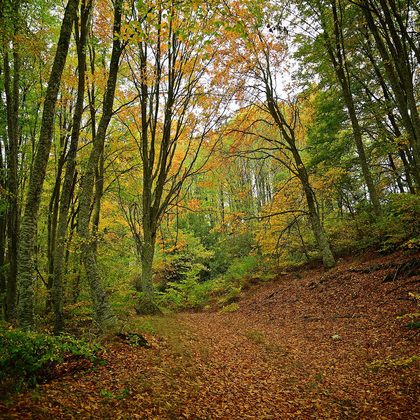
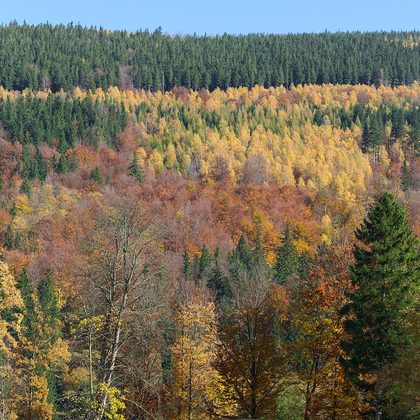
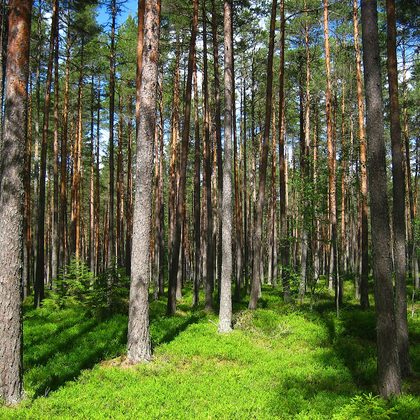
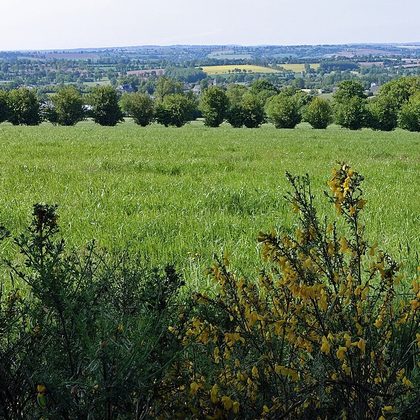
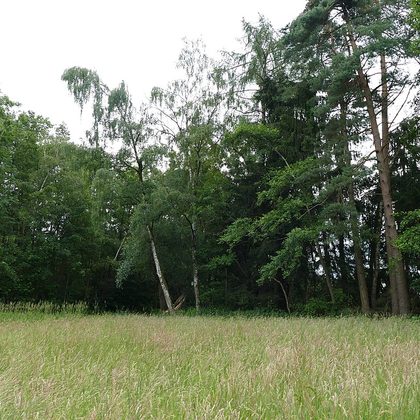
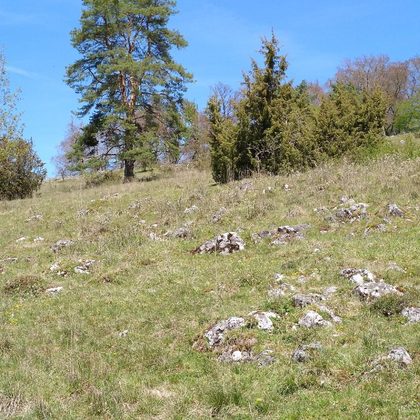
Woodland and vegetation resembling it: broadleaved and mixed woodland with a well-developed shrub and field layer, young plantation, bramble-covered clear-fell, conifer forest with an understorey, and above all edges: hedge banks, hedges, sunken lanes, railway embankments and ditch sides with scrub. Dead wood, bramble, ivy and a deep litter layer matter more than the tree species. In the mountains the species reaches the upper limit of woodland, in the north the birch zone. Bare grassland and open arable are avoided; a single bush or a vegetated ditch edge can suffice. Gardens with shrubs and compost heaps are also occupied.
Where the animal is most at home, classified with EUNIS — the European standard for habitats.
Distribution
From Ireland and the north of the Iberian Peninsula to central Russia and from northern Scandinavia to northern Italy and the Balkans; in the south confined to mountain forest. On the Iberian Peninsula it lives only in the northern third: the Cantabrian range, Galicia, the Pyrenees and Pre-Pyrenees, the northern Iberian System and the northern half of the Meseta as far as the Sistema Central, where the southern limit of the Iberian range lies. At that southern edge it is confined to north-facing slopes and riparian woodland, in fragmented populations. It is absent from the southern half of the peninsula, the Balearics and the Canary Islands. In Britain it is common on the mainland, and there are island forms on Skomer (off Pembrokeshire), Mull, Raasay and Jersey. In Ireland it was introduced accidentally near Listowel in County Kerry around 1925 and first recorded in 1964; since then it has spread at about one to two kilometres a year and now occupies much of the southern half of the island. In the Netherlands it occurs almost wherever there is woodland, scrub or a hedge bank, and is absent from the most open parts of northern Groningen, Friesland and North Holland, from parts of Flevoland and from most of the Wadden Islands. Everywhere numbers fluctuate strongly with the seed crop of beech and oak: a mast year is followed by a peak and then a crash.
- Native
- dark = core range, pale = thinly spread
Way of life
Active in short alternating bouts of rest and activity round the clock, with the emphasis on dusk and night, but in woodland also by day, clearly more so than other voles. The species climbs well in the field and shrub layer and swims when necessary. The diet is more varied than that of the grass-eating voles: seeds, beech mast, acorns, berries, buds, fungi, moss, green plant material, and in spring and summer also insects, worms and snails. Females hold and defend a small territory; males have larger home ranges. Litters follow one another from April to September: after about three weeks' gestation three to five young, which can be sexually mature within a month, so that in a favourable year the spring young breed themselves by late summer. Few animals survive a second winter; the species is a main prey of Tawny, Long-eared and Barn Owls, Common Buzzard, Red Fox, Weasel, Stoat, Pine Marten and domestic cat. It does not hibernate and is active all winter, under the snow and in the litter layer.
Where and when to look
In May or June, sit still at a wood edge with plenty of dead wood, bramble and moss, and watch the ground rather than the trees: within a quarter of an hour a rufous animal usually crosses an open patch. A log pile, a compost heap or the root plate of a windblown tree is the best place. For a reliable species list, work through pellets from a Tawny Owl roost in autumn; one afternoon gives a fuller list than a year of field observation. Live-trapping with small mammal traps is permitted only under licence and with proper care. On Skomer the animals show little fear and can be observed at close range. The species carries the hantavirus that causes nephropathia epidemica, and human cases increase in mast years: avoid inhaling dust from old sheds and log piles.
Conservation status
Least Concern (2021) and one of the commonest mammals in Europe. Numbers fluctuate strongly, but there is no evidence of a long-term decline. Some isolated island forms are vulnerable, above all that of Skomer, which lives on an island of a few square kilometres and depends on the continued absence of rats and other introduced predators. The populations at the southern limit of the Iberian range, in the Sistema Central and the Iberian System, are also vulnerable: they live in fragments of humid woodland and are among the first to respond to drier, warmer summers, so their decline is used as an indicator of climate change in the middle mountains. The loss of hedges, shelterbelts and dead wood from farmland affects the species, but suitable edges remain available almost everywhere. The species is an important prey of Tawny and Barn Owls, Weasel, Stoat and Red Fox, and fluctuations in its numbers partly determine the breeding success of those species.
Scientific name
Clethrionomys glareolus | (von Schreber, 1780) (GBIF: Myodes glareolus)
Von Schreber described the species in 1780 as Mus glareolus; because it was later moved to another genus, the author and year stand in brackets. Clethrionomys is Greek: the second element is mys, 'mouse', and the first is usually read as klēthrion, a diminutive of klēthra, 'alder'. Other dictionaries derive it from kleithron, 'bar, bolt'; the origin is not certain. glareolus is a Latin diminutive of glarea, 'gravel'; what it refers to is not certain, presumably the banks in which the animal digs its burrows. The specimen the first description was based on came from Denmark, Lolland.