All species › Woodpeckers and allies › African barbets › Yellow-Throated Tinkerbird
Yellow-Throated Tinkerbird | Pogoniulus subsulphureus
Geelkeelketellapper | Barbudito Gorjigualdo
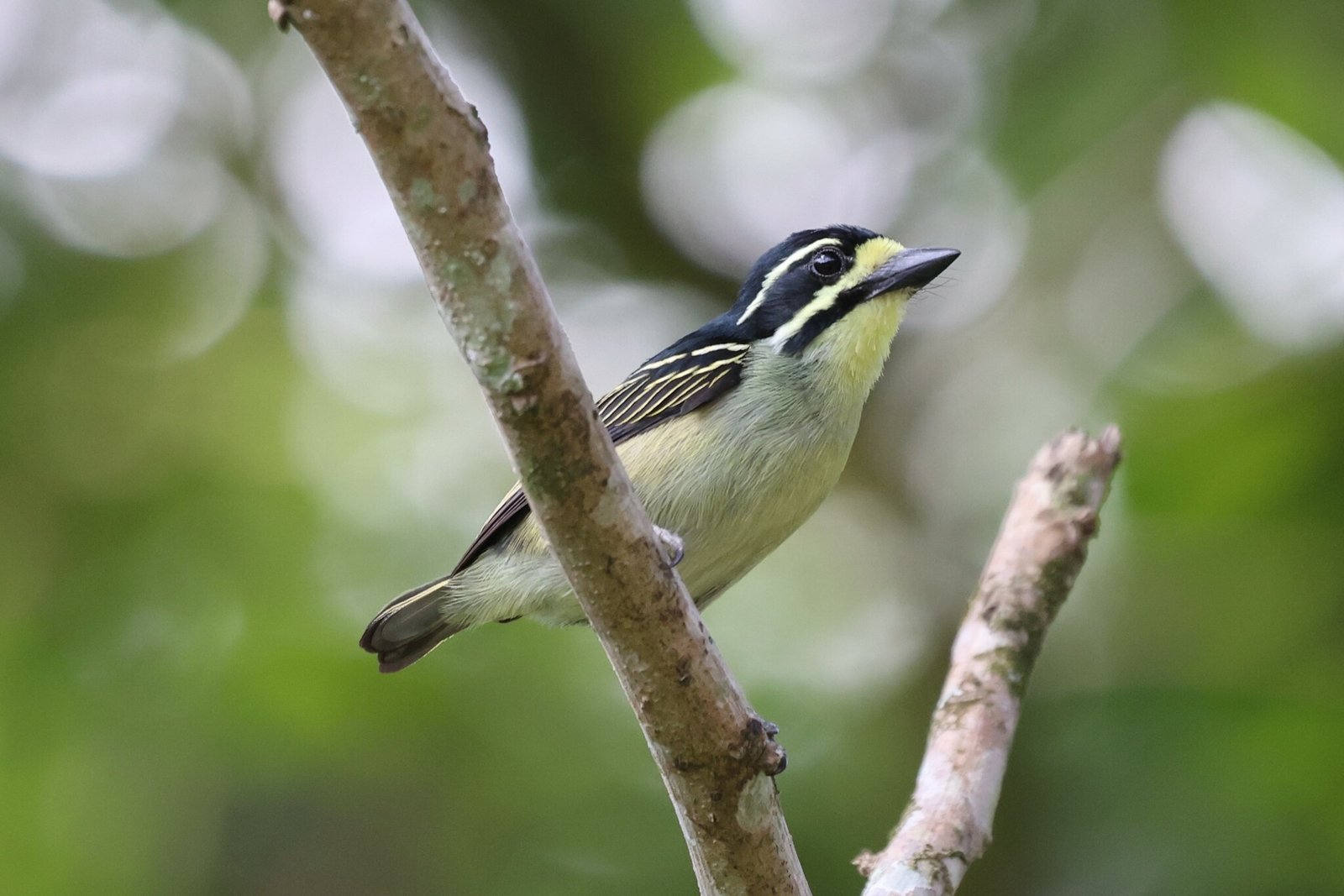
The Yellow-Throated Tinkerbird is a tiny black-and-yellow barbet of the lowland rainforest of West and Central Africa, reaching the region only in the far north of Angola. It keeps high in the canopy and betrays itself almost entirely through its endless series of tinking calls.
Voice
A long, fast and regular series of tinking notes, pop-pop-pop-pop-pop, sustained for minutes and faster than the call of Yellow-Rumped Tinkerbird. Also a short, dry trill.
Recording: Jaap van der Waarde — CC BY-NC-SA 4.0 · converted to mono · xeno-canto
Identification
About 9–10 cm, compact with a short tail and a short, stout black bill. Upperparts glossy black with a lemon-yellow rump and yellow edges to the flight feathers. Two yellow stripes cross the black face: a supercilium from the bill base and a broader stripe below the eye, separated by a black eye-stripe. The throat is bright yellow, the rest of the underparts greyish olive. The sexes are alike; juveniles are duller with a paler bill base.
Confusion species
Yellow-Rumped Tinkerbird (Pogoniulus bilineatus) has white rather than yellow face stripes and a whitish throat, and calls in short groups rather than a continuous series. Red-Rumped Tinkerbird (Pogoniulus atroflavus) is larger, with a red rump and a yellow belly. In dense canopy the voice is often more decisive than throat colour.
Habitat
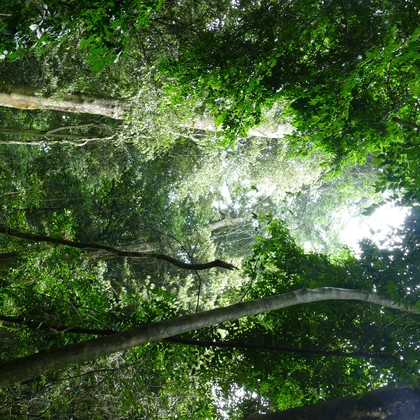
Humid lowland rainforest and older secondary forest, forest edges and clearings with tall trees. It forages high in the canopy on small fruits, especially mistletoe berries, and on insects. It excavates its own nest hole in a dead branch.
Where the bird is most at home, classified by the vegetation units of southern Africa.
Range and movements
Within the region confined to the rainforest of northern Angola, chiefly Cabinda and the north-west of the mainland. Beyond the region from Sierra Leone and Guinea through Nigeria and Cameroon and across the Congo Basin to western Uganda.
How and when to look
A target species for visitors to northern Angola. Follow the continuous call series, then scan the tops of fruiting trees and mistletoe clumps. The bird often sits motionless for long periods on a bare canopy branch, so a telescope is a real help.
Conservation status
Not threatened and common in the Central African rainforest. Within the region the population is small and peripheral, depending on the remaining forests of northern Angola, which are shrinking through logging and agriculture.
Scientific name
Pogoniulus subsulphureus | (Fraser, 1843)
Fraser described the species in 1843 as Bucco subsulphureus; because it was later moved to another genus, the author and year stand in brackets. The genus Pogoniulus was introduced in 1842 by De Lafresnaye. Pogoniulus is a diminutive of Pogonias, from the Greek pōgōnias, 'bearded' — thus 'little barbet', fitting for these smallest barbets. subsulphureus is Latin for 'somewhat sulphur-yellow' — for the pale yellow throat. The specimen the first description was based on came from Malabo (Clarence), Bioko, Equatorial Guinea.