All species › Passerines › African Warblers › Yellow Longbill
Yellow Longbill | Macrosphenus flavicans
Gele langsnavelzanger | Picolargo Amarillo
The Yellow Longbill is a small, short-tailed forest bird with a strikingly long bill that hides in dense lianas and foliage. It belongs to the African ‘warblers’ of the family Macrosphenidae, together with the crombecs and the grassbirds. In the region it occurs only in northern Angola and the far north-west of Zambia.

Voice
A loud, clear series of whistles rising and falling in pitch, such as weet-weet-wee-choo-choo, powerful for such a small bird. Also a dry, rattling contact call.
Recording: isaac kilusu — CC BY-NC-SA 4.0 · converted to mono · xeno-canto
Identification
10–11 cm. Small and compact, with a short tail and a long, straight, pointed bill. The head is greyish olive, the back and wings olive-green. The underparts are bright yellow, paler on the throat and washed olive on the flanks. The eye is reddish-brown to pale brown, the legs greyish pink. Juveniles are duller yellow below.
Confusion species
Green Crombec Sylvietta virens is equally short-tailed but has a shorter bill, a brownish head and greyish-brown, not yellow, underparts. Green Hylia Hylia prasina is darker olive, with a long pale eyebrow and a shorter bill. Little Greenbul Eurillas virens is larger and longer-tailed, with a short bill and olive-grey underparts. The colour and long bill make the species almost unmistakable within its range, once seen well.
Habitat
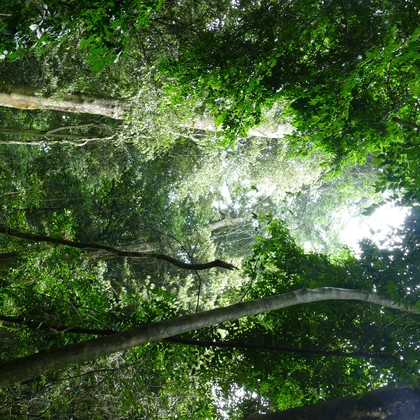
Dense lianas and tangled growth at forest edges, in clearings and in secondary, gallery and moist lowland forest. It often forages in pairs or mixed flocks in the middle stratum, probing curled leaves and liana tangles for insects with its long bill.
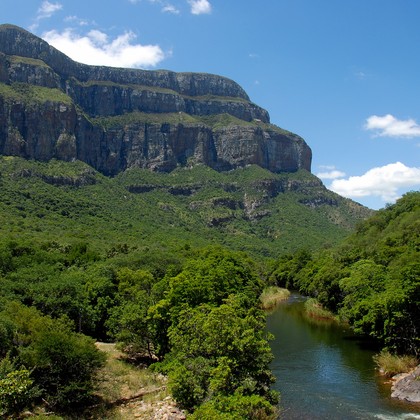
Where the bird is most at home, classified by the vegetation units of southern Africa.
Range and movements
In the region in northern Angola, from Cabinda and Uíge east to the Lunda provinces, and in the far north-west of Zambia (Mwinilunga). Beyond the region from Cameroon and Gabon east through the Congo Basin to western Uganda.
- Winter visitor (c. Apr–Sep)
- dark = core range, pale = thinly spread
How and when to look
Year-round. Best located by song at forest edges and in gallery forest; a singing bird often stays in one liana tangle for a long time. In Zambia the gallery forests around Mwinilunga are the obvious place to try.
Conservation status
Not threatened; widespread in Central African forest. Within the region it is rare and local, and depends on gallery forests that are under pressure from logging and cultivation.
Scientific name
Macrosphenus flavicans | Cassin, 1859
Cassin described the species in 1859 and placed it straight away in the genus where it still stands. He introduced the genus Macrosphenus in that same work. Macrosphenus comes from the Greek makros, 'long', and sphēn, 'wedge' — for the long, tapering bill. flavicans is Latin for 'yellowish', from flavus, 'yellow' — for the yellow underparts. The specimen the first description was based on came from Sette Cama, Gabon.