All species › Passerines › Finches › Yellow Canary
Yellow Canary | Crithagra flaviventris
Geelbuikkanarie | Serín Amarillo
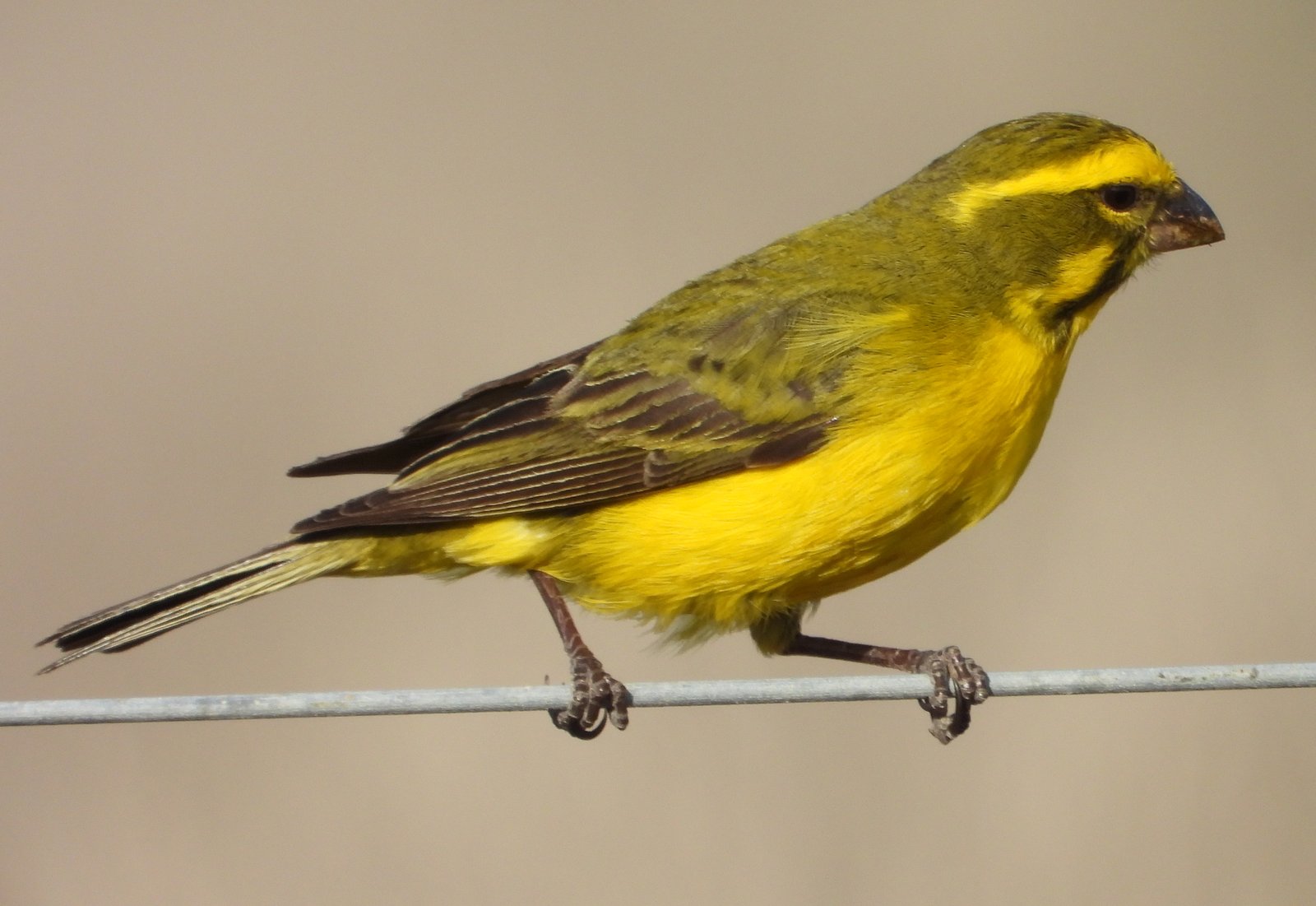
The Yellow Canary is the canary of the Karoo and the arid west: the male is bright yellow below with a yellow supercilium and a yellow rump, the female grey-brown and streaked. Outside the breeding season it wanders in small flocks, sometimes with other small seedeaters, and regularly visits waterholes.
Click a thumbnail to switch the photo above.
Voice
A fast, rich, sustained song of clear rolling and whistled notes, often from a bush top or a wire and sometimes in a short song flight. The call is a soft chissik or tswee-ee.
Recording: Campbell Fleming — CC BY-NC-SA 4.0 · converted to mono · xeno-canto
Identification
13–14 cm. The male has yellow-green upperparts streaked dark, a bright yellow supercilium, an olive-green cheek patch with a dark moustachial stripe and plain yellow underparts; the rump is yellow. Males in Namibia and south-western Angola are a brighter golden yellow than those of the Cape and Karoo. The female is grey-brown streaked dark above, with a pale supercilium and off-white underparts clearly streaked brown across breast and flanks; she too has a yellowish rump. Juveniles resemble the female but are more heavily streaked. The bill is medium-sized and horn-coloured.
Confusion species
The Yellow-Fronted Canary (Crithagra mozambica) has a grey crown and nape, a sharper black moustachial stripe and white tail tips, and lives in moister savanna and woodland in the north and east; the ranges barely overlap. The Brimstone Canary (Crithagra sulphurata) is larger and greener, with a much heavier pale bill and no yellow rump. The female resembles the White-Throated Canary (Crithagra albogularis) and the Streaky-Headed Seedeater (Crithagra gularis), but these have an unstreaked breast; the White-throated also has a white throat and a much heavier bill. The Black-Throated Canary (Crithagra atrogularis) is smaller, with a black-speckled throat. In females the combination of streaked breast and yellow rump is decisive.
Habitat
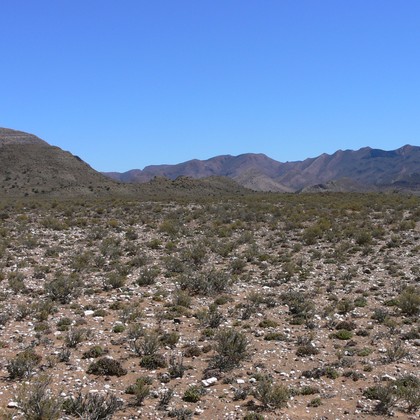
Karoo veld, dry shrubland, dry fynbos and renosterveld, dry watercourses with bushes, the edges of fields and villages, and in Namibia also grassy semi-desert and bushes on rocky hills. It eats grass and forb seeds on the ground and in low shrubs, as well as buds and insects. It drinks regularly and then comes in small flocks to dams and stock troughs.
Where the bird is most at home, classified by the vegetation units of southern Africa.


Range and movements
Within the region in western and central South Africa (Western, Northern and Eastern Cape, Free State and western North West), Lesotho, virtually all of Namibia except the north-east, southern and western Botswana and south-western Angola. Absent from the moist east of the region. Nowhere else naturally; introduced on St Helena and Ascension.
- Resident
- Winter visitor (c. Apr–Sep)
- Passage (Mar–Apr, Oct–Nov)
- dark = core range, pale = thinly spread
How and when to look
In the Karoo and Namaqualand often the commonest canary; males sing in spring from the tops of bushes. Flocks of females and juveniles can be confused with other species: look for the streaked breast combined with the yellow rump, best seen as the birds flush. A waterhole in dry country often produces good numbers early in the morning.
Conservation status
Not threatened. Common and widespread in the arid west. Trapped locally as a cage bird. Introduced and established on St Helena.
Scientific name
Crithagra flaviventris | (Gmelin, 1789)
Gmelin described the species in 1789 as Loxia flaviventris; because it was later moved to another genus, the author and year stand in brackets. The genus Crithagra was introduced in 1827 by Swainson. Crithagra comes from the Greek krithē, 'barley', and agra, 'hunting' — a 'barley hunter', for the seed-eating diet of these canaries and seedeaters. flaviventris comes from the Latin flavus, 'yellow', and venter, 'belly' — for the yellow underparts. The specimen the first description was based on came from Berg River, Western Cape, South Africa.