All species › Passerines › Leaf warblers › Wood Warbler
Wood Warbler | Phylloscopus sibilatrix
Fluiter | Mosquitero Silbador
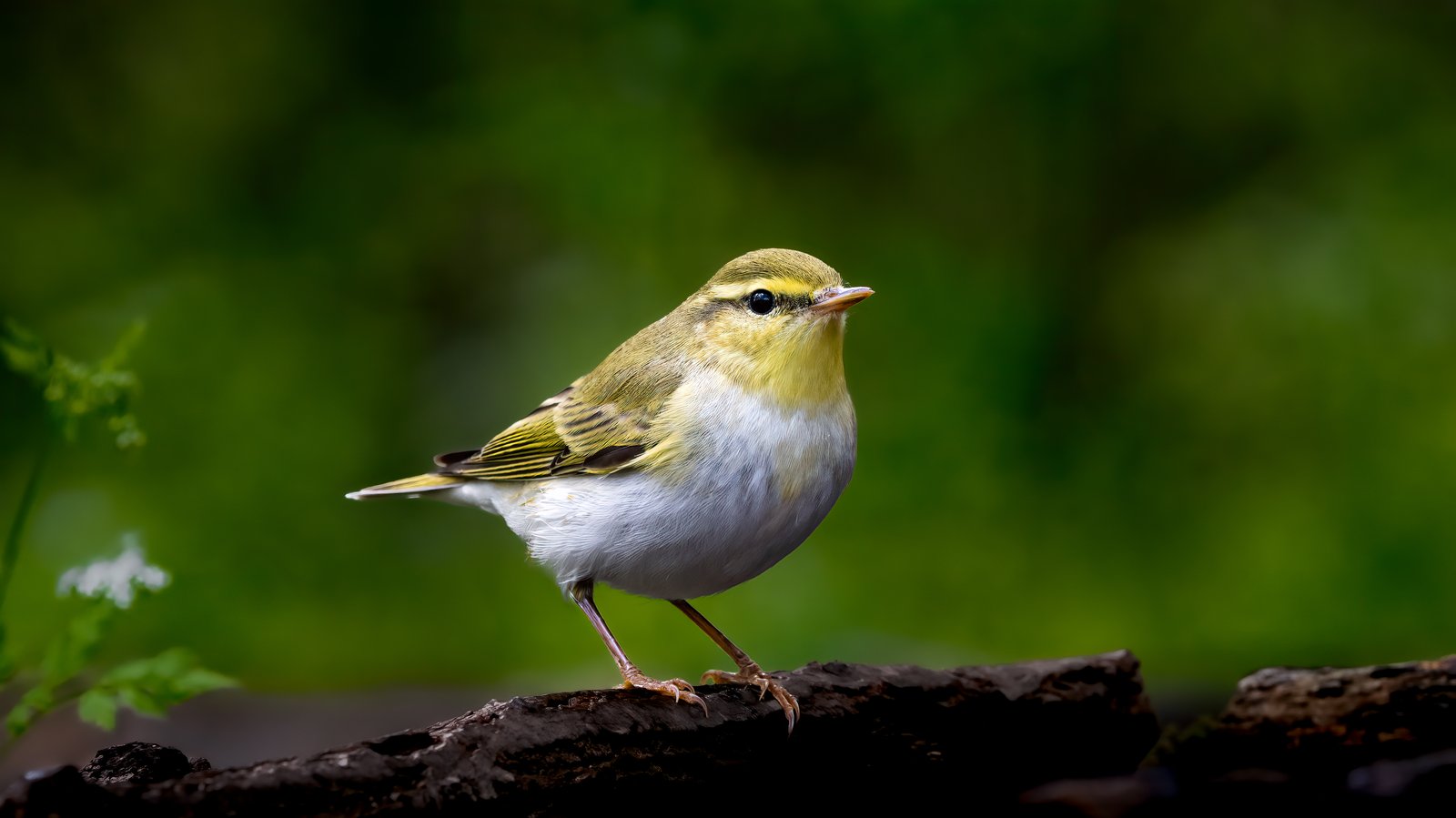
The Wood Warbler is a bright green Palearctic leaf warbler with a sulphur-yellow throat and a pure white belly, which winters in the rainforest belt of West and Central Africa. The region lies south of its normal wintering grounds: there are only a few records, mainly from the north, and every bird deserves careful documentation.
Voice
Usually silent in winter quarters; the call is a soft, plaintive pew or sip. Before departure in spring the song is sometimes heard: an accelerating series of dry ticks that runs into a shivering trill, sip-sip-sip-sipsiprrrrrrr, sometimes alternating with a series of melancholy whistles, pew-pew-pew.
Recording: Sunny Tseng — CC BY-NC-SA 4.0 · shortened to the first 60 s, mono · xeno-canto
Identification
11–12 cm, with long wings and a relatively short tail, giving a compact, front-heavy outline. The upperparts are fresh yellow-green, the flight feathers and tertials dark with broad green-yellow fringes. A long, bright yellow supercilium and a dark eye-stripe give the head a strong pattern. Throat, cheeks and upper breast are bright sulphur-yellow and contrast sharply with the snow-white belly and undertail coverts. The primary projection is long, about equal to the tertials. The legs are yellowish-brown to flesh-coloured, and the fairly broad bill has a pale lower mandible. After moult in Africa the plumage is fresh and contrasting.
Confusion species
Willow Warbler Phylloscopus trochilus is the obvious pitfall: it is paler and less contrasting, with a shorter primary projection and a longer tail, a yellowish wash over all the underparts or else a dingy white breast, and it lacks the sharp border between yellow throat and white belly; its call is a disyllabic hoo-eet. Icterine Warbler Hippolais icterina is larger, with a heavy orange-pink bill, a pale wing panel and wholly yellow underparts. Yellow-Throated Woodland Warbler Phylloscopus ruficapilla and Laura's Woodland Warbler Phylloscopus laurae are residents with short, rounded wings and a shorter supercilium; the former has a rufous crown.
Habitat
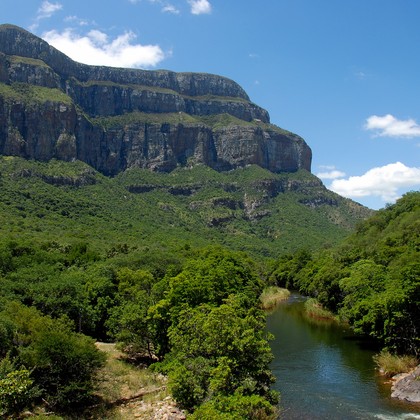
In winter quarters the canopy of moist forest, forest edges, gallery forest and tall broad-leaved woodland with a closed canopy. It forages high in the trees, often in mixed flocks, taking insects by fluttering along the leaves and picking them from the undersides.
Where the bird is most at home, classified by the vegetation units of southern Africa.

Range and movements
Within the region a rare vagrant with only a few accepted records, mainly from northern Zambia and from Malawi; not reliably recorded elsewhere in the region. It breeds in deciduous forest of western and central Europe east to western Siberia, and winters in the forest belt of Africa from Guinea to Uganda and northern Congo-Kinshasa.
- Winter visitor (c. Apr–Sep)
- dark = core range, pale = thinly spread
How and when to look
Most likely between November and March in tall gallery forest in northern Zambia or in Malawi, among mixed flocks of leaf warblers and white-eyes. Look for the combination of a sharp border between yellow throat and white belly with long wings. A record should be documented with photographs or a sound recording and submitted to the national rarities committee.
Conservation status
Not threatened, but the European population has declined steeply in recent decades, partly through changes in forest structure on the breeding grounds and forest loss in the West African winter quarters. For the region of this guide the species is an accidental visitor of no conservation significance.
Scientific name
Phylloscopus sibilatrix | (Bechstein, 1792) (GBIF: Phylloscopus sibillatrix)
Bechstein described the species in 1792 as Motacilla Sibilatrix; because it was later moved to another genus, the author and year stand in brackets. The genus Phylloscopus was introduced in 1826 by Boie. Phylloscopus is Greek, from phullon 'leaf' and skopos 'seeker', from skopeō 'to watch': the bird that searches the foliage. sibilatrix is Latin for 'female whistler', from sibilare 'to whistle', after the trilling song of the male. The specimen the first description was based on came from the mountains of Thuringia.