All species › Woodpeckers and allies › African barbets › Whyte's Barbet
Whyte's Barbet | Stactolaema whytii
Whytes baardvogel | Barbudo Especulado
Whyte's Barbet is a brown, unobtrusive barbet of miombo woodland that is strongly tied to fruiting fig trees. In the region it is most frequently recorded on the Zimbabwe plateau and in Malawi and eastern Zambia.

Voice
A soft, whistled hoo or poo, repeated in a slow series and often barely noticed. Groups also give a fast, harsh chattering at the nest hole or on a fruiting tree.
Recording: Patrick Smet — CC BY-NC-SA 4.0 · converted to mono · xeno-canto
Identification
About 17 cm, compact, with a stout dark bill. The plumage is mainly dark grey-brown, slightly paler and faintly streaked below. The forehead and face show pale whitish to yellow spots or a pale band depending on race; in Zimbabwe (sowerbyi) the forehead is pale yellow. The wing has a clear white patch at the base of the primaries, most obvious in flight. The sexes are alike.
Confusion species
White-Eared Barbet (Stactolaema leucotis) is darker, with a white stripe behind the eye and a clean-cut white belly; it lives in lowland forest and hardly overlaps. Anchieta's Barbet (Stactolaema anchietae), in Angola and western Zambia, has an all-yellow head and lacks the white wing patch.
Habitat
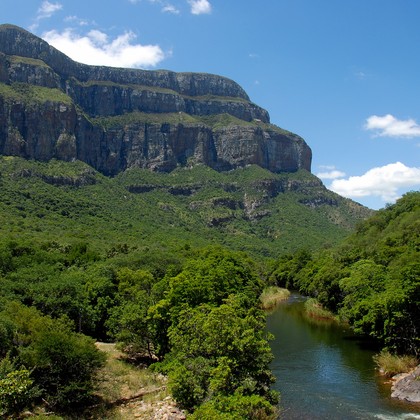
Miombo and other broadleaved woodland with scattered large fig trees, often near rocky outcrops, streams or in villages with fruit trees. It feeds mainly on figs and other fruit. It breeds, often with helpers, in a self-excavated cavity in a dead branch.
Where the bird is most at home, classified by the vegetation units of southern Africa.

Range and movements
The north-east of the region: the central and north-eastern plateau of Zimbabwe (Mashonaland), western and northern Mozambique, Malawi, and eastern and northern Zambia. Beyond the region in southern and western Tanzania and south-eastern DR Congo.
- Resident
- Winter visitor (c. Apr–Sep)
- Passage (Mar–Apr, Oct–Nov)
- dark = core range, pale = thinly spread
How and when to look
In Zimbabwe best seen around Harare and in the north-eastern highlands: check large fruiting figs in miombo, where the birds come to feed and then sit quietly in the crown for long periods. The white wing patch is the best field mark in flight.
Conservation status
Not threatened, but scarce and local in Zimbabwe. Felling of fig trees and old miombo for firewood and farming reduces both food and nest sites.
Scientific name
Stactolaema whytii | (Shelley, 1893)
Shelley described the species in 1893 as Smilorhis whytii; because it was later moved to another genus, the author and year stand in brackets. The genus Stactolaema was introduced in 1870 by Marshall & Marshall. Stactolaema comes from the Greek staktos, 'dripping', and laimos, 'throat' — for the streaked, as if tear-stained throat and breast of the type species. whytii honours the British naturalist Alexander Whyte (1834–1905), government naturalist in Nyasaland (Malawi) from 1891 to 1897. The specimen the first description was based on came from Zomba, Malawi.